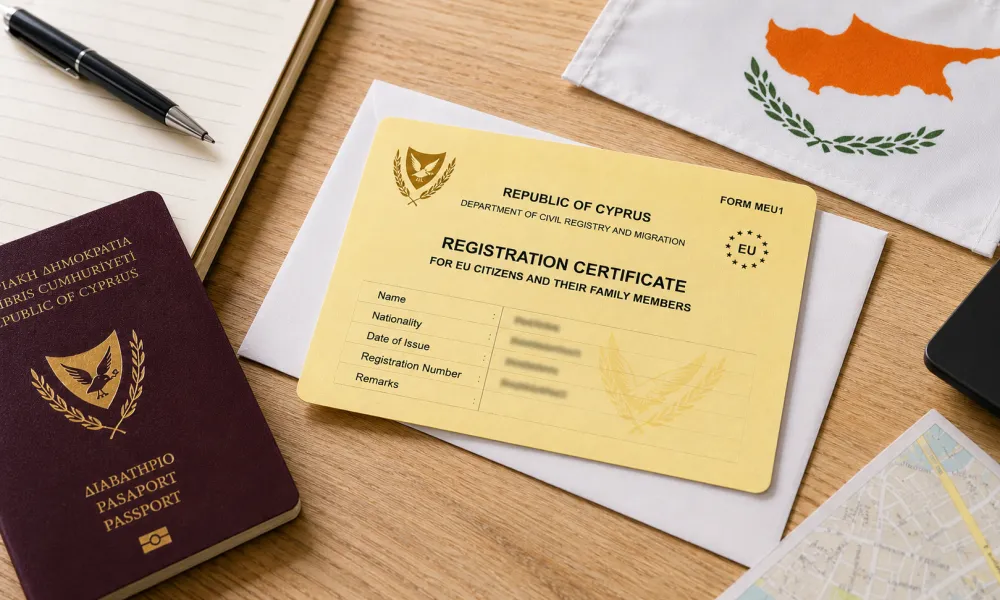
For many newcomers, residence registration is one of the first formal steps after moving to Cyprus. The process is often described through one familiar phrase, the “yellow slip”, but the term does not apply to everyone in the same way.
For EU citizens and their EU family members, the yellow slip refers to the Registration Certificate, issued through form MEU1. It confirms that the holder has registered their residence in the Republic of Cyprus. For non-EU nationals, the process is different and usually involves a temporary residence permit or another permit category, depending on the reason for staying in the country.
What is the yellow slip?
The yellow slip is the common name for the Registration Certificate issued to EU citizens and to family members who are also EU citizens. It is not a visa and it is not a work permit. It is proof that an EU citizen has registered their residence in Cyprus under EU free movement rules.
EU citizens may enter and remain in another EU member state for up to three months with a valid passport or national identity card. Those who wish to stay in Cyprus for longer must register with the authorities. In Cyprus, the application for the Registration Certificate must be submitted within four months from the date of entry into the Republic.
The document is often requested in everyday administrative procedures, including employment, banking, tax registration, healthcare registration and dealings with public authorities.
Who needs to apply for MEU1?
MEU1 applies to EU citizens, citizens of the European Economic Area and their EU family members who intend to live in Cyprus for more than three months.
The documents required depend on the applicant’s reason for residence. A person moving to Cyprus for work will be asked for different evidence from someone moving as a student, a self-employed person, a pensioner or a person living on independent income.
In general, applicants should be ready to provide a valid passport or national identity card, copies of the same document, passport-sized photographs and evidence showing why they are staying in Cyprus. Depending on the case, this may include an employment confirmation, proof of self-employment, student enrolment documents, proof of comprehensive health insurance, evidence of sufficient resources or documents proving a family relationship.
Where is the application submitted?
Applications are submitted to the competent Migration Department application office or local immigration authority, depending on the applicant’s district and category.
New arrivals should check the latest official instructions before booking an appointment, as procedures and appointment requirements may change. It is also important to confirm the exact document list in advance, especially where documents have been issued abroad and may need official translation or certification.
What about family members who are not EU citizens?
Non-EU family members of an EU citizen do not apply for MEU1. They usually apply for a residence card through the separate MEU2 process.
This applies, for example, where an EU citizen moves to Cyprus with a spouse or family member who is not an EU national. According to the Migration Department, non-EU family members of an EU citizen must apply for a residence card within four months of arrival. The residence card is generally valid for five years, or for the planned period of residence of the EU citizen if that period is shorter.
This is an important distinction for mixed-nationality families, as the documents, form and legal basis are not the same as those for EU citizens applying for MEU1.
What about other non-EU nationals?
Non-EU nationals who are not applying as family members of an EU citizen follow a different immigration route. Their permit depends on why they are living in Cyprus.
The relevant category may be a visitor permit, employment-related permit, student permit, family reunification permit or another residence route provided under Cyprus immigration rules. The correct procedure depends on whether the person intends to work, study, join family members, retire or live in Cyprus using income from abroad.
For visitor permits, the Migration Department states that the application must be submitted using the relevant visitor form and must be accompanied by the required supporting documents. Supporting documents submitted with such applications must be officially translated and duly certified where required.
Applicants should not assume that a visitor permit gives them the right to work. Work rights depend on the type of permit issued and the conditions attached to it.
What to prepare before applying
The first step is to identify the correct category. For EU citizens, this will usually be MEU1. For non-EU family members of EU citizens, it will usually be MEU2. For other non-EU nationals, the route depends on the purpose of stay.
EU citizens applying for MEU1 should prepare proof of identity, proof of residence in Cyprus and documents showing the basis of their stay. Workers should prepare employment evidence. Self-employed applicants should prepare evidence of self-employment. Students should prepare enrolment documents and, where required, proof of health insurance. People moving without employment should be ready to show that they have sufficient resources and healthcare cover where applicable.
Non-EU nationals should check the official document list for their specific permit category before applying. In many cases, foreign-issued documents may need to be translated, certified or otherwise prepared before submission.
Common mistakes to avoid
The most common mistake is assuming that the yellow slip applies to all foreign residents. It does not. In strict terms, it refers to the EU Registration Certificate, while non-EU nationals follow separate residence procedures.
Another frequent problem is leaving registration too late. EU citizens planning to stay in Cyprus for more than three months must apply within four months of arrival. Non-EU nationals must follow the deadlines attached to their own permit category and should not wait until their lawful stay is close to expiry.
Applicants should also avoid relying only on informal advice or outdated document lists. Requirements can differ depending on nationality, employment status, family status and the reason for residence. The safest approach is to check the latest official instructions before attending an appointment.
Why it matters
Registering residence is more than a formality. It can make it easier to deal with employers, banks, tax authorities, healthcare registration and other services that require proof of lawful residence in Cyprus.
For EU citizens, the process is usually straightforward if the documents are complete and the correct category is chosen. For non-EU nationals, the procedure is more dependent on the type of permit and should be checked carefully before making long-term plans.