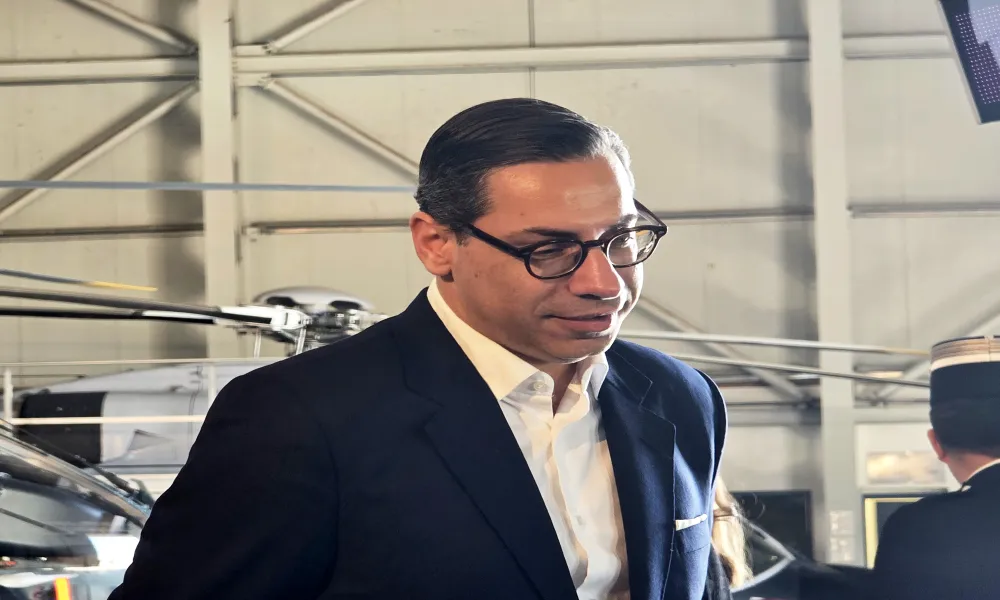

Central Asia has emerged as one of the key priorities of Cyprus' foreign policy, Foreign Minister Constantinos Kombos has said, as he continued a regional tour aimed at strengthening diplomatic, economic and political ties.
Speaking to the Cyprus News Agency (CNA), Kombos said the region had gained increasing strategic importance over the past two years, offering opportunities for both geopolitical engagement and economic cooperation.
The minister completed the second leg of his tour on Sunday in Uzbekistan and is due to travel to Kyrgyzstan for the final stage of the visit.
Building on recent diplomatic momentum
The tour follows President Nikos Christodoulides' recent visit to Kazakhstan, the first by a Cypriot head of state, during which a business forum was held and Cyprus officially opened its embassy in Astana.
Kombos said the primary objective of his trip was to deepen bilateral relations and create new opportunities for investment and economic cooperation.
"The external and domestic dimensions of policy are interconnected," he noted.
First visit to Tajikistan
During the first stop of the tour in Tajikistan, Kombos became the first Cypriot foreign minister to visit the country.
He held meetings with Foreign Minister Sirojiddin Muhriddin, Speaker of the Lower House Faizali Idizoda and President Emomali Rahmon.
A key outcome of the visit was the signing of a memorandum of cooperation in higher education and research, establishing a framework for academic exchanges and scientific collaboration between the two countries.
Kombos also highlighted Cyprus' scholarship programme, noting that significant numbers of scholarships had been awarded to citizens of Tajikistan and Uzbekistan over the past two years.
Strengthening ties with Uzbekistan
The foreign minister's visit to Uzbekistan marked his second trip to the country since his first visit two years ago.
Kombos said bilateral relations had intensified significantly since then, including political consultations and visits by business delegations.
In Tashkent, he held further talks with Uzbek Foreign Minister Bakhtiyor Saidov, with whom he said he maintains regular contact at the United Nations General Assembly and other international forums.
Next stop: Kyrgyzstan
Kombos is scheduled to arrive in Kyrgyzstan on Sunday afternoon, where he will meet Foreign Minister Zheenbek Kulubaev and other senior officials on Monday.
The discussions are expected to focus on strengthening political dialogue and exploring opportunities for closer economic cooperation.
The foreign minister stressed that Cyprus' engagement with Central Asia is driven not only by economic considerations but also by national priorities linked to the Cyprus issue.
He pointed to the joint EU-Central Asia declaration issued in April 2025, which included references to Cyprus, as evidence of the diplomatic benefits of deeper engagement with the region.
Kombos noted that all Central Asian states had endorsed both the EU-Central Asia Ministerial Meeting declaration in March 2025 and the EU-Central Asia Summit declaration in April 2025.
Both documents, he said, contain explicit references to respect for the independence, sovereignty and territorial integrity of all states, as well as references to UN Security Council Resolutions 541 (1983) and 550 (1984), which relate specifically to Cyprus.
Expanding Cyprus' diplomatic reach
Kombos said the expansion of Cyprus' diplomatic presence remains a central pillar of the government's foreign policy strategy, particularly in regions of growing geopolitical significance.
"The expansion of our diplomatic footprint is a strategic compass for the conduct of our foreign policy, especially in regions with particular sensitivities," he said.
The minister's tour reflects Cyprus' broader effort to diversify its international partnerships while strengthening support for its national positions in key multilateral forums.