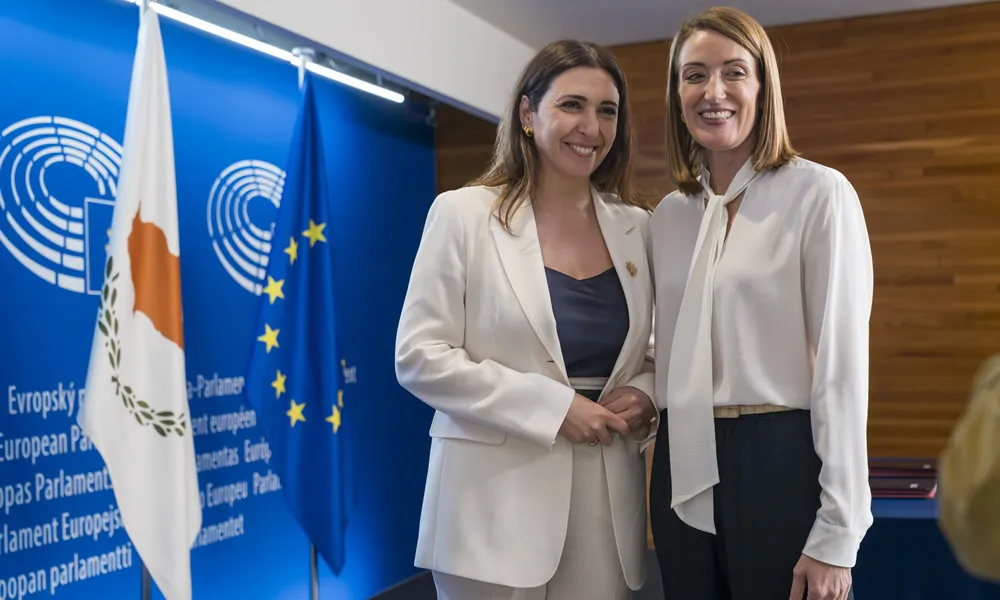



European Parliament President Roberta Metsola gave an interview marking the end of Cyprus' six months at the helm of the Council of the EU, assessing the presidency's record, discussing efforts to reconnect with European citizens and young people in particular, the challenges posed by populism and disinformation, and the Cyprus problem, which she said remains as much a European issue as a Cypriot one.
A presidency that delivered
Asked how she assesses the course of the Cyprus Presidency, Metsola said, "Cyprus took on the presidency of the Council at a time of rapid developments, great uncertainty and heightened expectations from our citizens." "It was not an easy task, nor an easy moment, but President Christodoulides and the whole Cypriot presidency team met the challenge successfully," she noted. "I have always known Cyprus as an honest broker, a bridge between continents, countries and people, and so your country was able to push further on security, competitiveness and simplification," she added.
Asked what mark the presidency will leave behind, she said, "During the Cyprus Presidency we saw important legislative files completed that respond directly to citizens' concerns and to Europe's strategic needs." "From the agreement we reached on Monday on air passenger rights, something that makes me particularly happy after 13 years of negotiations, to Tuesday's final vote on the EU-US trade agreement, we proved together that Europe can deliver results," she added.
"At the same time, we made significant progress on enlargement too," Metsola continued. "With the opening of the first thematic cluster of accession negotiations for Ukraine and Moldova, we proved that hard work and reforms lead to progress, and that Europe keeps its commitments." "Throughout its presidency, Cyprus has been an outstanding partner for the European Parliament. President Christodoulides showed through his leadership what real determination means. I want to thank him for that, but also for his friendship," she said.
Closing the gap
Asked what concrete steps the European Parliament is taking to strengthen its relationship with citizens and reduce the sense of alienation, Metsola said, "When I was elected President of the European Parliament, I wanted our institution to move beyond the 'bubble' of Brussels and Strasbourg and reach as close as possible to citizens, to their cities, villages and regions." "Members of the European Parliament meet citizens where they are, listen to their expectations, understand their realities and explain why the decisions we take matter. Because Europe is everywhere, in every member state," she said.
She added, "MEPs have a particular responsibility to keep citizens engaged in this process, and it is a responsibility that I and my colleagues, including Cypriot MEPs, take very seriously." "That is why, during my visit to Cyprus last year, President Christodoulides and I spoke with schoolchildren in Larnaca as part of an open discussion," she said. "Listening to young people and bringing their ideas and concerns back with us to Brussels is not a parallel activity. It lies at the core of how we build trust," she stressed.
Asked how the EU can involve young people more effectively in decision making, she said, "It is true that some young people feel distant from the European Union, particularly in countries that have been members for a long time. Perhaps because the benefits of participating in the EU have become something we take for granted." "But, as I said before, we have to listen to citizens' concerns. That is why, both in the legislation we adopt and in how we communicate our work and keep young people's ambitions at the top of our agenda, we must speak to them directly and adapt to new realities," she added. "We must be ready to change course if needed, and to deliver tangible results that are felt and seen in citizens' everyday lives," she said.
Populism and disinformation
Asked about the rise of populism and disinformation in member states and what the European Parliament can do, Metsola said, "There is growing dissatisfaction with the traditional way we do things, which is leading citizens either to vote differently or not to vote at all." "At the same time, European democracy is being tested, as foreign interference and disinformation become more frequent. They are no longer isolated risks. This is exactly why our institutions must remain strong, credible and capable of delivering results for citizens," she continued.
Metsola said, "Protecting democracy from foreign interference requires action. As a result, the European Parliament has already set up a special committee on this issue, and one outcome of its work was the creation of the European Centre for Democratic Resilience, a coordination hub between institutions, member states and civil society." "Within this framework we can also make use of existing European legislation, such as the Digital Services Act and the Artificial Intelligence Act," she said. "Above all, though, we must keep working with those who run online platforms, since they are undoubtedly part of the solution," she added.
The Cyprus problem
Asked about the Cyprus problem and the European Parliament's role, Metsola said, "The European Union will only truly be united once Cyprus is reunified." "The way forward is clear. A sovereign European state, based on a bizonal, bicommunal federation, in line with United Nations resolutions and grounded in shared European values and EU law," she said. "This path rests on dialogue and diplomacy, while the foundation of any viable solution is trust. That is why we hope for an early resumption of the talks," she noted.
She also gave assurances: "The European Parliament will always be a friend of Cyprus. Europe stands by Cyprus and its people." "As I have said many times before, this is not only a Cyprus issue, it is a European issue. We will continue to support the process under the leadership of the United Nations, providing political support, strengthening confidence-building measures and maintaining steady European interest, so as to help create the conditions for a viable solution," she said.
Asked what it means to her, coming from a small country, to hold the office of President of the European Parliament, Metsola said, "In our European Union there are no big and small countries." Cyprus, she added, "is the proof of that." "I want to make sure that the European Parliament, as an institution, carries out its work always with citizens' concerns at its centre, and that we are doing everything in our power to move Europe forward, all together," she concluded.
Source: CNA