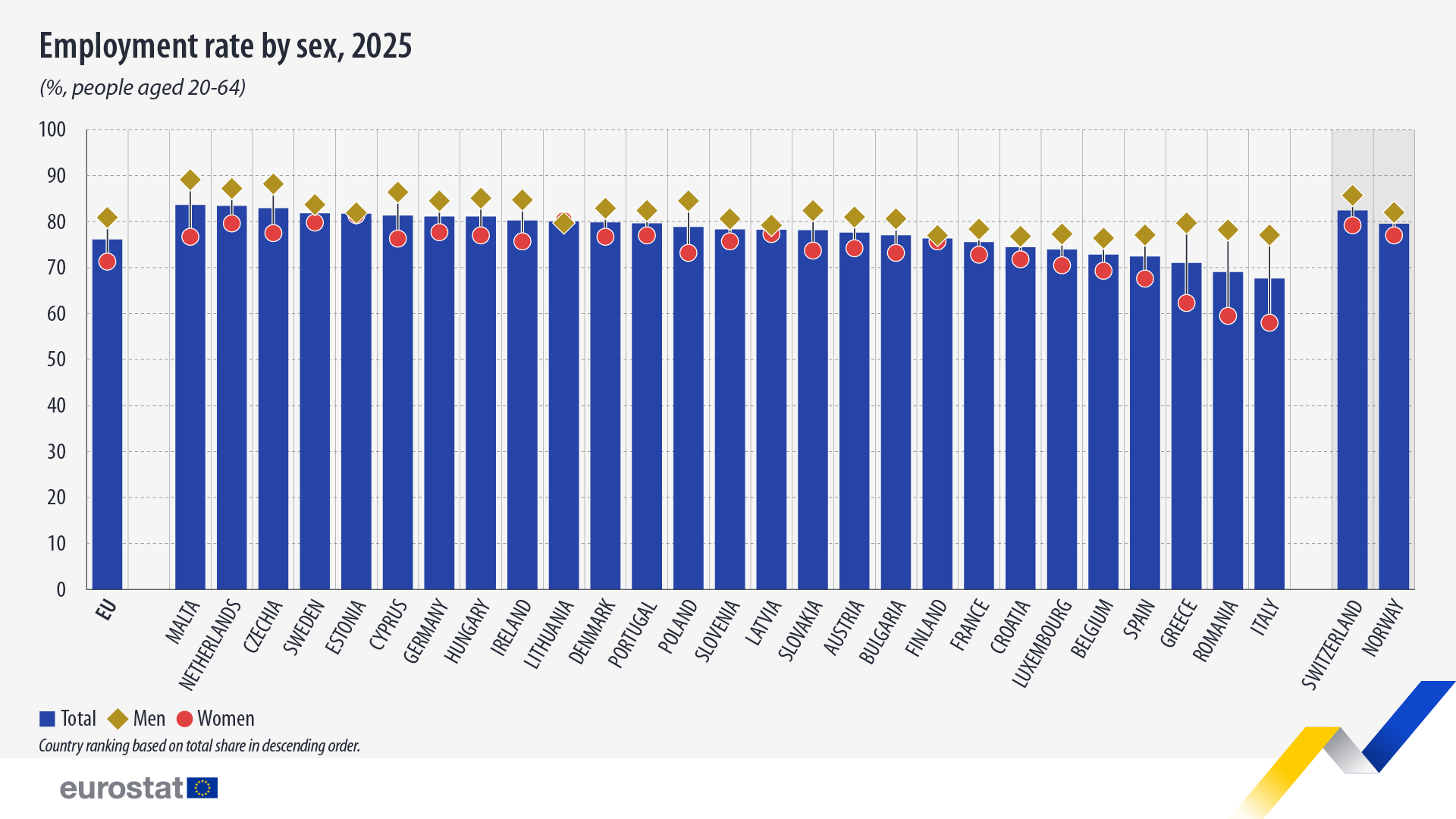

Across the EU, 76.1% of people aged 20 to 64 were in employment, representing around 197.7 million individuals. This marks the highest level recorded since data collection began in 2009, with a modest increase of 0.3 percentage points compared with 2024 and 0.8 points compared with 2023.
Among EU member states, the highest employment rates were reported in Malta (83.6%), the Netherlands (83.4%) and Czechia (82.9%). Cyprus ranked among the top performers, significantly above the EU average.
At the lower end of the scale were Italy (67.6%), Romania (69.0%) and Greece (71.0%).
Gender gap persists across the EU
In 2025, men continued to have higher employment rates than women in all EU countries except Lithuania.
The employment rate for men in the EU stood at 80.9%, with the highest levels recorded in Malta (89.1%), Czechia (88.2%) and the Netherlands (87.2%). The lowest rates were observed in Belgium (76.4%), Croatia (76.8%) and Finland (77.0%).
For women, the EU employment rate reached 71.3%. Estonia (81.4%), Lithuania (80.3%) and Sweden (79.8%) recorded the highest levels, while Italy (58.0%), Romania (59.5%) and Greece (62.3%) remained at the bottom of the ranking.