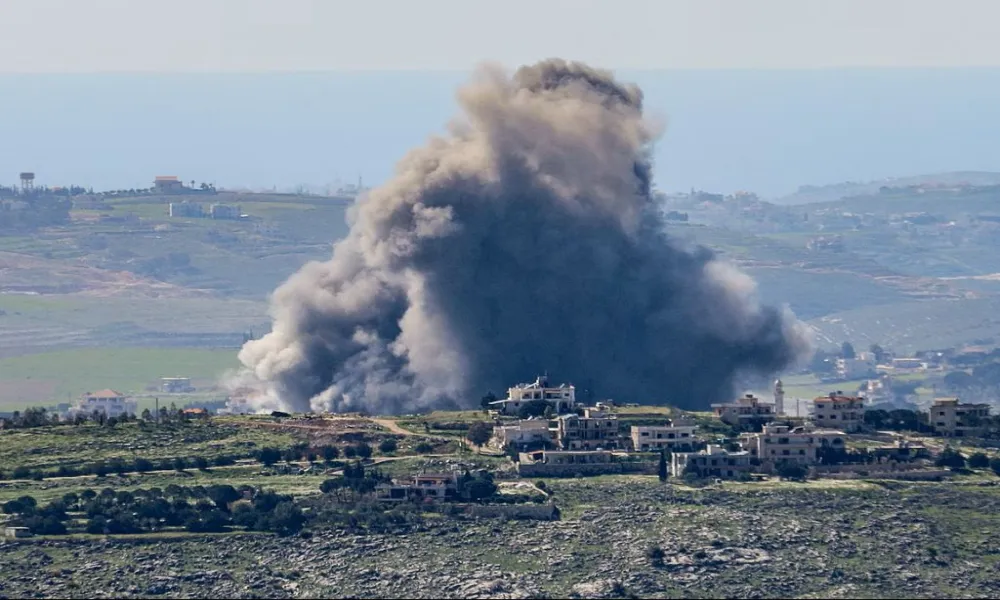
A 10-day ceasefire between Israel and Lebanon took effect at 5pm Eastern Time on Thursday, aimed at halting the fighting between Israel and Iran-backed Hezbollah, with fireworks and celebratory gunfire lighting up Beirut's skyline in the early hours of Friday as the truce came into force. President Donald Trump, who announced the deal, called it potentially a "historic day for Lebanon," adding that "Good things are happening." The truce has nonetheless shown immediate signs of fragility, with Lebanon's army accusing Israel of ceasefire violations within hours of it taking effect.
The Lebanon truce is being read primarily as a diplomatic step toward the larger objective: a negotiated end to the broader war between the United States, Israel and Iran, which has raged since late February and claimed more than 3,300 lives inside Iran alone. Iran had said it would not engage in negotiations with the United States unless Israel entered into a ceasefire in Lebanon, making Thursday's agreement a prerequisite for any resumed talks with Tehran.
A fragile truce and an unresolved question over Hezbollah
Israeli Prime Minister Benjamin Netanyahu said Israeli forces will not withdraw from positions in southern Lebanon, and a Hezbollah official warned the group reserves the right to respond to attacks. Israel's ambassador to the United Nations, Danny Danon, stated that while the truce was in effect, Israeli troops would remain in southern Lebanon and the military would take action if threatened. "We will have to follow very carefully what's happening on the ground. And if we will feel threatened, we will react," he said. "The problem is not with the Lebanese government. The problem is with Hezbollah."
Lebanese President Joseph Aoun said Lebanon was eager to stop the violence, and described the withdrawal of Israeli forces from the south and the deployment of the Lebanese army to the shared border as an "essential step" toward consolidating the ceasefire. He added that negotiations between the two countries would be conducted by "the Lebanese authority alone," excluding Hezbollah from any formal role. The United Kingdom offered Lebanon nearly $28 million in humanitarian assistance to support the hundreds of thousands of people displaced by the conflict.
Trump said he was inviting Netanyahu and Lebanese President Aoun to the White House for peace talks and suggested a meeting between the two leaders could take place within two weeks. He also told reporters he "might" travel to Pakistan if there was a peace deal with Iran to sign.
The wider war: diplomacy, a blockade and a mounting toll
The war began on 28 February 2026, when the United States and Israel launched airstrikes on Iran, targeting military and government sites, assassinating Supreme Leader Ali Khamenei and other Iranian officials, and inflicting civilian casualties. Iran responded with missile and drone strikes against Israel, US bases and US allies in the Middle East, and closed the Strait of Hormuz, disrupting global trade.
A first round of negotiations between the US and Iran took place in Islamabad on 11 and 12 April, mediated by Pakistan. Vice President JD Vance led the US delegation, with special envoy Steve Witkoff and Jared Kushner, while Iran was represented by Foreign Minister Abbas Araghchi and parliamentary speaker Mohammad Bagher Ghalibaf. The talks ended without agreement after 21 hours of negotiations, and Vance announced their failure on 12 April.
Following the breakdown, Trump announced that the US Navy would blockade the Strait of Hormuz, stopping ships travelling to or from Iranian ports. The blockade took effect on 13 April at 10am Eastern Time, under the command of Admiral Brad Cooper at US Central Command, with over 10,000 US personnel supported by more than a dozen warships and dozens of aircraft enforcing the operation. By Thursday, the US military said it had turned back 13 ships since the blockade began. Defence Secretary Pete Hegseth warned Iran "we're watching you" and said the US was "locked and loaded" for renewed combat if Tehran did not agree to a peace deal.
Iran has condemned the blockade as illegal. An Iranian army statement warned that if the security of Iran's ports in the Persian Gulf and Arabian Sea was threatened, "no port in the Persian Gulf and the Arabian Sea will be safe." Iran has also halted petrochemical exports, citing an order issued by the director of development of petrochemical industries, who told the managing directors of Iranian companies to halt all exports due to the country being "in a war situation and subjected to severe sanctions," in order to ensure adequate domestic supply.
Pakistan's mediation and the next round of talks
Pakistan has emerged as the central diplomatic actor in efforts to end the conflict. Prime Minister Shehbaz Sharif visited Saudi Arabia and Qatar this week, while Army Chief Field Marshal Asim Munir travelled to Iran, as part of what Islamabad describes as "collective efforts" aimed at promoting regional peace and de-escalation. Pakistan's foreign ministry spokesman Tahir Andrabi said that a ceasefire in Lebanon is "essential" for the Iran peace talks, adding that no date has yet been set for a second round of US-Iran negotiations, though a Pakistani delegation is in Tehran to try to push the process forward.
Trump said Thursday he believes a deal with Tehran is "very close" and that talks could resume in Islamabad as early as this weekend. He told reporters that Iran had agreed to return nuclear material buried deep underground following US B-2 bomber strikes. "They've agreed to give us back the nuclear dust that's way underground because of the attack that we made with the B-2 bombers. So we have a lot of agreement with Iran and I think something is going to happen very positive," he said. An Iranian army spokesperson, however, said a ceasefire agreement with the US "does not make much difference," according to the semiofficial Tasnim News Agency.
Russia and China have also entered the diplomatic picture. Russia's deputy foreign minister Alexander Alimov said a joint draft resolution with China has been submitted at the United Nations, and that Moscow is monitoring ongoing negotiations between Iran and the US. Trump, for his part, said China is "very happy" about the opening of the Strait of Hormuz and claimed President Xi Jinping had agreed not to send weapons to Iran.
At a conference in Paris on Friday, French President Emmanuel Macron and British Prime Minister Keir Starmer are chairing a meeting focused on coordinating maritime traffic in the Strait of Hormuz once the war ends, under an initiative Macron's office has named the "Initiative for Maritime Navigation in the Strait of Hormuz."
The human and economic toll of the conflict continues to mount. Iran has assessed the damage to its own economy at a minimum of $300 billion and possibly as much as $1 trillion. The cost to the US military was estimated at $18 billion as of 19 March, with the Pentagon requesting a further $200 billion. The cost to Arab countries was estimated at over $120 billion by 31 March. The war has also produced what analysts describe as the world's biggest oil supply disruption since the 1970s energy crisis.
Source: Al Jazeera, CBS, CNN, NPR