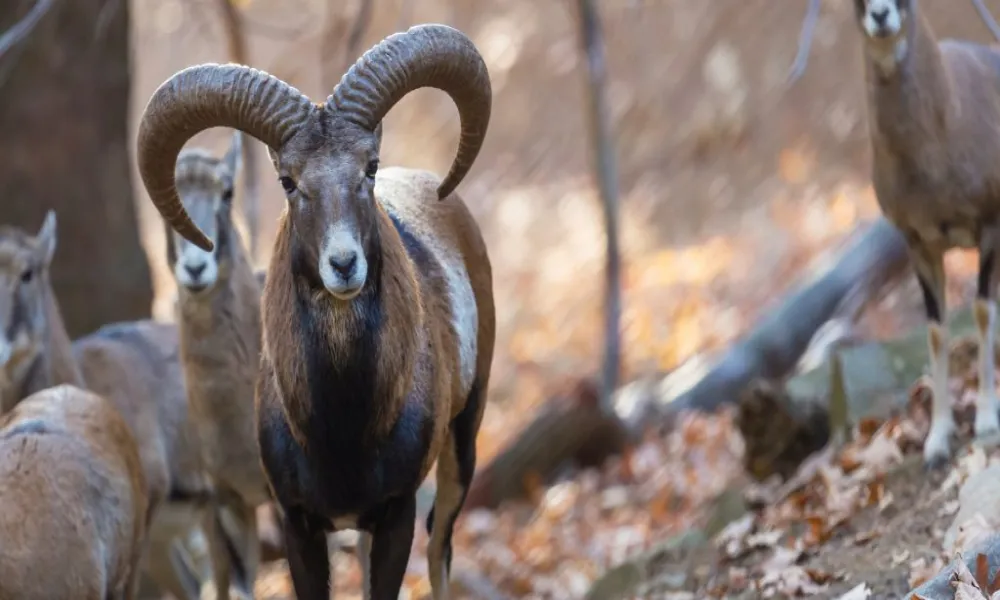
Because of the ongoing foot‑and‑mouth veterinary crisis, which is advancing northwards from Larnaca toward Nicosia, the Mouflon Management Committee convened an emergency meeting last Friday to adopt preventive measures. The Committee includes the Game and Fauna Service – responsible for managing and protecting Cyprus’ most iconic wild animal – the Veterinary Services, and the Departments of Forests and Environment.
The authorities are primarily concerned that the disease has now “broken through” the Larnaca district barrier and that co‑grazing between mouflon and sheep or goat herds – especially along the Green Line – significantly increases the risk of transmission. According to the agreed measures, free grazing of goats must immediately stop in areas on the northern and southern fringes of the Paphos Forest. If the virus reaches the forest, the danger to the mouflon would be severe. For this reason, a key decision was to transmit a message – through the United Nations – urging Turkish Cypriot herders to also restrict their animals within their units in areas bordering the forest.
A quarter of the population lost to disease
To date, no impact on mouflon from foot‑and‑mouth disease has been recorded, senior Game and Fauna officer Nikos Kasinis told Politis. However, between 2001 and 2003 they were hit by another disease, once again transmitted from sheep and goats in the north. The disease, Infectious Keratoconjunctivitis (IKC), first affected the mouflon in September 2001. It targets the eyes and is caused by the mycoplasma Mycoplasma conjunctivae, leading to blindness or death.
“The animals went blind and then either died, were torn apart by packs of wild dogs, or starved because they could no longer feed,” Kasinis explained.
Over the 17‑month outbreak, the mouflon population fell by roughly 25%. Reproductive activity dropped by up to 35% in 2003 and only began to recover in 2004.
Preventive measures
Immediately after the first foot‑and‑mouth case was reported in the free areas last February, the Game and Fauna Service mobilised to implement strict containment measures. As part of the government’s strategy to limit spread through animal movements, it imposed a full ban on hunting and on the training of hunting dogs in areas adjacent to infected livestock units in Larnaca. The Service also participates daily in the Coordinating Meeting at the Joint Rescue Coordination Centre with all agencies involved in handling the outbreak.
Special long‑range vaccination guns for mouflon were ordered from abroad. According to Kasinis, these would serve as a supplementary measure to protect certain animals if an outbreak occurred in the wild population.
Free grazing remains the biggest risk
“What is most important,” he stressed, “is that in areas where mouflon are found, herders – on both sides of the divide – must keep their sheep and goats within their units.” Free grazing is not limited to the north: co‑grazing also occurs in regions such as the Tylliria villages and Agios Ioannis in Paphos. The practice of free grazing, particularly of goats, requires great caution, he said, because if foot‑and‑mouth reaches these locations, the risk of transmission to the Paphos Forest mouflon would be extremely high.
Last Tuesday, Veterinary Services Director Christodoulos Pippis informed Parliament that at the latest meeting of the Bicommunal Health Committee, the Republic of Cyprus formally requested monitoring of grazing along the Green Line as part of efforts to establish a joint action policy with the north based on EU legislation.
“This is extremely important,” Kasinis added. “We have raised it repeatedly in the past – urgently – after echinococcus was detected in wild dogs north of the Paphos Forest, coming from the occupied areas.” Attempts to resolve the issue through the United Nations, particularly in the areas of Kampi and Kokkina, have so far yielded no results.
Asked whether mouflon are as susceptible to foot‑and‑mouth as domestic cloven‑hoofed animals (sheep, goats, cattle, pigs), Kasinis said: “We have no previous experience, nor is there any similar case in the literature. However, I believe wild cloven‑hoofed species are somewhat less susceptible.” He noted that in other countries, deer species and wild boar have been infected during previous foot‑and‑mouth outbreaks.