The plane from Cyprus lands at Heathrow and suddenly 50 red‑haired English officials snap to attention. They rush to man the “Biosecurity” gate, ready to receive Cypriots arriving from the Foot‑and‑Mouth zone. Some wear masks, others protective suits and gloves. Their appearance understandably startles the Cypriots. It’s a somewhat insulting welcome, you might say – especially for the ladies of Nicosia or the blonde shoppers from Limassol heading to London. But with foot‑and‑mouth spreading across Cyprus, the meticulous British have decided that checks must now apply to people as well. Where once you only put your Gucci bag, laptop and crocodile‑skin belt through security, you must now also prove you are not carrying half a goat pen in your luggage.
“Have you visited a farm in the last 48 hours?” the ginger‑haired officer asks, and you do a quick mental rewind. Does your aunt’s goat shed in the village count? Was the roast lamb we ate safely sourced? Last week’s day trip – does petting that calf in the field qualify? Some think even more abstractly: could that “cow” of a neighbour have infected me?
Call it pettiness, but there are worse things. If you’ve been inside a livestock pen, you will not escape being sprayed. If a cow licked your forehead, if a bull mooed at close range while you attempted to play matador, quarantine may be unavoidable.
Not fiction
Some may think the above is science fiction, but in reality it has happened – in places like the UK, Australia and New Zealand, all of which have faced foot‑and‑mouth outbreaks. Airports can separate passengers based on country of origin. Travellers may be required to walk through disinfectant mats. Where the risk is high, stricter protocols apply, including spraying shoes or luggage with disinfectant. Now imagine telling a woman in Giuseppe Zanotti heels to step onto a disinfectant mat – or having her limited‑edition Louboutins misted with cheap insecticide. How is she supposed to get into a taxi with shoes dripping in disinfectant on her way to the Four Seasons on the Thames?
Passengers may also have to fill out declarations about animal contact or farm visits. The red‑haired Heathrow officer could very well ask: “When was the last time you spoke to a piglet? Did you touch the live lambs you placed in baby Jesus’s manger at Christmas?”
None of this concerns human health; it’s because the virus can be carried passively in mud, manure or organic material on shoes, clothing or equipment. People don’t get infected – but they can be seriously inconvenienced, all thanks to that stubborn farmer from Dromolaxia who refuses to follow protocols.
Precautions
Most people, of course, don’t know that humans are not at risk, and that it is safe to eat meat and drink pasteurised milk from affected animals. But when someone hears “foot‑and‑mouth disease in sheep,” all they imagine is contaminated chops – and in a panic they decide to turn vegetarian. This Easter, wild asparagus will go for €20 a bunch and everyone will be roasting chicken instead of lamb.
In any case, let’s be careful. Let’s take precautions. What does that entail? No trips to areas with livestock pens. No flirtatious chats with goats of the ‘tsoura’ kind. If you have farmer friends, vets or pen workers – and suspect they are not frequent bathers – tell them you will be away for a while. If you cannot avoid your farmer friends – after all, they are people too – set up a disinfectant pool outside your gate for their shoes and car tyres. And for good measure, lightly spray them with yellow aerosol before they enter your home (not the green one). You may spray your veterinarian friend more thoroughly – up to three pumps – if he has vaccinated more than 200 goats that day.
Quarantine
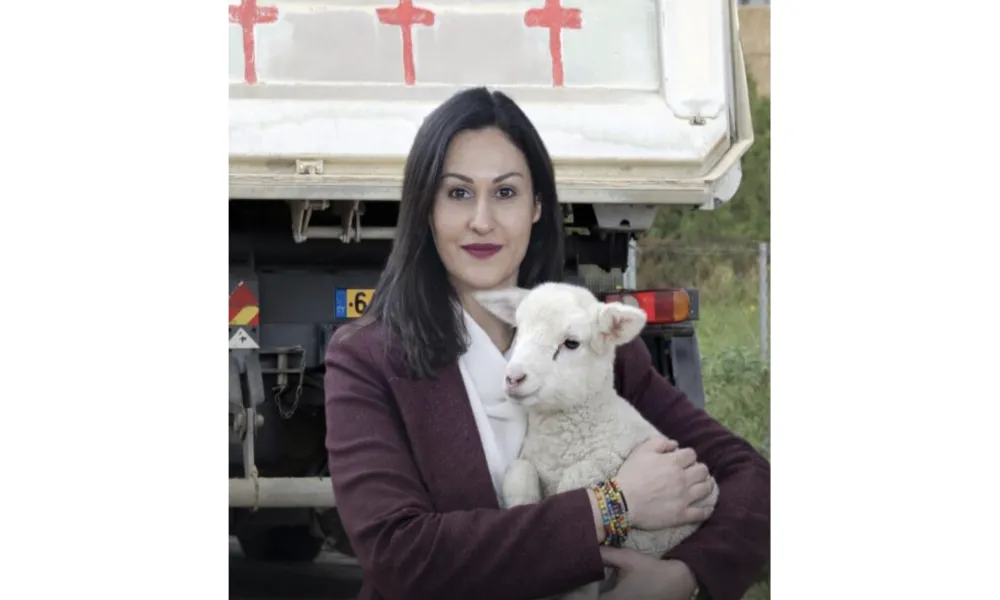
The Ministry of Agriculture and the Presidential Palace should probably go into quarantine too. At the ministry, archimandrites, farmers, veterinarians and livestock workers come and go freely, while the Minister, Maria Panayiotou, has visited nearly every pen in the restricted zone from Dromolaxia to Dali. She has met thousands of lambs, cows and piglets, so she also belongs to the group that could carry the virus. That means Cabinet members – who sit with her – plus the President himself, and her friend Philippa Karsera, are already in the high‑risk category.
In short, be cautious around gatherings where the President or ministers are present. Avoid, for now, anyone connected to the livestock sector. And let us repeat: Cypriots are not at risk from foot‑and‑mouth disease. They are at risk from the footloose farmers who ignore protocols, and the headstrong minister who insists on doing things her own way.