The debate over nuclear energy has returned strongly to the European agenda amid concerns over energy security – both supply and price stability – and the need to achieve zero‑emission targets. A nuclear‑energy summit convened by the French President two weeks ago revived the discussion. Cyprus is not absent from it. Professor Poullikkas explains why nuclear energy – and in particular small modular reactors (SMRs) – is emerging again as a realistic energy option, not as a competitor to renewables but as a complement to them.
Poullikkas outlines Europe’s shift toward “technological neutrality,” the maturation of new nuclear technologies, and the advantages of SMRs, such as lower upfront costs, enhanced safety, and flexible installation. At the same time, he acknowledges persistent challenges: high costs, waste management, public acceptance, and regulatory gaps.
Focusing on Cyprus, he notes that nuclear energy could play a role in a mixed energy system, strengthening reliability, supporting hydrogen production, and even enabling seawater desalination. However, he stresses that making such an option viable would require long‑term planning, institutional safeguards, investment, and, above all, political and social consensus.
The debate on nuclear energy is re‑emerging in Europe, particularly after the summit convened by the French President. What explains this renewed presence of nuclear energy on the international energy agenda?
“The return of nuclear energy to the European agenda stems from a convergence of factors that make it necessary for achieving climate‑neutrality goals and energy security,” Poullikkas says.
First, nuclear power is recognised as a key pillar of energy security and decarbonisation, covering around 22.8% of the EU’s electricity generation. While member states follow different policies – Germany having shut down its nuclear plants – others such as France, Hungary, Poland, the Czech Republic, Sweden and Finland continue investing, considering nuclear essential for cutting carbon emissions and ensuring security of supply.
Second, the EU has designated nuclear fission as a “transition technology” under the Sustainable Finance Taxonomy, allowing nuclear projects to receive funding under specific safety and waste‑management conditions. This reflects a pragmatic recognition that nuclear energy, alongside renewables, can be an economically competitive solution for achieving climate‑neutrality objectives.
Third, the recent joint statement by Emmanuel Macron and Germany’s new chancellor, Friedrich Merz, marks a new phase of Franco‑German understanding. The two leaders support “technological neutrality” in European energy policy – accepting different national choices but agreeing not to obstruct nuclear development in other member states.
Fourth, rising demand for low‑emission electricity – particularly from data centres operated by technology giants such as Microsoft, Google and Amazon – is accelerating interest in stable, reliable and clean energy that only nuclear can offer.
Recently, fourteen EU member states – France, Bulgaria, Croatia, the Czech Republic, Finland, Hungary, the Netherlands, Poland, Romania, Slovenia, Slovakia, Sweden, Estonia and Lithuania – issued a joint statement affirming that nuclear energy is a core component of their national decarbonisation, competitiveness and energy‑security strategies. They emphasised its role as a valuable complement to intermittent renewable sources and called on the European Commission to expand nuclear access to EU funding and financing tools.
Europe appears to be embracing the principle of “technological neutrality” in energy policy – accepting all low‑emission technologies, including nuclear. How does this shift change the conversation about Europe’s energy future?
“The adoption of technological neutrality radically changes the discussion,” he says, “because it shifts the emphasis from ideological preferences to practical evaluation of all available low‑carbon technologies.”
This approach means recognising nuclear energy, renewables, energy storage, and interconnections as options to be judged by effectiveness, cost, reliability and environmental impact – not political bias.
Technological neutrality allows member states to shape their energy mix according to national needs and priorities while maintaining coordination at EU level. France supports nuclear power as a decarbonisation tool; Germany remains sceptical. Yet both agree to cooperate on supply security, competitiveness and EU energy autonomy.
Within this framework, opportunities for complementarity emerge: renewables provide cheap but variable output, while nuclear ensures stable baseload generation that balances the grid and meets demand when renewables are not producing. It also accelerates innovation, enabling new technologies – such as SMRs and nuclear fusion – to compete and integrate into the energy system.
Small Modular Reactors (SMRs)
In your article, you describe SMRs as a “new era” for nuclear energy. What exactly is this technology, and how does it differ from traditional nuclear plants?
Small modular reactors are compact nuclear reactors with capacities of up to 300 MW, compared with large conventional reactors of 1,000 MW or more. They feature modular design, enabling factory construction and transport for installation at remote sites or locations with limited space.
Key differences include smaller size and greater flexibility, lower upfront capital cost, faster construction, enhanced safety systems, and a smaller physical footprint. Their size allows installation in places unsuitable for large plants, including islands, remote regions, or even near data centres.
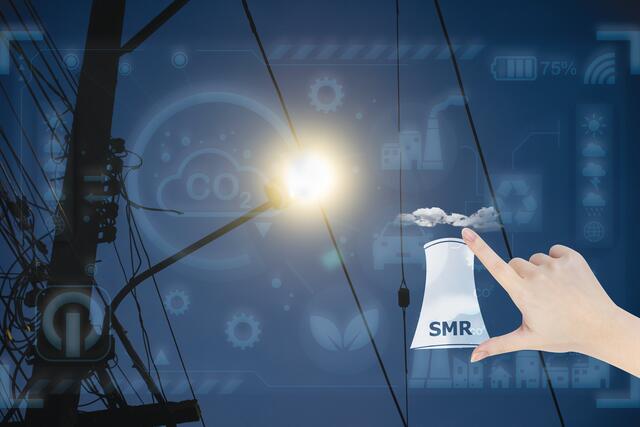
Although SMRs incur higher cost per MW due to scale, total upfront investment is significantly lower. Factory fabrication and simplified installation substantially shorten construction schedules. They incorporate advanced passive‑safety cooling systems that operate without external power and automatic shutdown mechanisms, while many designs include underground containment structures.
Several European countries – including Poland, Romania, the UK, Sweden and France – have already placed orders or formed partnerships with companies such as GE Hitachi, NuScale Power, Rolls‑Royce and EDF.
Environmental organisations, led by Greenpeace, strongly oppose nuclear projects, citing real concerns over safety and waste management. Can nuclear energy be environmentally friendly?
Safety and waste issues are real and require serious attention. But modern nuclear technologies, especially SMRs, have made major advances in environmental sustainability.
SMRs integrate advanced passive‑cooling and safety systems, produce smaller volumes of radioactive waste per unit of energy, and are designed for automatic shutdown in case of malfunction. Waste management remains a challenge with no large‑scale, long‑term global solution yet in place, although deep geological storage and fuel recycling offer promising pathways.
Overall, nuclear energy does not produce direct carbon emissions during operation and provides stable, reliable output without the intermittency of renewables. Environmentally friendly nuclear energy is feasible if three conditions are met: maintaining high safety standards, developing effective waste‑management solutions and maintaining continuous innovation and investment in technologies such as SMRs and nuclear fusion.
Cost
Nuclear projects are also criticised for being expensive and often delayed. Is this criticism justified?
The criticism is partly justified, particularly for large traditional nuclear plants. However, SMRs are designed specifically to address these issues.
Problems with conventional plants include high upfront capital cost, long construction timelines, underestimated budgets and diseconomies of scale, with smaller projects often costing 30% more per MW than large reactors.
SMRs offer lower total cost because – although their cost per MW may be higher – the overall upfront investment is far smaller, easing financing. Their modular deployment allows phased investment and earlier revenue generation. Factory prefabrication and simplified onsite installation can reduce construction time by 25–50%. Standardised designs and mass production can offset scale disadvantages once the market grows. Reuse of existing coal or gas plant infrastructure can reduce construction costs by 15-35%.
According to available estimates, the levelised cost of electricity (LCOE) for SMRs ranges from 60 to 120 USD/MWh. A recent study by Frederick University shows SMRs can achieve competitive LCOE levels of 40–100 USD/MWh, with hydrogen production costs of 1.78–5 USD/kg and desalinated‑water costs of 0.40–0.98 USD/m³.
What should Cyprus do?
Could nuclear energy have a role in Cyprus?
Cyprus could indeed consider the use of nuclear energy – particularly through small modular reactors (SMRs) – as part of an integrated energy‑transition strategy. Several conditions make this technology potentially suitable for the country.
Reasons why SMRs may fit Cyprus’s needs include the heavy reliance on fossil fuels, with oil accounting for roughly 85% of total energy consumption, while transport records the highest rate of petrol use in the EU. Water scarcity is another factor: Cyprus faces severe water shortages, and SMRs could supply desalination plants with stable, continuous power. They could also support hydrogen production (“pink” hydrogen) for transport and industry, helping to decarbonise hard‑to‑abate sectors. Additionally, Cyprus could attract investment in data centres from global technology companies such as Microsoft, Google, and Amazon, which require stable, clean energy – something SMRs, in combination with renewables, could provide. Finally, Cyprus’s geographic position in the Mediterranean could make it a regional hub for hydrogen exports.
Despite these advantages, there are significant challenges and limitations: public acceptance remains an obstacle due to persistent fears surrounding nuclear energy; Cyprus lacks a regulatory framework for nuclear power; technical expertise is limited, as the country has no domestic specialisation in nuclear technologies; and geopolitical risks – including the Cyprus issue and regional tensions – add complexity.
What conditions – institutional, technical, and economic – would Cyprus need to meet to consider such an option?
To examine the nuclear option seriously, Cyprus would need to satisfy several requirements across three main areas.
Institutional requirements include strengthening and expanding the mandate of the existing nuclear and radiological safety authority so it can handle licensing of nuclear power facilities; adopting specialised legislation on nuclear safety, waste management, civil liability, and radiation protection; ensuring full compliance with international treaties such as the Convention on Nuclear Safety and the Joint Convention; conducting extensive public consultation and information campaigns; and achieving political consensus through cross‑party agreement on a long‑term strategy that transcends electoral cycles.
Technical requirements involve developing human capital by training and certifying engineers, physicists and technicians in nuclear technology, in collaboration with experts from nuclear‑experienced countries; identifying suitable installation sites, such as coastal areas for cooling; planning grid integration and storage infrastructure; undertaking detailed technical, environmental and economic feasibility studies; designing frameworks for temporary and long‑term radioactive‑waste storage; and promoting electrical interconnection with the European market, for example through the GSI project, to increase flexibility and security.
Economic requirements include securing financing through EU programmes such as the EU Taxonomy and the Net Zero Industry Act, international financial institutions, or public‑private partnerships; conducting a thorough cost‑benefit analysis comparing SMRs with alternatives such as renewables, storage, and natural gas; exploring export potential for electricity and hydrogen to enhance economic viability; and creating an attractive investment environment through stable regulatory policies and guarantees.
Strategic linkage to broader policies is essential: nuclear energy must not be viewed in isolation but as part of an integrated approach connecting electricity, transport, heating and cooling, desalination, hydrogen production and data‑centre development. The state must establish coordination mechanisms between ministries – Energy, Transport, Environment and Finance – to ensure synergies.
Is Cyprus mature enough even to examine this option?
The maturity to consider nuclear energy in Cyprus exists only partially and would require significant preparation and political will.
Positive indicators of readiness include the European framework – since the EU has recognised nuclear energy under the Taxonomy and is promoting SMRs through the European Industrial Alliance; the existence of a research community in Cyprus with expertise in energy systems; successful international studies, including a recent one by Frederick University showing that SMR integration into the Cypriot energy system is technically and economically feasible; opportunities for partnerships with experienced companies such as EDF, Rolls‑Royce, NuScale Power and GE Hitachi; and the geopolitical relevance of Cyprus’s strategic location and energy needs, which could attract international interest.
The increasing prominence of the nuclear‑energy debate is also reflected in Cyprus’s participation – via the Minister of Energy, Commerce and Industry – at the second Nuclear Energy Summit in Paris on 10 March 2026, where the need for a safe, affordable and competitive EU energy system was emphasised, along with respect for each member state’s right to determine its own energy mix. In his address, the minister highlighted that combining renewables with nuclear power, under strict standards of peaceful use and safety, can strengthen energy security, support industrial competitiveness and ensure affordable energy for European citizens.
However, Cyprus still faces significant gaps: limited public acceptance due to the absence of broad information and debate; a regulatory void, since no framework exists for nuclear power installations; limited domestic technical expertise; lack of political consensus, with no cross‑party agreement or clear government position; and no financial planning, as no detailed economic assessment or funding strategy has yet been developed.