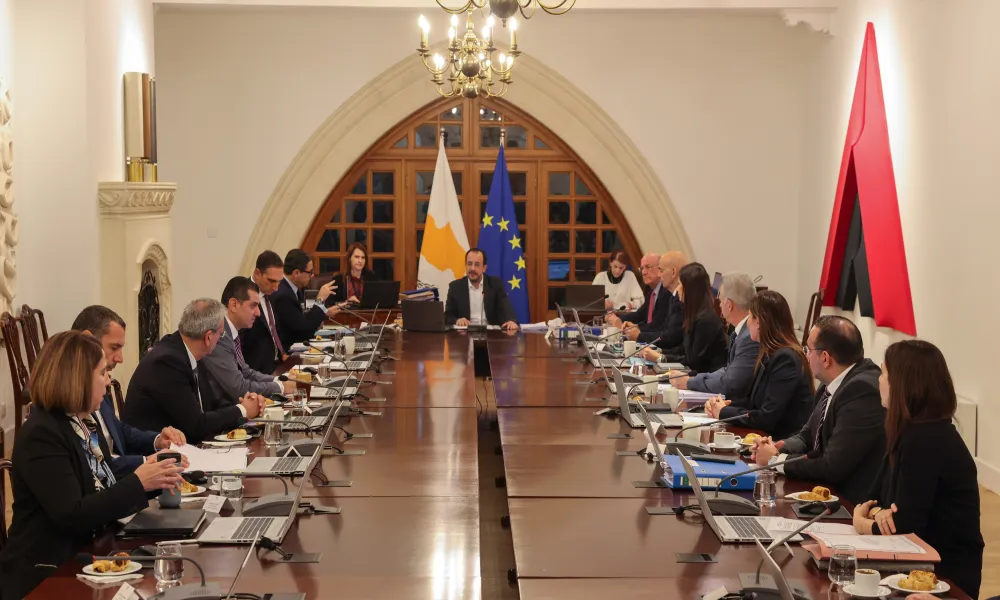

The government of President Nikos Christodoulides is proceeding with the partial satisfaction of the longstanding demand of refugees through the maternal lineage to exercise their voting rights in their place of displacement. In this context, the Council of Ministers is expected to approve, at today’s meeting, a bill prepared by the Ministry of Interior granting refugees through the maternal line the right to vote in Local Government elections both on the basis of their place of permanent residence and on the basis of their place of displacement, in the same manner that currently applies to those displaced through the paternal line.
This electoral right will take effect from the next Local Government elections in 2029. Following approval by the Council of Ministers, the bill will be submitted to the House of Representatives for enactment.
According to the Ministry of Interior, in elections for Local Government authorities, displaced voters through the paternal line already exercise their electoral rights both in their place of displacement and in their place of residence. Granting the same electoral rights to those displaced through the maternal line is not expected to have any impact on the electoral balance between the government-controlled and occupied areas. By contrast, a similar arrangement in parliamentary elections would result in significant changes to parliamentary seat distribution.
What changes
The bill in question is titled “The Civil Registry (Amendment) Law of 2026” and introduces the following changes:
-
Displaced persons through the maternal line will continue to vote in parliamentary elections based on their place of residence, as currently applies. In elections for Local Government authorities, they will have the option to exercise their electoral rights both on the basis of their place of residence and on the basis of their place of displacement.
-
In cases where both parents are displaced, registration on the electoral roll will be based on the father’s place of displacement. This arrangement may be modified upon submission of a relevant application by the voter so that registration is based on the mother’s place of displacement. It is noted that an application to change electoral registration may be submitted only once.
According to the Ministry of Interior, this arrangement achieves the following:
- It avoids the problem that could arise if registration required the prior submission of an application by the voter to select a place of displacement and the voter failed to respond, resulting in the inability to complete registration. By contrast, for voters where only one parent is a refugee, registration will take place automatically in the relevant electoral roll without requiring any application.
- It prevents pressure or interventions by candidates aimed at influencing voters to change their electoral registration before each election.
- It avoids the possibility of voters altering their registration and standing as candidates each time in different occupied municipalities or communities.
- Voters will be able to access information regarding their electoral registration status and voting rights through a dedicated electronic service, which the Ministry of Interior intends to develop in cooperation with the Deputy Ministry of Research, following the implementation of automatic voter registration on 1 July 2027.
No to parliamentary elections
In contrast to Local Government elections, both the Ministry of Interior and parliamentary parties opposed granting refugees through the maternal line the right to vote in their place of displacement in parliamentary elections. The reason is that such a regulation could disrupt the balance of the electoral map, leading to a distribution of parliamentary seats that is not representative of the electorate.
Specifically, if refugees through the maternal line who are already registered on the electoral roll were required to exercise their voting rights based on their mother’s place of displacement, there would be an immediate impact on the number of parliamentary seats by electoral district as follows: the districts of Limassol, Larnaca and Paphos would each lose one seat, while Famagusta would gain two seats and Kyrenia one seat.
Beyond these immediate effects, over time the number of seats per electoral district would change even more significantly, with further losses from the government-controlled districts.
It is also noted that if voting based on place of displacement were made compulsory for the children of refugees through the maternal line, and given that current legislation does not limit the number of generations eligible for refugee status, it is estimated that within approximately 20 years the vast majority of voters, if not all, would be considered displaced. The result would be the loss of parliamentary seats from the government-controlled districts to such an extent that the distribution of seats would no longer reflect the electorate.
The legislative proposal
It should be noted that a separate legislative proposal is pending before the House Internal Affairs Committee, granting refugees through the maternal line the right to vote in all elections on the basis of their place of displacement, including parliamentary elections. Discussion of this proposal began on 13 February 2025 but is currently on hold, as the majority of committee members decided not to promote any change on this issue concerning the forthcoming parliamentary elections.
The proposal is signed by Members of Parliament Rita Theodorou Superman, Efthymios Diplaros, Nikos Georgiou, Giorgos Karoullas, Kyriakos Hadjiyiannis, Onoufrios Koullas, Irene Charalambidou, Kostis Efstathiou, Zacharias Koulias, Pavlos Mylonas, Charalambos Theopemptou, Alexandra Attalides, Stavros Papadouris, Christos Christou, Linos Papagiannis and Sotiris Ioannou.
Why no option was given
If refugees through the maternal line had been given the option to choose registration on the electoral roll either on the basis of their place of residence or on the basis of their mother’s place of displacement, a similar right would have had to be granted to refugees through the paternal line, in order to avoid creating new discrimination while attempting to correct the existing situation.
According to the Ministry of Interior, such a development would have unpredictable consequences for the allocation of parliamentary seats. This is because the final distribution of seats would depend on voters’ own choices, and it could not be ruled out that even the seats of the occupied electoral districts might decrease if the majority opted for registration based on place of residence.
By contrast, in Local Government elections, voters displaced through the paternal line already vote both on the basis of their place of displacement and their place of residence. Granting the same electoral rights to those displaced through the maternal line is not expected to have any impact on the distribution between government-controlled and occupied areas, according to the Ministry.