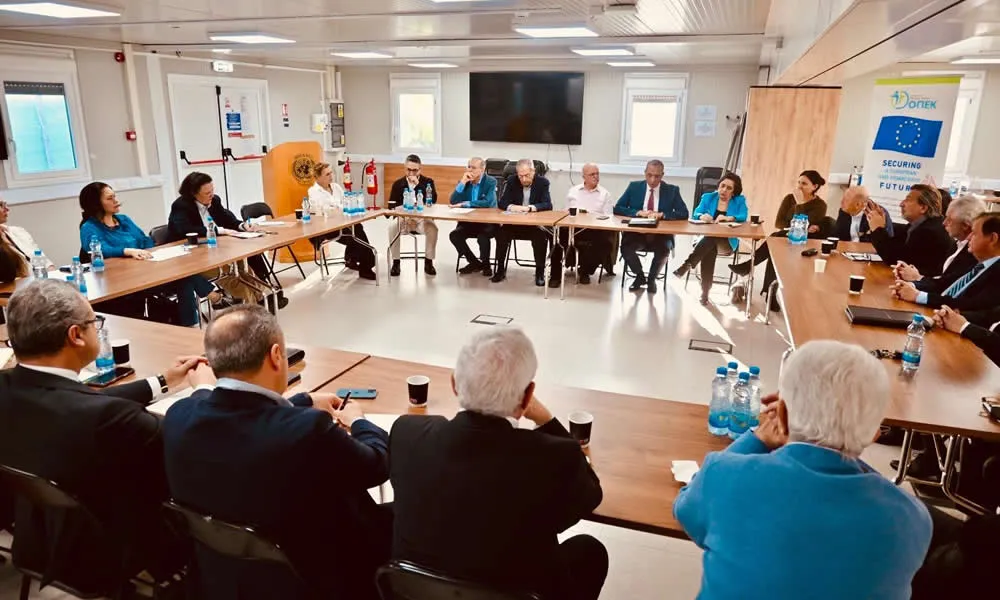

A high-level bicommunal round table discussion on evolving European security and defence policies and their implications for the UN-led reunification efforts was held on Tuesday, 21 April 2026, at Ledra Palace, Nicosia.
The event was co-organized by the Association for Social Reform (OPEK) and the Cyprus Peace and Dialogue Centre (CPDC), bringing together political representatives, academics, policy experts, and opinion leaders from both communities to examine how evolving European defence dynamics intersect with the Cyprus peace process.
Key Messages
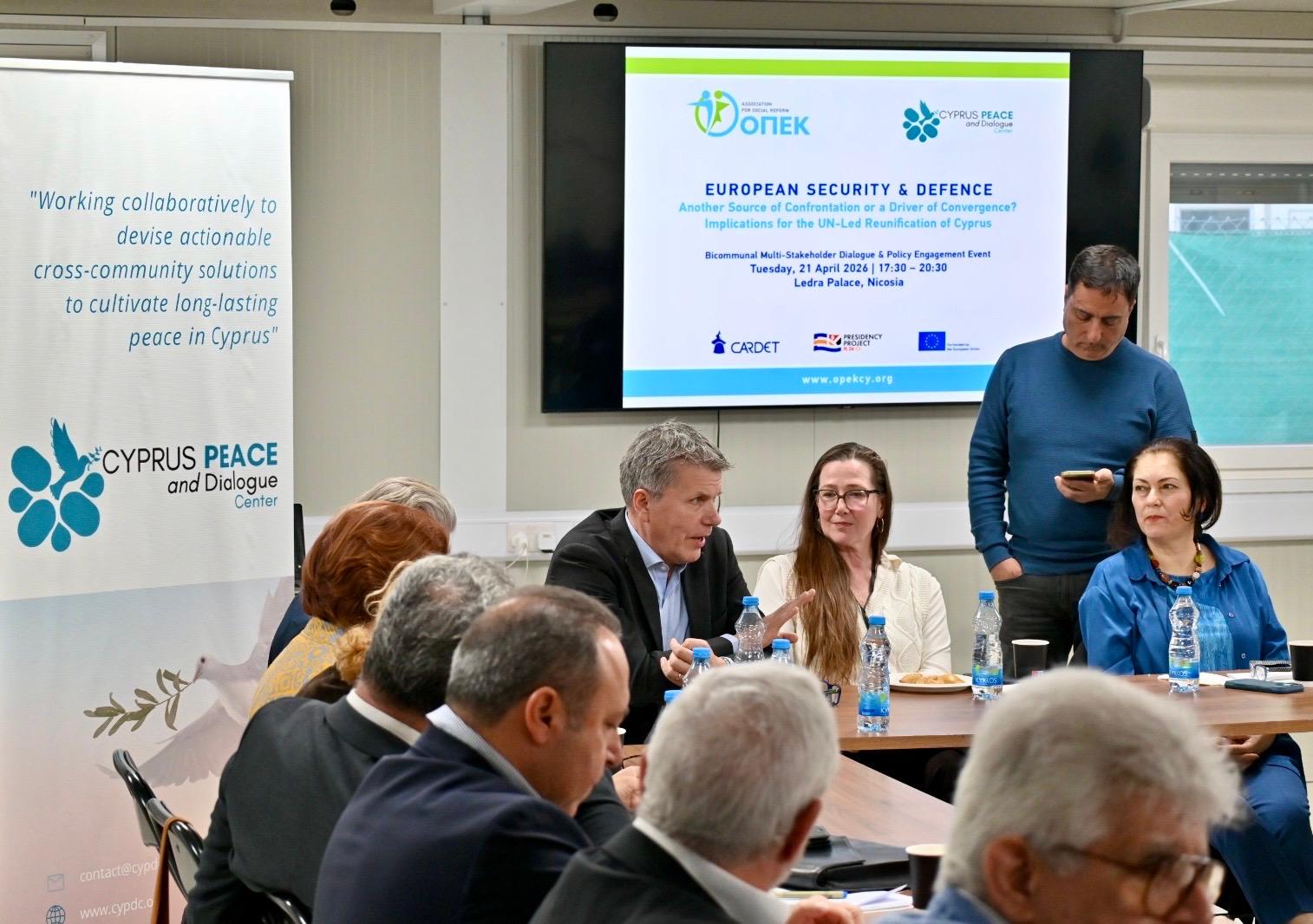
The keynote speakers underlined that current geopolitical developments and growing uncertainty in transatlantic relations make the development of a European Security and Defence Union increasingly necessary, stressing that the EU must move forward in taking crucial decisions to shape a new security architecture.
Ioannis Kasoulides, former Minister of Foreign Affairs, emphasized that such a framework could create a “win-win” dynamic for Europe, Cyprus, and regional actors, particularly if it evolves into a modern security mechanism capable of replacing outdated arrangements and supporting a balanced and sustainable settlement in Cyprus. At the same time, he stressed the importance of strategic pragmatism and flexibility, warning that rigid or exclusionary positions, particularly regarding the participation of key actors such as Türkiye, could prove counterproductive.
From the Turkish Cypriot perspective, Fikri Toros, a senior politician of the Republican Turkish Party (CTP), stressed that the impact of European defence integration on Cyprus will depend critically on how inclusive it is in design and implementation. He highlighted that an inclusive European framework, one that meaningfully engages all stakeholders, including Türkiye, could act as a catalyst for convergence and confidence-building, whereas an exclusionary approach risks reinforcing division and mistrust.
Menelaos Menelaou, negotiator of the Greek Cypriot community, emphasized the importance of preserving the foundations of the Cyprus settlement process, including political equality and the agreed basis of a bizonal, bicommunal federation. He noted that a sustainable security model must move beyond outdated arrangements and align with EU principles, while avoiding confrontational approaches that have historically failed to deliver results.
Similarly, Erhan Erçin, former representative of the Turkish Cypriot leader, highlighted the structural challenges of European defence integration, stressing that the absence of a clear common strategic vision within the EU limits the feasibility of a fully-fledged Defence Union. At the same time, he emphasized that inclusive engagement, particularly with Türkiye, is essential for any future European security architecture to be credible and effective, especially in relation to Cyprus.
Interventions by Professors Ahmet Sözen and Pavlos Pavlou converged on a critical point: the current Cyprus approach, based on entrenched narratives and “business as usual”, is no longer viable in a rapidly changing and more securitized international environment. They emphasized that continuing with existing patterns of engagement will only reproduce stalemate and called for a strategic shift towards more flexible, inclusive, and forward-looking approaches that reflect emerging global realities.
The debate was facilitated by Fiona Mullen, Economic and Political Analyst.
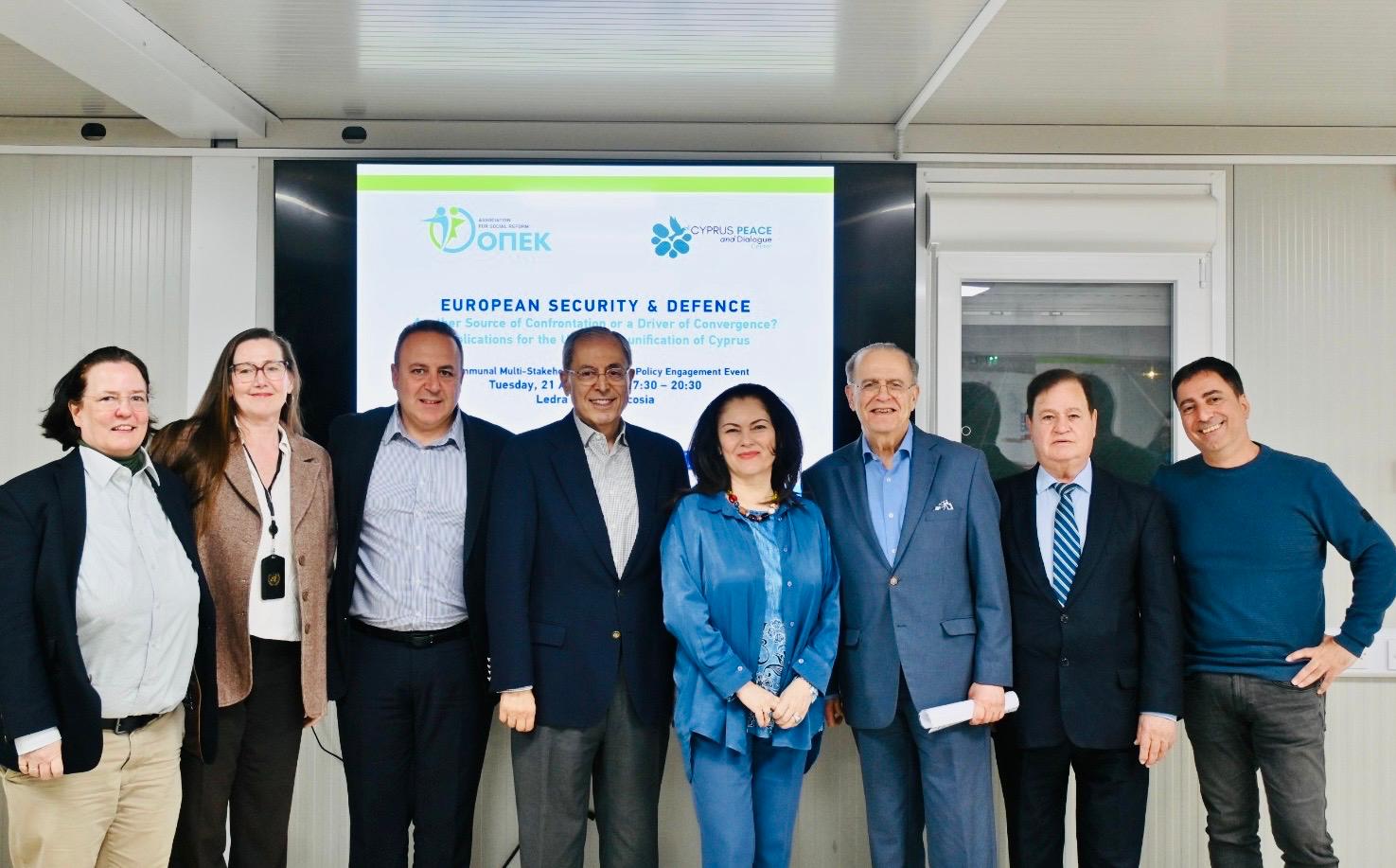
Opening remarks and closing reflections were delivered by Kyriakos Pieridis (OPEK) and Dr. Meltem Onurkan Samani (CPDC).
Convergences
Across the discussion, participants broadly agreed that:
- The status quo in Cyprus is unsustainable and requires new strategic thinking
- European defence developments are increasingly relevant to the Cyprus problem
- A shift away from zero-sum and confrontational approaches is necessary
- European frameworks could potentially serve as confidence-building mechanisms
At the same time, key debates focused on:
- The scope and feasibility of a European Defence Union
- The role of Türkiye in any future European security architecture
- Whether EU defence integration will act as a driver of convergence or a new source of tension in Cyprus
Next Steps
The round table provided a structured space for substantive and forward-looking dialogue on the intersection between European defence integration, Cyprus’s security architecture, and the UN-led peace process. High-level officials from the UN Good Offices and the European Commission were also present and described the discussion as valuable and productive.
A key takeaway is that the outcome, confrontation or convergence, will depend on political choices, inclusivity, and the ability to align European developments with the realities of Cyprus and the wider region. The organizers will prepare a policy reflection paper summarizing the main findings and recommendations.
The Project
The event was organised within the framework of the project “Towards an open, fair and sustainable Europe in the world – EU Presidency Project 2024–2026.” The project, implemented by OPEK, aims to strengthen democratic participation, informed public debate, and societal resilience in Cyprus, with a focus on EU security and defence, countering disinformation, and promoting inclusive bicommunal dialogue.The project is co-funded by the European Union and implemented in partnership with Global Focus, Grupa Zagranica, CARDET, and CONCORD.
For more information: 📞 +357 96387498 | +905428522484
✉️ info@opekcy.org | contact@cypdc.org
The project "Towards an open, fair and sustainable Europe in the world – EU Presidency Project 2024-2026" is co-funded by the European Union and implemented by Global Focus, Grupa Zagranica, CARDET, and CONCORD, the European Confederation of NGOs working on sustainable development and international cooperation. Project Number: 2024 / 459-484. The content of the publication is the sole responsibility of its author and do not necessarily reflect the views of the European Union.