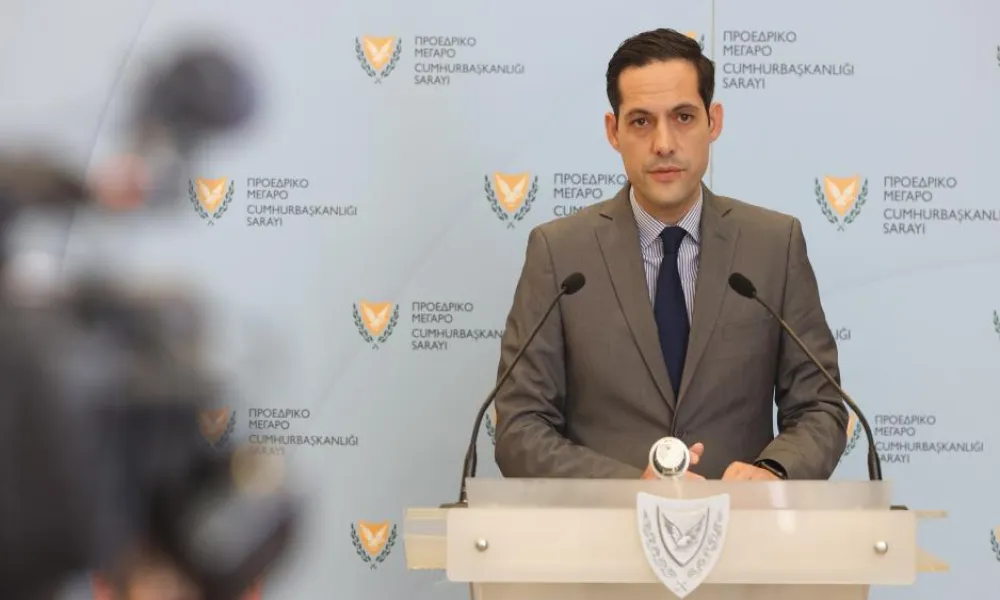

Cyprus is pressing the European Union to transform its mutual defence clause from a legal commitment into an operational reality, government spokesman Konstantinos Letymbiotis said on Wednesday, arguing that an initiative launched by President Nikos Christodoulides at last week's informal EU summit has already moved beyond the conference room and into European-level political action.
The gap between legal obligation and operational reality
Article 42.7 of the Treaty on European Union obliges member states to assist a fellow member that is the victim of armed aggression. It was invoked by France following the 2015 Paris attacks, but has never been underpinned by a clear operational framework specifying who mobilises, who coordinates, what assets are made available, what the chain of contact is, and how fast a response can be expected. That gap, Letymbiotis said, is precisely what Christodoulides put on the table before European leaders. "The question the Union must answer before a crisis, not after it: how security stops being a promise on paper and becomes readiness in practice," he said.
Backing from Weber and Von der Leyen
The initiative appears to have found traction at the highest levels. European People's Party president Manfred Weber, speaking at the European Parliament plenary in Strasbourg on Tuesday, voiced support for clear implementation rules for Article 42.7 and specifically cited Christodoulides by name, describing his push to place the clause on the agenda as addressing its operational dimension. European Commission president Ursula von der Leyen also raised the issue in remarks to the German Bundestag, asking precisely the question Cyprus had posed: Article 42.7 exists in the Treaties, but how and with what means is it actually applied?
Why this matters for Cyprus in particular
Letymbiotis framed the initiative as carrying particular weight for Cyprus given its position as a frontline EU member state. As a country on the Union's external border in a region of acute geopolitical pressure, with part of its territory under continued occupation, Cyprus has direct experience of what it means to rely on the credibility of European security guarantees. "European security is not an abstract concept for us," he said. "It is a matter of political responsibility, institutional consistency, and practical readiness."
The spokesman argued that the initiative could stand as one of the most consequential legacies of Cyprus's current EU Council Presidency, a contribution measured not in conclusions documents but in a more operationally prepared Union. "Cyprus does not simply observe European developments," he said. "It helps shape them."