
By George Koumoullis*
Those who trumpet the liberation of the occupied territories, implying a military confrontation with Turkey, are killing off the last remaining brain cells of their audience. If liberation could be achieved through slogans, it would have happened decades ago. Unfortunately, balances of power do not read patriotic social media posts.
"States go to war for their own vital interests and not for their friendships."
Dwight Eisenhower
How much more rational we would be if we all understood Eisenhower's observation. Perhaps then we would have rid ourselves of the dangerous illusion that, in the event, heaven forbid, of a Turkish attack on Cyprus, Greece, Israel, the United States or other friendly countries would automatically and without hesitation rush to fight on our behalf.
We forget that not even Greece came to fight alongside us in 1964, despite our being under its "defensive umbrella", when Tylliria was being bombed by the Turkish air force. Nor did it do so in July 1974 when Turkey invaded Cyprus, or in August 1974, after democracy had been restored in Greece, when Turkey completed its occupation of 37% of the territory of the Republic of Cyprus.
If, therefore, we cannot seriously count on any "Good Samaritan" in a time of crisis, can we manage on our own by investing in our deterrent capability?
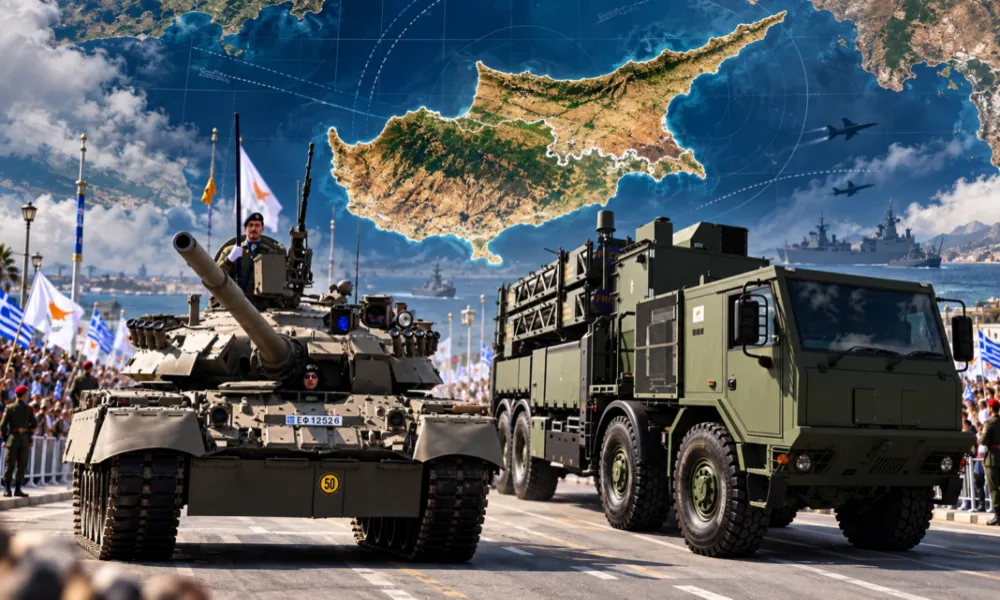
The Minister of Defence enthusiastically proclaims that defence spending will reach €680 million in 2027. This represents an increase of around €262 million compared with the €418 million budgeted for 2026. Indeed, in Cyprus' case, the EU approved a Cypriot defence programme worth about €1.2 billion through the SAFE mechanism. An initial disbursement of €177 million has already been received.
There is, however, one very important detail: SAFE is not a grant. It is a loan on favourable terms that must be repaid by the Cypriot state, namely by us, the taxpayers.
To examine whether these enormous sums will be worthwhile, it is necessary to refer to a principle used in economics, the law of diminishing marginal returns, because it is directly relevant to the issue.
Initial defence expenditure significantly increases the cost and risk faced by a potential aggressor. However, beyond a level of adequate deterrence, every additional million euros spent by Cyprus imposes an increasingly smaller cost on Turkey without materially altering the strategic balance of power. As a result, a small country may bear a disproportionately large economic burden while gaining only minimal additional deterrent benefit against a far stronger adversary.
In simple terms, every additional euro spent to bridge this gap yields progressively lower, if not negligible, returns.
Incidentally, the Barak MX system will likely improve Cyprus' defence capabilities, but it does not decisively alter the overall balance of power between Cyprus and Turkey. This is a distinction that is often lost in public debate.
Paradoxical as it may sound, procurement of the Barak MX could actually increase the Republic's sense of insecurity. While it strengthens defensive capabilities, it does not fundamentally change the strategic asymmetry vis-à-vis Turkey and may simultaneously provoke balancing reactions and a new cycle of armaments.
See Chapter III, Perception and Misperception in International Politics, by Robert Jervis, one of the leading theorists of international relations.
The inevitable question, therefore, not of one million euros but of many millions, is whether such economic sacrifices are worth making in order to strengthen what is described as our deterrent capability.
My answer is no.
To restate the obvious, Cyprus has neither a navy nor an air force capable of competing with Turkey on a comparable scale, nor does it possess the demographic or economic size to do so.
The romantic biblical story of David defeating Goliath cannot be repeated in the 21st century.
Cyprus' security does not depend on its military strength. It depends on international law, its membership of the European Union, its diplomatic alliances, the political cost of any new Turkish military action, and the involvement of regional and international actors.
To put it bluntly, the reason Turkish officers are not enjoying their Turkish coffee at the port of Paphos is not the awe inspired by our military power.
And one more thing: those who blindly support higher defence spending in order to increase Turkey's costs in the event of conflict, have they considered the cost Cyprus itself would bear? Have they considered that Cyprus could undergo experiences similar to those seen in Gaza?
What is the benefit if we shoot down ten more Turkish aircraft but Cyprus is reduced to ashes?
Since the balance of power between Turkey and Cyprus can never fundamentally change, then beyond a threshold of "adequate defence", one we surpassed long ago, additional resources yield greater returns when directed towards economic development, energy security, technological innovation, diplomatic alliances and other infrastructure projects.
Those who proclaim the liberation of the occupied territories while implying a military confrontation with Turkey are killing off the last remaining brain cells of their audience.
The idea of militarily "liberating" the occupied territories is the geopolitical equivalent of believing that an elephant can be brought down with a slingshot, provided you shout loudly enough: "Long live the immortal Greek spirit!"
Some appear to confuse military planning maps with Facebook posts, and strategy with nostalgia.
In their plans, Turkey possesses hundreds of aircraft, ships and troops, but somehow politely decides not to use them.
If liberation could be achieved through slogans, it would have happened decades ago. Unfortunately, balances of power do not read patriotic social media posts.
*Economist, social scientist