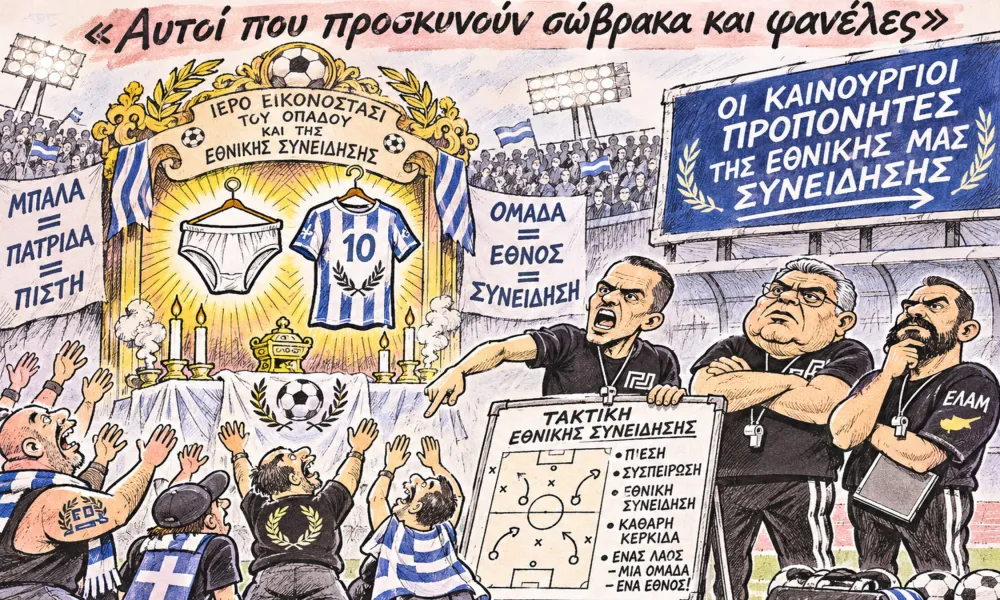

There is a particular category of our fellow citizens who go to the football stadium to defend the homeland. Not from some foreign invasion, but from the opposing centre-forward.
For these people, football is not a game, a shirt is not merely a shirt, and a footballer's underpants are something close to a national relic. If they happened to be worn by a striker who scored against Omonia or APOEL, depending on one's camp, they could be placed alongside the banners of 1821 and the EOKA struggle of 1955.
This peculiar religion of athletic underwear (no, we are not talking about the lawyer's thong from Paphos) appears to be attracting more and more followers.
At APOEL, Anorthosis, Apollon and elsewhere, there are those who believe the terraces are the most appropriate place to resolve all our national issues. The Cyprus problem, the Macedonia issue, the Fall of Constantinople and, quite possibly, the Asia Minor Catastrophe.
Kasidiaris
The latest achievement of this school of thought was the gift of a commemorative APOEL shirt to Ilias Kasidiaris.
The club celebrated one hundred years of history and some people apparently decided that a convicted former Golden Dawn MP serving a prison sentence was the most suitable person to honour the anniversary.
Kasidiaris wore the shirt, posed for photographs and thanked the nationalist supporters.
Fortunately, he did not announce that he was also taking over as head coach.
Although, with his experience in formations, guards and commands, he could probably organise a fairly disciplined defensive line.
There would, of course, be a problem with red cards.
In football, they are issued by the referee, not by political opponents.
ELAM
And this is where ELAM enters the picture.
The party that began with black T-shirts, a military style and a particular fondness for parades, while today trying to present itself in more parliamentary attire.
The tie has, in many cases, replaced the black T-shirt, but history does not change as easily as a wardrobe.
After all, Christos Christou himself once declared that ELAM was Cyprus' Golden Dawn. And his relationship with Nikos Michaloliakos is a documented part of his political journey.
Michaloliakos, for his part, had his own conception of organisation, discipline and national pride.
Had he taken charge of a football team, he would probably have required the players to enter the pitch in parade formation.
And for the goalkeeper to stand at attention during penalties.
The amusing thing is that, in our time, some people have managed to combine two seemingly incompatible identities.
To be both fanatical supporters of a football club and self-appointed guardians of national purity.
In other words, they view the world through two fabrics: the black T-shirt of their political identity and the colourful underpants of their favourite footballer.
The problem begins when the two fabrics end up in the same washing machine, as the song says, "clothes that are washed together eventually turn pink".
Out of this laundering emerge some strange ideological shades.
The yellow-and-blue supporter becomes a national fighter, the blue-and-white supporter a defender of history, and any opponent is transformed into an enemy of the nation.
An offside decision can be interpreted as national treason and a penalty awarded against a team can provoke greater outrage than an actual political crisis.
This Is Sparta
The familiar figures appear in the stands.
Black clothing, hoods, martial slogans such as "This Is Sparta" and, in some cases, clubs.
Sparta was the symbol of the disciplined society admired by dictator Ioannis Metaxas. The club is an especially interesting sporting accessory, apparently employed by the Sacred Band of Thebes in the era of Epaminondas.
The club is not included in FIFA regulations, but some seem to regard it as an integral part of their football education.
Ordinary supporters go to the stadium with their children, buy a cheese pie, complain about the referee and return home.
The others depart as if they are about to liberate occupied territories, armed with banners, slogans and the conviction that the fate of Hellenism depends on Sunday's result.
The national anthem is never missing
When Dionysios Solomos wrote the "Hymn to Liberty", it is difficult to imagine that he might have foreseen his verses, two centuries later, being used to prepare a football terrace psychologically for a derby.
Nor that patriotic uplift might be interrupted by a stadium announcement asking the owner of a car to move it because it is blocking an exit.
The paradox is that many of those shouting about the homeland display far less enthusiasm when it comes to addressing its actual problems.
They may know little about education, healthcare or the economy.
But they know with certainty which football club represents true Greeks and which should be treated as a threat to the nation.
Even more comical is the cult of the shirt.
They kiss it, worship it, raise it like a banner and stand ready to fight for its honour.
Until the footballer decides to sign for the eternal rival because a better contract has been offered elsewhere.
Then the national symbol is transformed, within a single afternoon, into a rag of betrayal.
Then come the insults directed at his race, his family and his entire ancestry.
Such is the lifespan of the nationalist ideology of the underpants.
About as long as a footballer's contract.
They have history
Of course, not all supporters are like this.
The overwhelming majority love their club without needing a political guide, a black uniform or a club.
APOEL, Anorthosis and Apollon possess histories that cannot be reduced to the slogans of an extremist minority.
Perhaps, then, the time has come for someone to explain to these professional defenders of our national consciousness that the homeland is not endangered when their team loses three-nil.
Nor is it saved when it wins through a stoppage-time penalty.
Football is a game.
It is joy, entertainment, companionship, banter and, occasionally, disappointment.
It does not require Michaloliakos, Kasidiaris, political commissars or squads armed with clubs.
National saviours
Those who continue to confuse politics with sport should at least make a basic effort to separate their clothes.
The tie belongs around the neck.
The football shirt belongs on the body.
And the underpants belong exactly where we all know they belong.
Because however high you raise them, however much you worship them and however often you sing the national anthem to them, underpants remain underpants.
Yellow in the front and brown-tinted in the back.
Even if they are black.
Even if they say ELAM.
And even if you wear them on your head in an effort to resemble a national saviour.