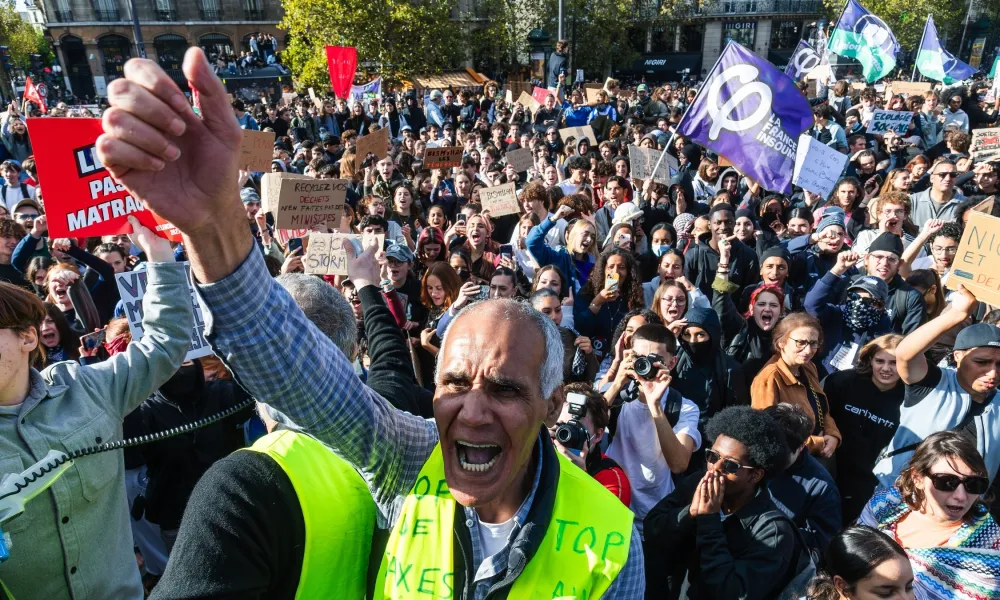

Rising prices, the housing crisis, high energy costs and uncertainty about the future have driven thousands of citizens onto the streets, not only in Europe but more broadly. The same frustration that is expressed through mass mobilisations can also be reflected at the ballot box, either through protest votes and a shift towards populist or far-right parties, or through abstention.
This was one of the main conclusions of an event titled "Greece and Cyprus in a New Political Landscape: Elections, Strategy and Geopolitical Balances", held on Wednesday in Nicosia at the initiative of the NGO Politeia Cyprus and communications consultants Gnora, with the participation of political analyst Maria Karaklioumi, journalist and author Kostas Laskaratos and communications specialist Charalambos Rossides.
A sense of futility
The common thread running through all three interventions was the crisis of confidence in the political system and the inability of traditional parties to present a convincing plan for addressing the problems affecting citizens' daily lives.
"Low participation in elections is not necessarily indifference. It may be disappointment and a sense of futility that, in the country where I live, nothing changes," according to Maria Karaklioumi, who also pointed out that far-right and populist parties find political space because "the establishment parties have not done the necessary work they should have done", whether in government or in opposition.
Abstention as political protest
Particularly noteworthy was the approach taken by Kostas Laskaratos, who challenged the perception that those who abstain from elections are necessarily indifferent to politics.
As he argued, abstention can be a political stance stemming from disappointment with the available political class and the absence of a vision capable of creating the expectation of a better life.
"Many parties do not have a political programme or political orientation. Many do not know what their objective is," he said, adding that the political system appears disconnected from the priorities of a significant segment of society.
The issue, therefore, is not only which party will win the next election but which citizens will ultimately decide to participate in it.
This approach shifts the discussion from the responsibility of citizens who do not vote to the responsibility of political forces to provide meaningful reasons for participation.
Clear positions
For his part, Charalambos Rossides pointed out that dissatisfaction with a government does not automatically translate into support for the opposition, while the clarity of the political positions of the far right is, in his view, one of the reasons for its growing strength.
In conditions of polarisation, he explained, clear positions can gain greater appeal than vague political messaging.
According to Rossides, the critical issue is whether political leaders can convince people that their proposals can provide meaningful solutions to everyday problems.
Communications and image-building are not enough when they are not accompanied by political effectiveness and credibility.
Citing an ALCO poll in Greece, he said that seven out of ten citizens state that they want political change, while New Democracy continues to maintain a clear lead in opinion polls.
At the same time, according to an Interview poll he presented, 63% of respondents attribute the primary responsibility for rising prices to the Greek government, compared with 34% who mainly associate the problem with international conflicts.
According to Rossides, these findings show that social dissatisfaction alone is not enough to overturn political balances unless there is an alternative proposal capable of inspiring confidence.
He expressed similar concerns regarding Cyprus, citing an Alpha-RAI poll according to which 64% of respondents were dissatisfied with President Nikos Christodoulides.
The question he posed was whether this dissatisfaction can be translated into political change, particularly in an environment where new political formations are emerging and party balances are shifting.
He stressed that governments now possess more communication tools than ever before, but their effectiveness is limited when their messages do not correspond to citizens' daily experiences.
A government, he explained, may highlight positive economic indicators, but that is not enough to persuade a household struggling to meet its basic needs.
High prices and corruption
According to Maria Karaklioumi, economic pressure and a sense of social injustice are key drivers of the crisis of confidence.
She identified two problems that cut across both Greek and Cypriot societies: rising prices and corruption.
"These are two problems, each feeding the other," she said, explaining that their interaction creates strong social dissatisfaction that can be expressed both at the ballot box and through social mobilisation.
Indicative are Eurobarometer figures she presented, according to which 99% of citizens in Greece and 95% in Cyprus consider corruption widespread, compared with 71% across the European Union.
At the same time, 68% in Greece and 67% in Cyprus say they feel personally affected by corruption, compared with a European average of 30%.
Karaklioumi clarified that these percentages do not reflect the actual extent of corruption but rather citizens' perceptions of it.
However, it is precisely those perceptions that affect their relationship with institutions and the political system.
Trust in governments is similarly low, according to the figures she cited, at 21% in Greece and 31% in Cyprus, compared with a European average of 51%.
The problem, she explained, is not only economic.
It is also an issue of justice and equality before the law.
Citizens feel that the state is slow to identify and address serious cases of wrongdoing, while appearing particularly strict towards minor infractions by ordinary people.
This perception of unequal treatment reinforces the belief that the political system does not operate according to the same rules for everyone.
The myth about young people
Another important dimension concerns younger generations.
Maria Karaklioumi rejected the notion that young people are not interested in politics, distinguishing political engagement from party affiliation.
As she explained, young people may be distancing themselves from political parties but continue to mobilise around issues that directly affect their lives.
"They are politicised; they are not partisan," she said, stressing that personal experiences can now be transformed into collective mobilisation through social media.
Social media allow personal experiences of dissatisfaction to acquire a collective dimension and lead to social mobilisation, even without traditional party organisation.
Kostas Laskaratos added that younger generations have grown up in conditions of constant crises and uncertainty, something that shapes both their expectations of politics and the way they view the future.
A parallel reality
Kostas Laskaratos also made particular reference to the gap separating the political system from society, directing criticism not only at politicians but also at journalists.
He described a closed circle of politicians, journalists and institutional actors who continuously interact with one another, reproducing the same discussions and developing the belief that they understand what concerns society.
"A community of people is created from morning until night," he said, explaining that while this community influences citizens' lives and takes decisions, it does not represent the critical mass of society.
According to him, citizens' political choices are shaped primarily by personal experience, their social environment and the information they receive.
"People vote with their wallets," he remarked, linking electoral behaviour to working conditions, income and expectations for the future.
Fragmented information and political communication
Another challenge facing traditional parties, according to Kostas Laskaratos, is the fragmentation of information.
Citizens no longer receive information from the same sources, nor are they exposed to the same events and political messages.
Social media, digital platforms, content creators and artificial intelligence have radically changed the way public opinion is formed.
"Information no longer has a single point of entry," he said, explaining that the political system can no longer know with certainty where each voter gets information or what perception of reality they have formed.
The result is that different social groups develop different understandings of the same issues, making communication between parties and society even more difficult.
As he noted, fragmentation of information is accompanied by fragmentation of priorities, trust and political representation.
The key issue
The central message emerging from the three presentations was that the crisis of political representation cannot be addressed solely through better communication, greater visibility or pre-election promises.
Citizens are looking for answers to the problems affecting their daily lives and are demanding transparency, justice and effectiveness from institutions.
At a time when social dissatisfaction is expressed in the streets, on social media and at the ballot box, the question facing political parties is not only how to win the next election but how to convince citizens that they have a credible plan for the day after.