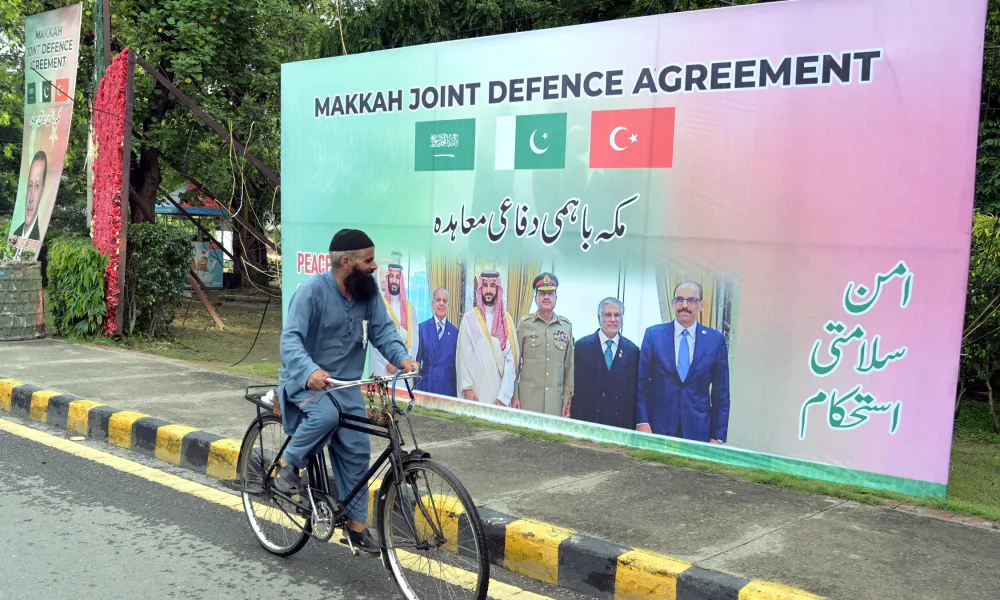

The Mecca agreement is moving toward the scrutiny that opposition parties have demanded since it was signed on 7 August. On 8 October, Fidan said the preparations to submit it to Parliament were complete and Ankara aimed to send it “as soon as possible.” AK Party spokesperson Ömer Çelik had said a day earlier that the process had matured and the agreement would be sent within days. As of 9 October, however, it has not been formally tabled, and Parliament has announced no debate or vote date. The pact’s full text has therefore not yet entered the parliamentary record for lawmakers and the public to examine.
The timing is consequential. On 5 October, the pact’s committee agreed to take steps toward providing agreed forces and capabilities for rapid deployment in Saudi Arabia, subject to approved arrangements and the parties’ domestic laws. The statement did not identify the units, their tasks or a timetable. Fidan has since said Turkish officials are assessing possible contributions, particularly air defence, electronic warfare and technical support. He also drew a clear line: Türkiye will stand by a partner under attack, but will not send troops to another country to carry out attacks. Reuters reported that assistance already being provided is mainly defensive and technical, much of it bilaterally arranged while parliamentary approval remains pending.
Parties agree on scrutiny, not on the pact
The AK Party presents the agreement as a defensive arrangement that strengthens regional deterrence and complements Türkiye’s existing alliances. The MHP supports it and has argued for a wider Islamic security initiative. Their case will face its first substantial test in Parliament: whether lawmakers consider the pact’s public description sufficient, or demand the full text and a precise account of the commitments it creates.
The CHP has recognised potential gains in defence-industry cooperation and regional influence, while warning that Türkiye could become a proxy carrying the security burden of larger powers. Its demand is now procedural as well as political. On 8 October, CHP group deputy chair Sevda Erdan Kılıç called for Fidan to address the General Assembly and answer whether parliamentary approval of the agreement would itself authorise military action, or whether a separate parliamentary decision would be needed.
The Islamist opposition is divided over the pact’s direction. Saadet leader Mahmut Arıkan has said sending Turkish troops to fight the Houthis alongside Saudi Arabia would be a mistake, arguing that the arrangement risks drawing Muslim-majority countries into conflict with one another. Yeniden Refah has called for a broader framework that includes Iran and other regional states, warning against the pact becoming an anti-Iran alignment.
On the nationalist right, İYİ, Yeni and Zafer parties have raised concerns about the risk of being pulled into the Yemen conflict or a confrontation with Iran. İYİ and Yeni have pressed for parliamentary oversight; Zafer leader Ümit Özdağ has rejected risking Turkish soldiers’ lives for Saudi Arabia. Yeni Party leader Özgür Özel has described a possible deployment to Yemen as an unacceptable adventure. DEM Party has not issued a clear formal position on the pact’s military commitments in the sources reviewed.
Outside reactions point to a more complicated region
Washington has said Saudi Arabia has the right to defend itself and that the United States will honour its own security commitments to the kingdom. That offers Riyadh reassurance, but it is not an endorsement of the Mecca pact’s specific military arrangements. India, which is attentive to Pakistan’s new role and its own Gulf interests, says it is examining the agreement’s implications for national security and regional stability.
Athens is watching the pact’s effect on Türkiye’s regional position, but Prime Minister Kyriakos Mitsotakis has cautioned against treating closer Turkish-Saudi relations as a reason for Greece to distance itself from Riyadh. Israeli media and analysts have been more concerned about the pact’s potential political weight, while questioning whether it has the integrated command and military structure of a functioning alliance. These are media and expert assessments, not a declared Israeli government position. Gulf states, meanwhile, are not moving as a single bloc: Qatar has backed discussion of a regional security framework that includes Iran, while the UAE is outside the pact but remains involved in the wider Yemen theatre.
What the vote will decide
Assessment: Parliamentary approval would give the pact a firmer legal and political footing, but it would not automatically settle the scale or form of a Turkish military contribution. Fidan’s public description points toward air defence, electronic warfare and technical assistance, and rules out an offensive Turkish role in Yemen. A limited defensive contribution is therefore more plausible than Turkish combat forces joining the Yemeni government’s campaign. The full text, a government explanation of the mission and a clear account of Parliament’s role will determine whether that restraint is credible.
The vote will also test the government’s claim that the pact is defensive and open to regional cooperation. Lawmakers will be able to ask whether the agreement creates an automatic obligation to act after an attack, how a partner’s request for assistance would be assessed, and what further parliamentary authorisation would apply to sending forces abroad. Until those questions are answered in public, “joint defence” remains a commitment whose boundaries are being negotiated alongside its implementation.