
Confidence building was supposed to be the most achievable part of the renewed Cyprus effort. Instead, it is emerging as its first serious problem.
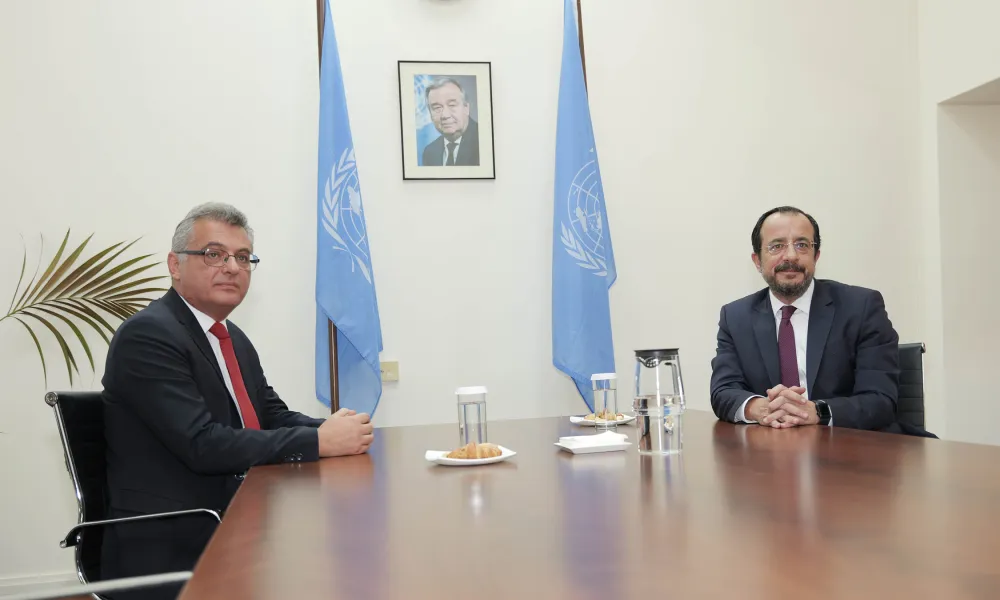
Nikos Christodoulides and Tufan Erhürman met for about an hour Wednesday, focusing on confidence-building measures and the methodology for a possible new negotiating process. They agreed to meet again at 11 a.m. on Sept. 17, but failed to agree on new CBMs.
More significant was Erhürman’s assessment that a substantial part of the meeting was devoted to domestic and external initiatives “eroding even the existing level of trust.” He linked the problem directly to UN Secretary-General António Guterres’ call for a “conducive climate,” arguing that progress requires both new CBMs and restraint from actions that damage confidence.
That increasingly defines the challenge facing the process before the diplomatic focus moves to New York. The issue is no longer simply how to create additional confidence, but whether existing confidence is being depleted faster than negotiations can replenish it.
Encouraging words, difficult reality
Christodoulides offered a more positive assessment after Wednesday’s meeting. He described the discussion as substantive, pointed to common understanding on some issues, particularly previous convergences, and reiterated his readiness to resume negotiations from where they ended at Crans-Montana.
His extensive interview with Tümay Tuğyan of Yeni Düzen two days earlier remains important mainly as a benchmark against which developments can now be measured.
Christodoulides made an unusually direct appeal to Turkish Cypriots, saying he genuinely believed Erhürman wanted a settlement and recalling that he had told him they could “write history together.” He even suggested that if the Cyprus problem depended solely on the two leaders, agreement could be reached rapidly.
There was substance behind the optimism. Christodoulides accepted preservation of previous convergences, the need for a time-conscious process and political equality, bringing him closer to three elements of Erhürman’s four-point methodology.
The principal procedural disagreement concerns Erhürman’s fourth point. Christodoulides portrays it as a demand for predetermined consequences if another process fails. Erhürman’s position is that Turkish Cypriots should not enter another UN-sponsored process, remain committed to its agreed basis and then automatically return to the same indefinite restrictions if the other side abandons the process.
It is therefore more accurately understood as an accountability safeguard than an automatic sanction.
Trust cannot be built with one hand
The more immediate difficulty concerns confidence itself.
Erhürman has cited regional arrangements involving Greece and Israel that, in his view, disregard Turkish Cypriots when shaping the island’s strategic environment. Domestically, he has pointed to controversies involving Barcelona youth activities, festivals and international sporting or cultural contacts, property cases and European Parliament initiatives Turkish Cypriots regard as one-sided.
Christodoulides’ position is that efforts to prevent activities that might imply recognition or normalisation of the north are legitimate consequences of the unresolved Cyprus problem. That reflects the established Greek Cypriot position, but it also exposes the central contradiction in the present confidence-building exercise.
Measures intended to prevent what Nicosia considers an upgrading of the north may simultaneously reinforce Turkish Cypriot isolation and deepen the mistrust that negotiations are supposed to overcome.
Turkish Cypriots cannot easily be persuaded that they will be politically equal partners in tomorrow’s reunited Cyprus while manifestations of their international visibility today are treated primarily as problems to be contained.
That does not mean the Republic of Cyprus must suspend its foreign policy or accept every international activity involving the north. Nor can Turkish Cypriots reasonably claim a veto over Greek Cypriot diplomacy.
But a leadership committed to reunification must consider not only whether an action is legally available, but also whether it strengthens or weakens the political environment necessary for a settlement.
That is the significance of Erhürman’s interpretation of Guterres’ “conducive climate.” Confidence building requires not only new measures, but restraint.
When the easy issues become difficult
The crossing-point dispute illustrates the problem.
The two sides offer different accounts of the UN proposals, their sequencing and which crossings formed part of the package. Behind those technical disagreements lies a more fundamental dispute. The Turkish Cypriot side seeks measures that reduce practical isolation, while the Greek Cypriot side rejects steps it believes might consolidate separate status.
Almost every apparently straightforward CBM can therefore become entangled in the recognition dispute it was intended to help transcend.
That makes it increasingly important to broaden the confidence-building agenda beyond crossings.
The recent ferry disaster off Kyrenia and fires in the north demonstrated that maritime accidents, wildfires, earthquakes, pollution and other emergencies do not recognise ceasefire lines.
A bicommunal civil-protection mechanism could establish direct emergency communications, notification procedures, liaison arrangements, protocols for requesting assistance and joint exercises. Such cooperation need not prejudice either side’s sovereignty or recognition positions.
It would simply save lives.
If Christodoulides and Erhürman genuinely want to “write history together,” protecting people together would be a credible place to begin.
Some movement on methodology
There is better news on the procedural track.
The UN inventory of previous convergences is reportedly nearing completion. Christodoulides says there is already common understanding on parts of the negotiating framework, while Erhürman accepts that established convergences should not simply disappear.
The inventory could prevent cherry-picking and avoid reopening years of previous work. But disagreement remains over how the document should be handled. The Greek Cypriot side wants it circulated and used as a basis for resuming negotiations, while the Turkish Cypriot side is more cautious about transforming a UN inventory into an immutable negotiating package.
Political equality also remains unresolved in substance. Christodoulides accepts the principle but regards rotating presidency as an issue for substantive bargaining. Erhürman argues that political equality must have institutional content, including effective participation and rotating leadership in principle, before bargaining begins.
The distinction matters. Political equality cannot become something the smaller community must effectively purchase through concessions elsewhere.
The wider diplomatic track
The process meanwhile extends beyond the two leaders. Tahsin Ertuğruloğlu has met UN Special Representative and UNFICYP head Khassim Diagne to discuss Cyprus developments and the peacekeeping force’s activities, while the leaders’ representatives are continuing their contacts.
UN Personal Envoy María Ángela Holguín’s illness has interrupted her travel plans, but the UN machinery on the island remains active as preparations continue for the New York phase.
Türkiye will also remain indispensable if negotiations eventually reach security and guarantees. Erhürman cannot negotiate Ankara’s strategic interests on Türkiye’s behalf, but neither can a durable settlement be designed without Turkish Cypriot consent. The eventual equation will require both.
New York cannot manufacture trust
The Sept. 17 meeting now assumes greater importance. A crossing compromise, an emergency-cooperation mechanism, another meaningful CBM or clearer methodological understanding would demonstrate that the dialogue is beginning to produce results.
Another meeting ending largely with agreement to continue meeting would suggest the opposite.
New York can provide diplomatic encouragement, pressure and structure. Guterres can determine whether enough common ground exists to justify another enlarged 5+1. But the UN cannot manufacture confidence in New York if it is being steadily depleted in Cyprus.
Christodoulides has demonstrated that he can articulate an encouraging vision of a common future. Erhürman must likewise show that his insistence on a conducive climate is intended to facilitate negotiations rather than enlarge the list of reasons for delaying them.
For now, however, the immediate challenge is simpler.
Before the two leaders can build new confidence, they must stop losing what little remains.
That is the real test before New York.