
Discussions of Türkiye’s geopolitical importance are usually dominated by maps. There is little need to explain why a country located at the intersection of three continents, controlling the straits linking the Black Sea to the Mediterranean and forming a natural bridge between Europe and Asia, should possess strategic significance. Yet Türkiye’s geopolitical value has never rested on the same foundations in every era. As the international system changed, so did the sources of strategic influence.
During the Cold War, Türkiye’s importance derived largely from its role as NATO’s forward position against the Soviet Union. Geography itself generated strategic value. With the disappearance of the Soviet threat, however, Türkiye emerged as a central country in energy corridors, regional security architecture and crisis management. Projects such as the Baku-Tbilisi-Ceyhan pipeline, TANAP, Blue Stream and TurkStream strengthened Ankara’s role as a bridge between Europe and Asia, while conflicts in Iraq, Syria, the Black Sea and the Caucasus increased its diplomatic relevance.
Today, a third geopolitical era is taking shape. The influence of states is no longer measured solely by energy pipelines or military bases. Digital connectivity, artificial intelligence, semiconductors, critical minerals, data centres, financing networks and technological standards have become essential instruments of power. Trade corridors are now determined not only by geography, but also by the rule of law, investment security, regulatory institutions and political predictability.
The real question, therefore, is no longer whether Türkiye possesses a strategic location. That has long been established. The issue is whether Ankara can transform this strategic asset into lasting strategic influence.
Strategic presence is not the same as strategic influence
Türkiye is active today across a vast geopolitical area extending from the war in Ukraine to Syria’s future, from Black Sea security to the Eastern Mediterranean, and from the Caucasus to the Gulf. It remains one of the few countries capable of speaking simultaneously with Washington and Moscow, Kyiv and Tehran, Baghdad and Damascus. This is an important source of diplomatic capital.
Strategic presence, however, is not the same as strategic influence. Real power is not measured simply by participation in multiple diplomatic files. It is measured by the ability to alter the preferences of other actors, shape the design of new initiatives and influence the rules of the emerging order. There is a profound difference between having a seat at the table and determining how that table is arranged.
The recent NATO Summit offered two revealing examples of this transformation. The reopening of discussions with Washington over the F-35 demonstrated that Türkiye’s military capacity and indispensable position within NATO continue to matter. The revival of a file that had appeared politically closed was itself a diplomatic development.
Yet another initiative announced at the summit pointed to a deeper shift. The creation of the Defence, Security and Resilience Bank under Canadian leadership illustrated that the future of the defence industry will not be defined by arms production alone. Defence ecosystems will increasingly depend on long-term financing, investment funds and industrial networks.
Türkiye’s decision not to join the bank as a founding member was, of course, a sovereign choice. Yet it also highlighted the changing nature of geopolitics. International influence is now generated not only through military platforms, but also through financial institutions, technology consortia and regulatory frameworks.
The Türkiye-United Kingdom Security and Defence Partnership signed in Ankara reflected another aspect of the same transformation. The agreement is not limited to expanding conventional defence cooperation. It also encompasses joint technology development, production capacity and stronger supply chains. Strategic partnerships are increasingly being judged not merely by their ability to conduct joint exercises, but by their capacity to innovate and produce together.
The meaning of energy corridors is changing
Energy geopolitics is undergoing a similar transformation. In the past, the route taken by a pipeline generated strategic advantage. Türkiye benefited significantly from this logic, becoming an indispensable transit country for European energy security through projects such as Baku-Tbilisi-Ceyhan and TANAP.
Today, however, energy corridors carry more than oil and natural gas. Financing, technology, insurance systems, port infrastructure, digital networks and political trust have all become part of the same strategic equation. The success of a project is no longer determined by its route alone, but by investor confidence and institutional predictability.
Türkiye’s efforts to reactivate the Kirkuk-Ceyhan pipeline and the agreement to supply natural gas to northern Cyprus through an undersea connection are important in this regard. Yet alternative routes are also taking shape. Plans to transport Iraqi oil to the Mediterranean through other corridors, the India-Middle East-Europe Economic Corridor, and energy and transportation projects developed by Israel, Greece and Cyprus all demonstrate that competition is no longer based solely on geography.
The new competition concerns which country is regarded as the more reliable partner by investors. Capital seeks predictability. Becoming an energy hub therefore depends not only on pipelines, but also on strong institutions and credible economic management.
The new Middle East is being shaped by strategic networks
A similar transformation is unfolding across the Middle East. Regional balances are no longer defined solely by military alliances. Transportation corridors, port investments, digital infrastructure, artificial intelligence applications and financial centres are becoming interconnected components of strategic power.
In the Eastern Mediterranean, cooperation among Israel, Greece and Cyprus in energy, transportation and security is being reinforced by India’s logistical capacity, the capital of the United Arab Emirates and political support from the European Union. The objective is not simply to hold joint exercises or develop isolated energy projects. It is to occupy a central position within the economic and technological networks stretching from the Eastern Mediterranean to Europe.
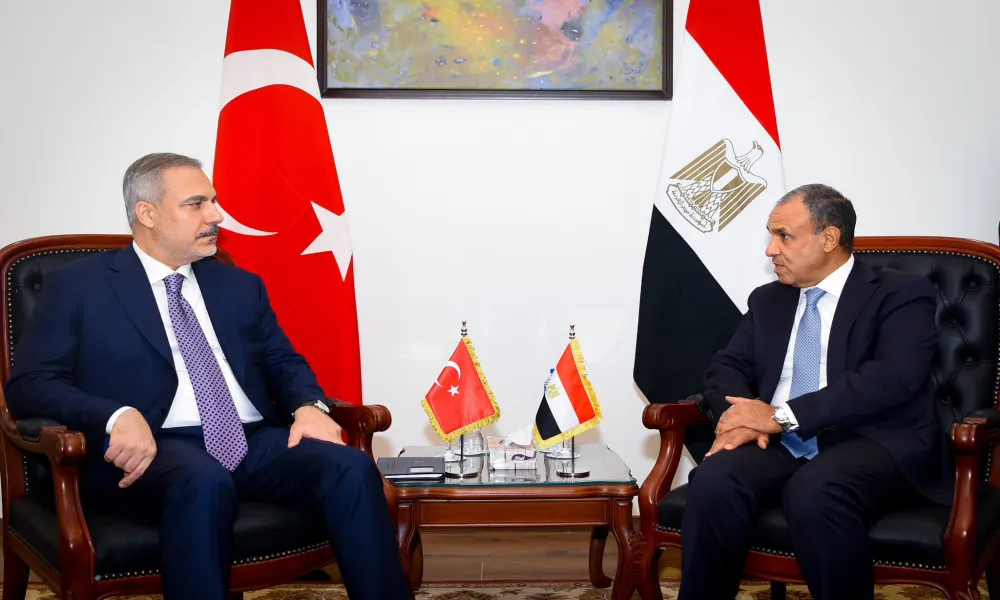
Türkiye is not outside this transformation. Its strategic partnership with Azerbaijan, normalisation with Gulf countries, energy and security dialogue with Iraq, renewed relations with Egypt and defence partnership with the United Kingdom all demonstrate Ankara’s effort to construct its own regional network.
The measure of success in the coming period, however, will not be the number of countries with which Türkiye maintains good relations. The real test will be whether those relationships can be transformed into joint technology production, shared investment funds, common financing mechanisms and durable institutions.
Those who shape institutions also shape the order
One of the most important geopolitical changes of the twenty-first century is the growing role of institutions in generating international influence. New financial organisations are being established, technology standards are being written, artificial intelligence rules are being formulated and critical mineral supply chains are being redesigned.
Countries that determine technological standards, create financing models and control supply chains can alter international behaviour without deploying a single soldier. Those who write the rules also shape the order.
Institution-building and participation in the design of institutions have therefore become central arenas of geopolitical competition.
Strategic influence begins at home
The line separating domestic and foreign policy is becoming increasingly blurred. Economic management, the rule of law, the credibility of regulatory institutions, the education system and research capacity are now integral components of national security.
International investors no longer examine costs alone. They also assess the rule of law, the predictability of monetary policy and institutional stability. Governments apply similar criteria when choosing strategic partners.
The European Union’s so-called Brussels effect, the international power of the United States through the dollar and its technology ecosystem, and China’s Belt and Road Initiative and Asian Infrastructure Investment Bank are different expressions of the same reality. These powers generate influence not only through their military capabilities, but through the economic and institutional systems they have created.
Türkiye has achieved a remarkable transformation in its defence industry over the past two decades. Advances ranging from unmanned aerial vehicles to naval platforms have widened Ankara’s diplomatic room for manoeuvre. The next phase, however, will be more difficult. Unless these achievements are supported by strong universities, qualified human capital, advanced technology production, sound financing structures and credible institutions, sustaining the same momentum will not be easy.
The principal challenge facing Türkiye is therefore not merely to produce more defence systems. It is to strengthen the scientific infrastructure, financing capacity, technology ecosystem and institutional environment that can sustain such production.
The question is no longer where Türkiye stands, but what it shapes
Türkiye is no longer a peripheral country in the international system. It is an indispensable actor in Europe’s security architecture, the Black Sea balance, the reconstruction of the Middle East and competition in the Eastern Mediterranean. This is a significant achievement.
The measure of success in the coming period will nevertheless be different. It will not be determined by how many summits Türkiye attends or how many crises it attempts to mediate. The real question will be how much influence it can exercise over the rules of the emerging order, from energy corridors and technology standards to financing mechanisms and regional economic networks.
The twentieth century rewarded states that used geography effectively. The twenty-first century will reward those capable of converting geography into institutions, technology, partnerships and trust.
Türkiye has already secured its place on the map. Its next test is not merely to remain a strategic crossroads, but to become one of the architects of the emerging regional and global order.
Real strategic power is measured not by being present during crises, but by having a place among those who build the order that follows them. That is the real geopolitical test now confronting Türkiye.