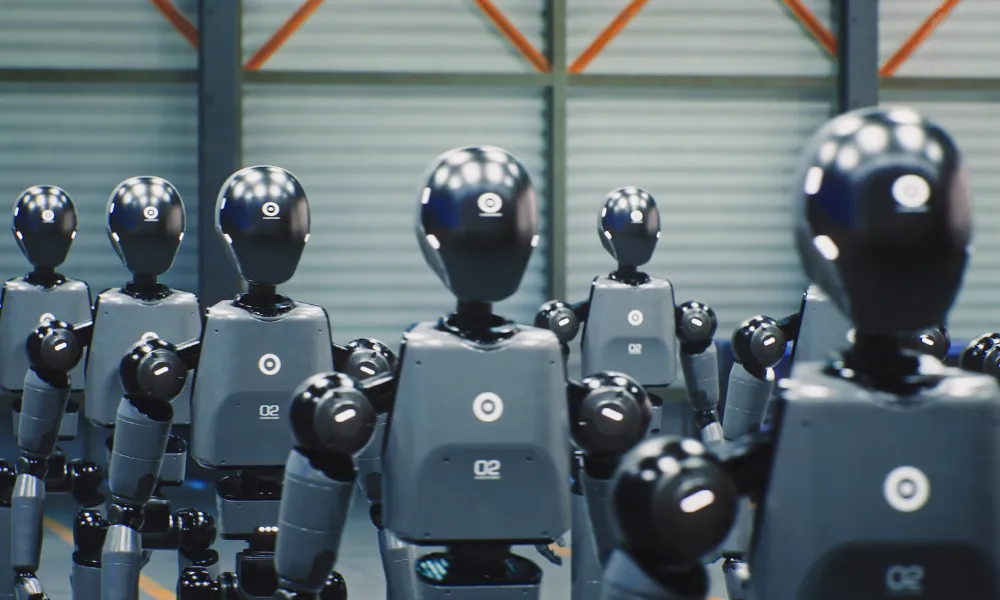

Images of weapon-carrying humanoid robots are no longer confined to science fiction, according to a Euronews report on Foundation Future Industries, a US robotics firm that builds humanoids for both commercial and military use and has already tested its Phantom robots in Ukraine.
The company's chief executive, Sankaet Pathak, told Euronews Next he expects to begin testing weaponisation options for the robots "as early as next year," building on the Ukrainian pilot programmes. Pathak pushed back on comparisons to killer-robot films, arguing that deploying a group of humanoids makes little sense if the aim is simply mass destruction, since a bomb would achieve that more cheaply. Instead, he said humanoids could gradually take on more combat roles precisely because they offer a level of precision that other weapons, including aerial bombing, cannot match, allowing a mission to be completed while limiting damage to infrastructure and harm to civilians.
Robots on the battlefield
Pathak does not expect humanoids to replace drones, but sees them filling a gap as ground combat grows increasingly dangerous for human soldiers. According to Euronews, he argued that humanoids only make sense for missions requiring precision, and described the technology as the next phase of precision warfare.
There is currently no dedicated treaty governing the use of humanoid or autonomous robots in combat, and such systems fall under existing international humanitarian law, which requires weapons to distinguish between combatants and civilians. Last week, UN Secretary-General António Guterres said his main concern was with what he called "killer robots," lethal autonomous weapons systems capable of selecting and engaging a target and taking a life without human control or judgement, according to a post on LinkedIn cited by Euronews. The UN has been negotiating a dedicated treaty on lethal autonomous weapons since 2023, with Guterres pushing for a binding ban on weapons that operate without human control by 2026. Asked about this, Pathak said he saw no reason humanoids should be treated differently from other precision weapons systems already in use, such as armed drones and unmanned ground vehicles.
The risk of AI misuse
The Phantom robots run on artificial intelligence built using the company's own world models, systems trained on video and simulation data that learn to build their own representations of physical scenes and predict how they will change over time, rather than predicting text the way large language models do.
Pathak played down the risk of AI seizing control of armed robots, telling Euronews that an AI intent on destroying humanity would be far more likely to rely on drones or nuclear weapons than on humanoids. He described the more immediate danger as what he called "AI terrorism," meaning the misuse of widely available AI models for cyberattacks, disinformation or arming consumer drones, which he attributed largely to open-source models. He said a scenario in which AI systems rewrite their own directives, improve themselves and replicate independently of large, detectable computing clusters remains several major technical steps away, estimating the industry is "probably like three, four, maybe five hops away from that."
What comes next
Even without carrying weapons, Pathak said humanoids could already serve a purpose on the battlefield in roles such as moving supplies between indoor and outdoor environments and reconnaissance, including mapping building interiors, tasks that have already been tested in Ukraine. The military trials pushed Foundation to redesign its hardware for outdoor, high-stress conditions. Its next-generation robot, Phantom 2, is waterproof and dustproof, with payload capacity rising from around 25 to 30 kilograms in the first version to about 80 kilograms, and fall tolerance increasing from 12-15 G-force to nearly 100 G-force, running on a three-kilowatt-hour battery.
Foundation's investors include Eric Trump, son of US President Donald Trump, along with Stripe and venture firm Define, among other backers. The company currently leases Phantom robots commercially for about $100,000 (€90,000) per robot per year, with military customers purchasing units at similar pricing.
Source: Euronews