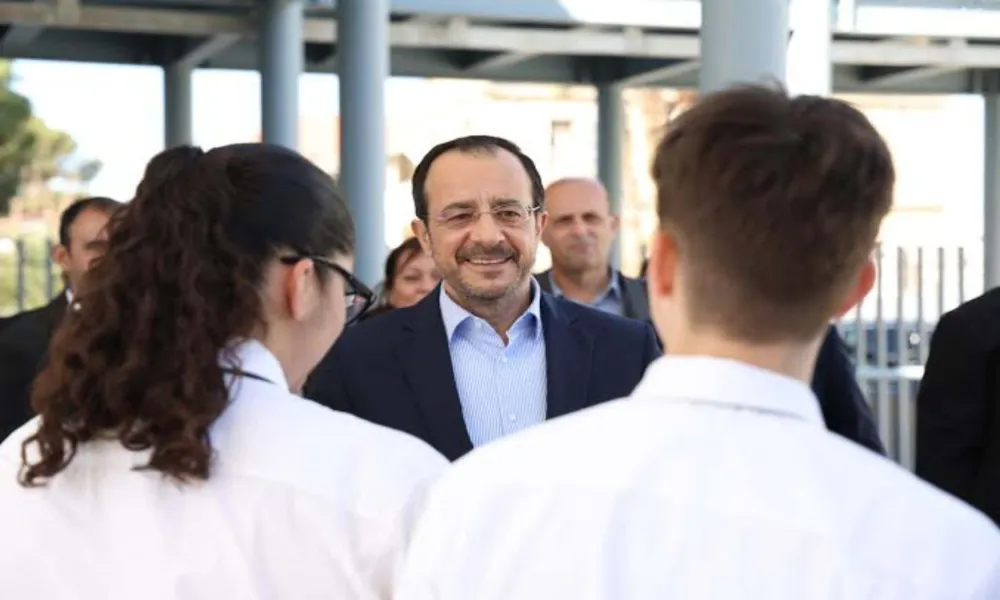

If there is one phrase President Nikos Christodoulides repeats at every opportunity, it is that "education and health are among the top priorities of our government." It is a phrase heard frequently in speeches, statements and public interventions.
The issue of healthcare can wait for another day. Let us focus instead on education.
To be fair, no one can claim that nothing has been done in education or that projects and reforms are not under way. But a government's real priorities are not measured by announcements. They are measured by actions, particularly when the time comes to allocate public spending.
That is where things become more difficult.
Take the Educational Psychology Service as an example.
Today, just 52 educational psychologists are expected to meet the needs of thousands of students across Cyprus. The ratio stands at approximately one psychologist for every 1,859 students.
And we are not talking about a service dealing with secondary issues. We are talking about children facing bullying, learning difficulties, serious health problems, disabilities, family crises and other situations that require timely intervention.
Behind these numbers are not statistics.
There are children. There are worried parents. There are teachers seeking support.
And there is a service that, however dedicated its staff may be, is forced largely into a reactive role, stepping in after problems have already emerged rather than having the time and resources to prevent them.
The most striking aspect is that the problem is not unknown.
The Education Ministry itself has acknowledged the need to strengthen the service. A plan was drawn up to recruit 60 additional educational psychologists over three years, with the aim of reducing the ratio to roughly 800 students per psychologist.
The total annual cost of the reform is estimated at around €3 million.
Yet implementation has been put on hold.
Not because the needs disappeared.
Not because circumstances changed.
But because, for the time being at least, it was deemed something that could wait.
Is the cost really so high?
Or is the cost of inaction even greater?
What is the price of a child who never received the support they needed in time?
What is the cost of a crisis that could have been prevented?
What is the cost of a family reaching breaking point because the system failed to intervene early enough?
These costs never appear in a state budget.
But society pays for them for many years.
The same picture can be seen in school infrastructure.
Important upgrades have been completed and others are under way after decades during which many facilities were neglected. Yet a recent Audit Office report serves as a reminder that needs continue to exceed available resources.
More than 500 prefabricated classrooms remain in use, including for pre-primary school children. At the same time, funding reductions have been recorded and mature projects worth millions of euros remain on the drawing board because financing has not been secured.
And one more point should be made clear.
No one expects problems that accumulated over decades to be solved overnight.
What people do expect, however, is that when a government declares education to be a top priority, it demonstrates that commitment in practice.
Because a priority is not recognising a need, developing a solution and then putting it back in a drawer until further notice.
When children are still being taught in prefabricated classrooms, when one psychologist is expected to support nearly 1,900 students, and when projects that should have been completed yesterday have not even begun, declarations alone are no longer enough.