
By Theano V. Kalavana
The government may be exhausting itself trying to convince us that the Presidency of the Council of the European Union went splendidly, but around us far more serious events are unfolding, which keep the country in stagnation. Yet, I wonder, why would the Presidency not have gone well? If nothing else, diplomacy in this kind of subject matter is one of President Christodoulides's strong points. Perhaps the only one, I would dare say! It is in the remaining subjects that he struggles, and this is attested by many and varied events of his term so far.
The NATO Summit in Ankara
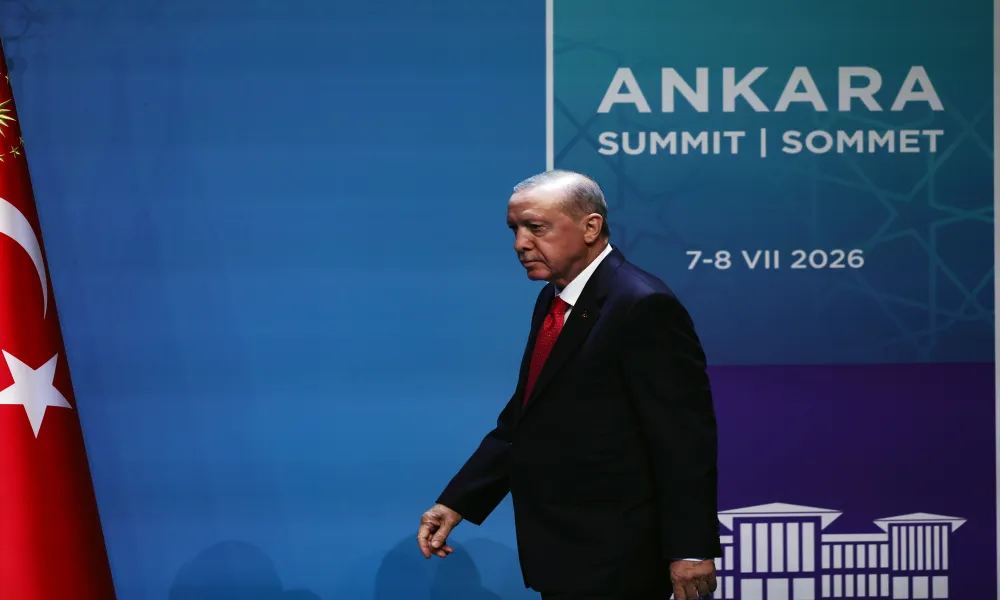
There are plenty of arguments with which to substantiate our country's inability to shape a future worthy of its potential. But I will confine myself to the most recent. The NATO Summit in Turkey. Yes, Cyprus may not be a member of NATO, but the Cyprus problem was nowhere on the agenda. The NATO Summit in Ankara was a powerful indication of the new geopolitical reality taking shape in Europe, the Middle East and the Eastern Mediterranean. The choice of Ankara as host was no accident. It is the practical recognition that Turkey has been transformed into one of the West's most critical geostrategic players, despite its constant clashes with allies, its authoritarian tendencies and its open pending matters with Greece and Cyprus.
Where did the diplomacy go?
Where, then, did Mr Christodoulides's diplomacy go? The Christodoulides Government may be investing in a strategy that links Turkey's European course to specific steps on the Cyprus problem, but the reality, unfortunately, is different, and indeed very unpleasant. Turkey's geopolitical upgrade does not by itself create incentives for concessions on the Cyprus problem. For those who have not grasped it, Ankara appears today more certain of its strategic value than at any other moment since 1974, however harsh that may sound. Turkey no longer speaks of a return to the framework of the previous negotiations. It consistently promotes the logic of "two states" and pursues the gradual international upgrading of the pseudo-state. It considers, moreover, that Turkey's growing strategic importance functions as a shield against international pressures. Turkey believes the West needs it more than it needs the West.
A failed strategy
The failed strategy of Nikos Christodoulides's diplomacy is confined to isolating Turkey and creating pressure for a solution of the Cyprus problem. And I write "failed strategy" because, what can it be when exactly the opposite of what we would want is happening? Turkey's cooperation with the EU on defence equipment is a reality; the recent NATO Summit in Ankara and the statements that followed are yet another reality. Turkey did not simply gain from the instability and uncertainty prevailing in the world. The war in Ukraine, the Israel-Iran conflict, the uncertainty over the future American presence in Europe and NATO's need to develop new defence capabilities have dramatically increased Turkey's strategic value. The country's geography makes it simultaneously a gateway to the Black Sea, the Middle East, the Caucasus and the Eastern Mediterranean.
Recep Tayyip Erdoğan now appears as the leader of a country that converses simultaneously with Moscow, Washington, Brussels, Kyiv and the Arab capitals. Turkey is no longer simply an ally of the West. It is an autonomous regional pole of power that negotiates from a position of strength with everyone. Ankara used the Summit to promote its own defence industry, to strengthen its relations with the US and to push for the lifting of restrictions on armament programmes, among them matters relating to the F-35.
A question of power balance
Turkey proved that the West needs its consent in order to proceed. How does Nikos Christodoulides intend to manage this reality? Because, for Cyprus, this means the Cyprus problem can no longer be treated solely as a problem of occupation or international law. It is, above all, a question of the balance of power within an Eastern Mediterranean that is turning into a central field of competition of the 21st century.
And in this new geopolitical environment, Nikos Christodoulides's greatest challenge is not to convince the international community that we are right. It is to find ways of restarting, but above all resolving, the Cyprus problem immediately, before Turkey's necessity is fully entrenched on the international stage. And this requires not diplomacy but boldness and seriousness in assuming responsibility for steps that prove in practice the will for a solution. From the opening of crossing points to joint projects that improve the country and build a better future for all. Only in this way can the international community take us seriously and hold Turkey responsible for implementing and applying the solution of the Cyprus problem. Otherwise we will continue to exhaust ourselves in denunciations and in strategies that bring no result, at the very moment Turkey strengthens even further its position and its necessity to the West.