The European allies did everything they could to ensure Donald Trump would be in a good mood at the NATO summit. The effort met with mixed success, but it is no longer their top priority. This year's NATO summit was the most anticipated in a long time. After five years of war on the continent and two years of friction from a confrontational White House, the time had come for Europe to prove it takes its own defence seriously.
The European countries and Canada are moving ever further away from unconditional appeasement and fear of the American President, adopting a more balanced approach. The experience of Trump's repeated threats has given them greater confidence in how they handle him, reinforced by the increase in their own defence spending.
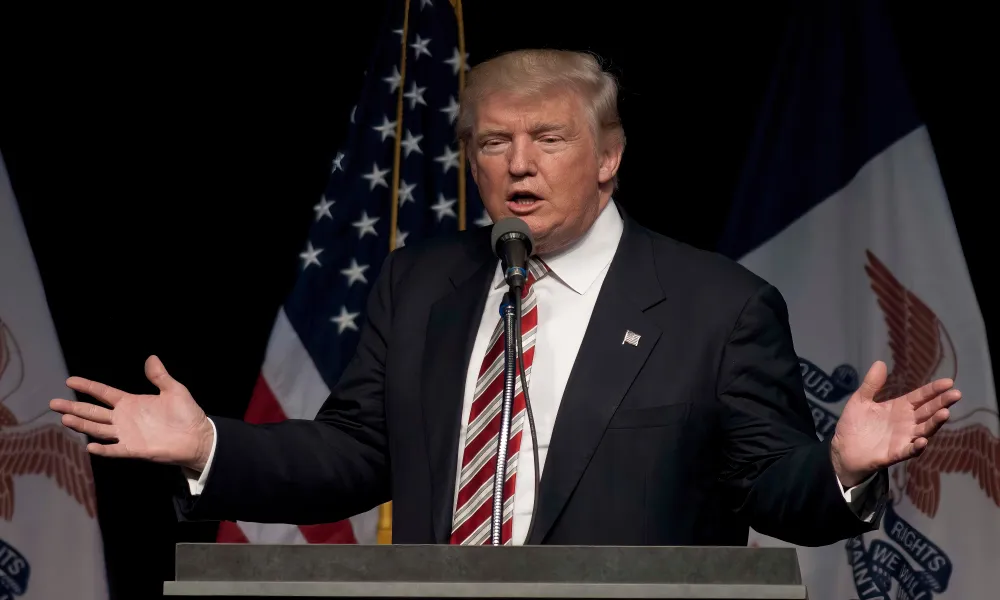
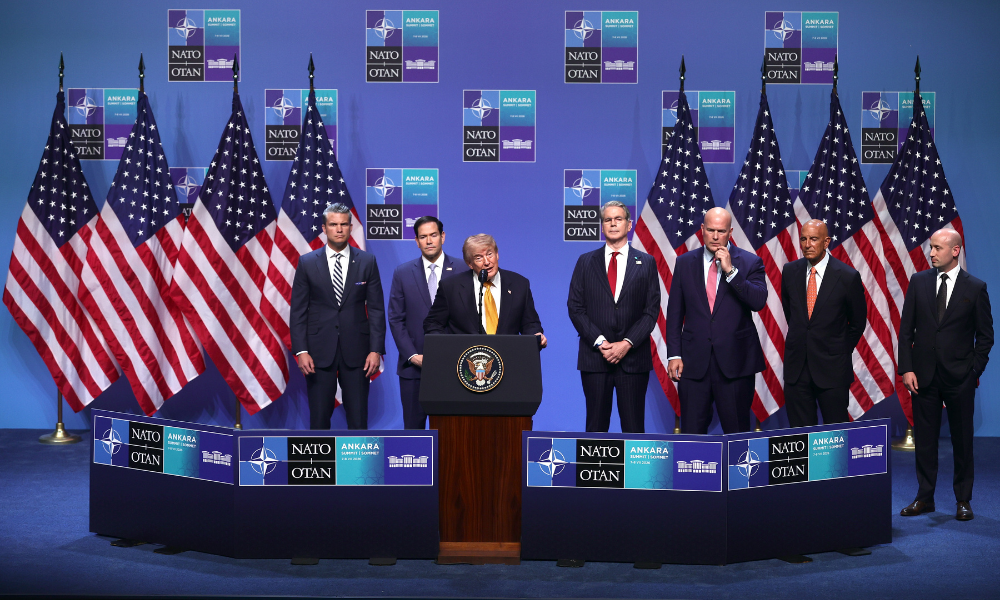
The Ankara Summit began with the whip and ended with the carrot, as Donald Trump's direct salvoes against the Alliance ultimately proved unable to tame the "tremendous love" which, in the American President's words, dominated the meeting room, and which translated into billions of dollars for new procurements of military equipment, as well as support for Ukraine, accompanied by US blessings for Patriot production in the defending country. Yet the state of elementary understanding between these uneasy allies does not erase Trump's statements that he attended the Ankara summit out of respect for President Erdoğan, and not out of enthusiasm for NATO itself.
A security situation
At the core of this change in the Europeans' stance lies a shift in the message: "We are spending more on defence for us, not for you."
"I did not come here to please Trump... If I came here, it was simply to take responsibility in the face of a security situation centred on deterrence," Luxembourg's Foreign Minister Xavier Bettel told Politico. "We did what we had to do."
"I am tired of us panicking about Trump," added a senior NATO diplomat, who, like other sources in the report, was granted anonymity to speak freely. "We have to do this for ourselves."
After a year of unprecedented pressure on the Alliance, during which Trump threatened to seize Greenland, announced plans to withdraw thousands of troops from Germany and cast doubt on NATO's mutual defence clause, the countries arrived in Ankara determined to avoid a new crisis.
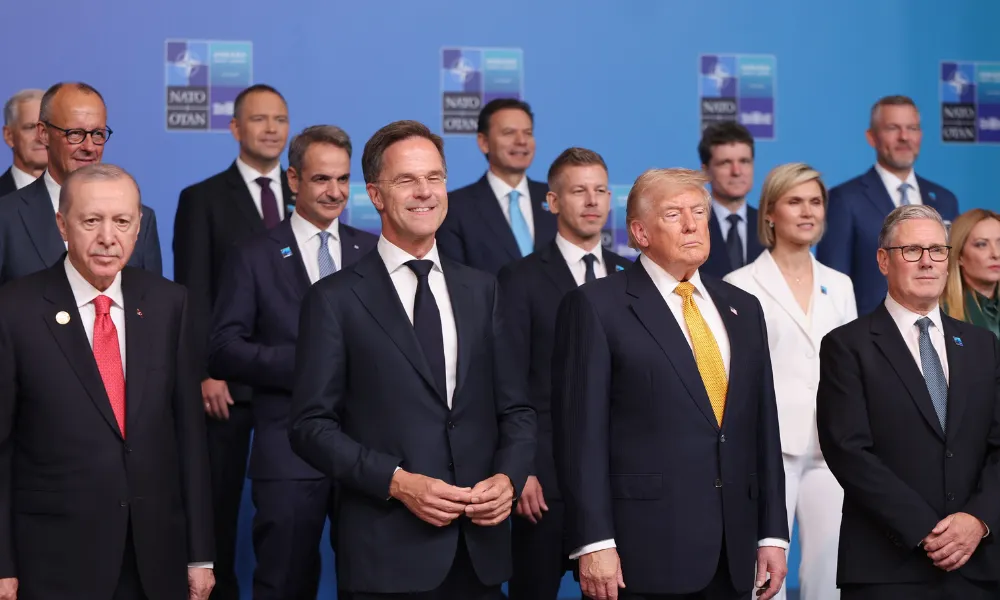
On Wednesday, the Alliance's 32 leaders approved a joint declaration committing to invest in new military capabilities, such as drones, stressing that Iran must never acquire nuclear weapons and unveiling new procurement agreements worth more than $50 billion, measures largely aimed at meeting Trump's standing demands. At the end of the summit, Trump appeared satisfied. "There is one word that characterises this day: unity," he told reporters after the meeting, calling it a "great summit" and praising the "love" the countries showed one another during the talks.
A restrained Trump
The start of the summit, however, promised greater tension. Trump unleashed his usual criticisms against allies who, in his view, do not spend enough on defence or had not assisted in the war against Iran, while reviving his old idea of American acquisition of Greenland from Denmark. "I am not happy with NATO because of what it did regarding Greenland, and I am not happy with NATO because it did not want to help us with Iran," he said, also threatening to cut off trade relations with Spain over its low defence spending.
Yet the allies were not cowed. One leader after another, including traditionally close allies of Washington such as Latvia, expressed their support for Denmark. "Greenland is an integral part of Denmark," said Latvia's President Edgars Rinkēvičs. "The red lines are absolutely clear: Greenland belongs to the people of Greenland," said Iceland's Prime Minister Kristrún Frostadóttir.
Belgium's Prime Minister Bart De Wever also criticised the American war against Iran. While the campaign is "justified" in order to prevent Tehran from acquiring nuclear weapons, he told reporters, "whether the operation was actually well planned and successfully executed is another matter; it does not appear to be unfolding particularly smoothly."
Behind closed doors, according to two people who took part in the discussions, Trump adopted a far more moderate tone towards his counterparts. He praised Poland, Germany and the Baltic states for increasing their defence spending. Although he repeated his complaints about certain countries spending too little, he made no mention of Spain nor any reference to Greenland. He nevertheless offered his own version of the summit's atmosphere. "If you could see the respect and the love that was in the room, and it really is love for our country," he said after the summit. "They like the job I am doing. They told me: 'We love you, sir, we love you.' These are grown adults saying this. Isn't that nice?"
Yet the key to the change of tone from the other allies was not so much the desire to please Trump as their growing confidence in their own capabilities.
A matter of survival
"NATO will survive with Trump, but it will often be unpleasant. For two basic reasons: first, admittedly with some validity, Trump believed and believes that NATO's 500 million Europeans and Canadians relied excessively on America and spent far too little on defence; Greece, Turkey and NATO's northeastern states are the exception that proves the rule. Second, Trump and the movement he represents have fundamental political-philosophical differences with the mindset of the European political class, which is not considered populist and nationalist enough, but on the contrary overly focused on embracing refugees and on the environment. However, Trump and especially the American people support alliances like NATO; the latest Chicago Council poll records the highest level of support for the Alliance of all time. Therefore anyone can understand, even Trump, although he will never admit it, that the US benefits greatly from and needs NATO and the European allies," James Jeffrey, former US special envoy to Syria and to the Global Coalition to Defeat ISIS, told Kathimerini of Athens.
European stature
Although he stressed the importance of the transatlantic bond at the leaders' meeting, German Chancellor Friedrich Merzargued that the increase in defence spending primarily serves Europe's own interests, according to one of the aforementioned sources. "Trump's speeches made us understand that it would be good to be able to rely on ourselves too," said Luxembourg's Bettel. "We want to acquire the necessary means, but if all this is simply about show and flattery, no, I am not here for that."
Ed Arnold, senior fellow at the Royal United Services Institute and former NATO official, said the allies' higher defence spending gives the United States less leverage. Last year, Europe and Canada increased their relevant spending by 20%, and are expected to raise it by a further 11% in 2026, according to provisional NATO figures published on Tuesday. In total, this means the other 31 allies now account for 43% of the Alliance's total defence spending.
Although the Europeans "do not want the US to leave NATO immediately," Arnold said, "there is a visible shift" compared with last year, when the allies were far more careful not to displease Trump over his criticisms of defence spending. The allies are also more sceptical of Trump's threats, following his repeated retreats on troop withdrawals and the absence of any substantive follow-through on Greenland, Arnold noted.
"Nobody was surprised" by Trump's latest criticisms of the Alliance, a second NATO diplomat agreed. "We still have to take them seriously — but people tend to take them less seriously," he said. "It is starting to resemble the tale of the boy who cried wolf."
As a result of the increased spending, Belgian Defence Minister Theo Francken told Politico that Europe will be able to assume responsibility for its conventional defence within the next "five to ten years". Describing the shift in the European stance after the summit, he wrote on social media: "While at the previous NATO summit there was still fear of Trump's wrath, this year that was far less evident. The European armed forces are strengthening quickly and dynamically. We are no longer doing it to appease Trump, but out of recovered European self-respect. This continent is our home."
A powerful player
Despite all that transpired and Europe's newfound stature, American dominance in NATO is far from over. As Nico Lange, analyst at Rasmussen Global, put it, the Europeanisation of the alliance will not become reality unless its members "replace NATO's strategic force multipliers with European ones". These include the basic military infrastructure necessary to connect troops and assets across the alliance, such as "satellite timing, navigation, airborne electronic warfare and long-range precision strikes", as he said. Lange explained that, although the leaders' general assessment is that the summit unfolded without major incident, Europe must take Trump's renewed threats over Greenland seriously and never forget his unpredictable character, as at any moment he may choose an entirely different course, damaging the alliance.
Fiott points out that, although Europe will continue to rely on the US in defence for some time, the direction, independence from the US, is clear. "We will still need the US, at least in the short term, as certain weapons are only available from there," Fiott noted. "But the direction for the long-term future is absolutely clear," he adds. "We are not going to spend European taxpayers' money without a return. And the return means jobs and European production capabilities, and I believe this is Europe's long-term path here," he told Euronews. "But it is a really good sign that the Europeans, at least on the defence production side, have understood that they must spend more and spend it wisely on capabilities."
What was agreed at the Summit
The heads of state and government of NATO member countries, including US President Donald Trump, reaffirmed their "unwavering commitment" to collective defence based on Article 5 of the alliance, in the declaration of the summit held in Ankara. In their declaration, European countries and Canada stated they are assuming greater responsibility for the alliance's defence, as the allies announced new procurements totalling more than $50 billion (€43 billion) for the production and supply of defence systems, from submarines and Patriot air defence systems to interceptors and munitions, all presented as proof that the alliance is on a credible trajectory to spend 5% of GDP on defence by 2035. NATO member countries also committed to providing Ukraine with military assistance worth €70 billion ($80 billion) for 2026and "at least equivalent levels" of support in 2027, according to the declaration.
- FIM-92 Stinger: Germany and the Netherlands plan co-production of the portable anti-aircraft system with the US.
- AIM-120C: Raytheon's medium-range missile will be built by a consortium of Belgium, Canada, Finland, the Netherlands, Norway and Germany.
- PAC-3 Patriot: The costly interceptor missiles of the Patriot anti-missile system are to be jointly manufactured by Germany, Poland, Sweden, the Netherlands and the US, under contract with Lockheed Martin.
- Battlefield missile initiative: America's Lockheed Martin and Germany's Rheinmetall plan the joint construction of ATACMS missiles, with an effective range of 300km, which have proven their worth in the war in Ukraine.
Among the most significant announcements was NATO's decision to select the Swedish company Saab to build surveillance aircraft that will replace the early warning and control system (AWACS), currently operated with American Boeing aircraft. In addition, NATO's Drone Hedge programme commits $40 billion (€35 billion) to counter-drone capabilities over the next five years, covering the entire alliance. It also focuses on recruiting and training pilots and will be fully interoperable across all member states. "Drones have, as we all know, profoundly changed the character of modern warfare," NATO Secretary General Mark Rutte told the Defence Industry Forum on Tuesday. "They have evolved into a decisive factor on the battlefield. This is clear from what we are seeing in Ukraine, in the Middle East and across the alliance."
Sources: The Guardian, Politico, Kathimerini