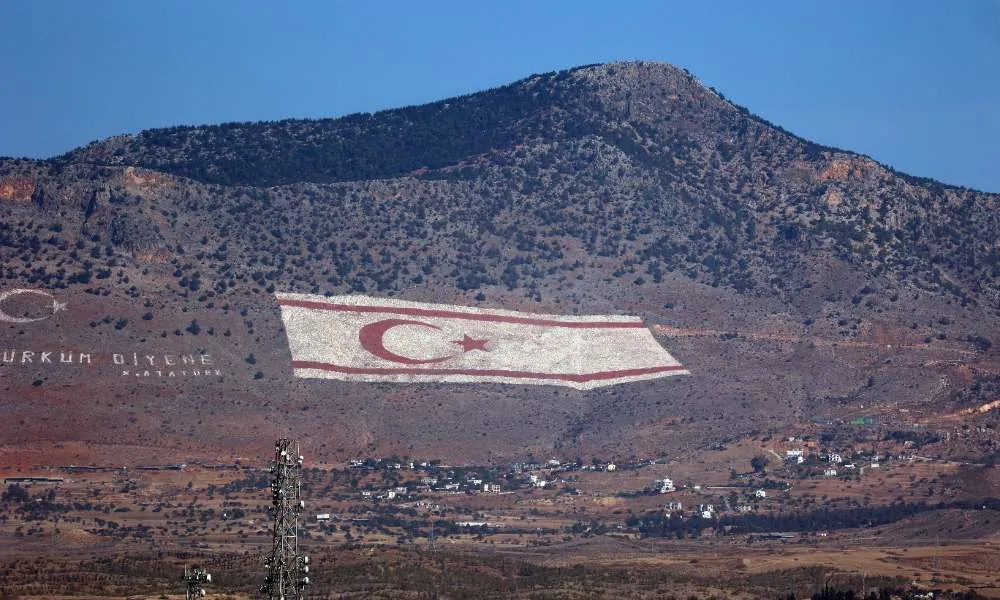
I will not lie, it is a strange feeling to hear about a Turkish Cypriot who designed the flag of the occupation regime.
During the first two days after the issue gained attention, I received various messages and had several conversations.
"First of all, we need to decide where we stand. He is a Turkish Cypriot who supports the occupation regime if he designed that infamous flag. We cannot support such views. We will lose our argument, which is reunification," people told me.
And they are right.
I cannot support Greek Cypriot nationalists, nor Turkish Cypriot nationalists.
However, we forget that at that time, roughly ten years after the Turkish invasion, communication was difficult. There was none of the exchange and contact that exists between the two communities today. The crossing points opened in 2003 and today, 23 years later, there are still relatively few people, compared to our population, who feel the need to meet and coexist with Turkish Cypriots.
As a young person, I recognise that many young Cypriots, especially those living far from the Green Line and far from the flag on Pentadaktylos, do not particularly feel the need to see or experience our occupied areas. Someone has to cultivate that need in you. A voice, an influence, a current of thought. The inherited trauma of displacement is not enough.
This Turkish Cypriot, then, I assume in his youth felt a need to provoke and shake things up.
Searching through the Politis archive, I found a reference to an exhibition he held at the Church of Panagia Potamitissa in Kazafani. At the time, Politis wrote:
"Everything would have been well and good if the exhibition had not taken place in an Orthodox Christian church that the occupation regime had turned into a gallery."
I do not entirely share that view. Old churches nowadays, or at least abroad, are spaces that communities use according to their needs, including for cultural events.
To pre-empt the crusaders of nationhood and Christianity, however, in 2025 the carved iconostasis and surviving wall paintings of the church were conserved through the Bicommunal Technical Committee on Cultural Heritage, in which Turkish Cypriots also participate.
From an old document I found on his website, it appears that his work The First Supper reinterprets The Last Supper, accompanied by a text stating:
"In this coexistence there is no traitor."
It continued:
"Let every figure become a memory of your shared journey, a sequence of sacred messages. If you intend to hide your shame on your face, your feet will betray you. Let your bare feet become the symbol of a difficult journey."
To me, this is probably a reference to the difficult journey of our island, the "sacred" messages we exchanged, and ultimately to the betrayal of this place in a broader sense.
Of course, everyone is free to interpret it differently.
A few years later, however, his concern for this island reappears in a work included in a bicommunal artistic initiative organised during the visit of then UN Secretary-General Kofi Annan to Cyprus.
In 2003, ahead of the referendum on the Annan Plan, Emin Çizenel created the work The Chosen Tree, a Candle for Peace, in which he outlined the idea for a symbolic artistic intervention that would take place on the day the agreement reunifying the island was signed.
According to his proposal, one of the cypress trees of Bellapais Abbey would be covered with fabric and illuminated from below with an intense red light, symbolically transforming it into a "candle for peace". At the same time, a new anthem for Cyprus and the anthem of the European Union would be played.
Today, the work is part of the Costas and Rita Severis Foundation Collection and was presented in August 2024 as part of the Sneak Peek series.
In 2004, in the Politis archive, Çizenel wrote about Greek Cypriot artist Andreas Charalambous.
Among other things, he wrote:
"I had always heard people talking about Andreas as an artist. Then one day we met and got to know each other in a foreign country. In Sweden. On an island in Sweden, in the Baltic Sea. We were far away from the Mediterranean, but our conversations about our shared destiny were as warm as the Mediterranean itself. With artistic sensitivity we shared many things, spoke about what happens around us, its explanations, its meaning, or even the lack of meaning. As I observed all those elements that so strongly reflected the merging of his artistic and Cypriot identity, our friendship kept growing."
In 2007, Gallery Argo hosted an exhibition by Çizenel, from which the Republic of Cyprus acquired the work A Lost Moment, which is currently on display at NiMAC.
The press release published at the time in Politis stated that the work dealt, as its title suggests, with the concepts of time and memory.
"Every meaning associated with any object or any scent is an instinctive escape into time, into the time we spent with it," the artist said.
Seeking to redefine the things he remembered, Çizenel recorded on the gallery walls a commentary on the current situation.
"In a single word and with immediacy he describes the place as 'an island in the eastern Mediterranean', the material to be consumed as 'jasmine,' the military situation as 'ceasefire', the political reality as 'government in crisis,' and the political climate as 'romantic.'"
The press release added:
"As a summer evening disappears into the night... perhaps we cannot return to lost time, but we can locate it."
It concluded by noting that in 2005 the artist participated in a parallel exhibition held along the Green Line.
In 2009, there is another record of his bicommunal participation, this time in an initiative by the UN Secretary-General's Special Adviser on Cyprus, Alexander Downer.
In 2015, he was among those selected by the two community leaders to form the Bicommunal Technical Committee on Culture.
He was appointed, naturally, by the then Turkish Cypriot leader Mehmet Ali Talat. However, the mission of the committee was, and remains, to bring the two communities closer through culture.
During Çizenel's participation, bicommunal theatre and musical productions took place in venues such as the ancient theatre of Salamis and Othello's Tower in Famagusta.
In addition, he served on the committee when approximately 200 works of art were returned from the occupied areas to the Greek Cypriot side, while the latter provided audiovisual material from the CyBC archive to the Turkish Cypriot community.
In 2024, Nikos Chr. Pattichis chose to include one of Çizenel's works in what was perhaps one of the largest exhibitions ever held in Cyprus.
The exhibition was staged in the old Carob Warehouses at Limassol's former port area, where the PSI Foundation now operates.
At the time, art historian Thaleia Stefanidou said:
"An essay-like approach with clear references to the history of Cyprus and its national imaginary is constructed through the exhibition Casts of an Island 2024."
In 2026, the artist's work A Lost Moment left the storage facilities of the State Collection and was installed at NiMAC (Nicosia Municipal Arts Centre, in collaboration with the Pierides Foundation).
At this point in time, personally, I feel that the title A Lost Moment, like the work itself, speaks about that lost moment which keeps repeating itself.
A lost moment to understand that, whatever happened on this island, however many opportunities have been missed, however many mistakes have been made, if we still seek the reunification of the country we will live alongside people we may not like, people we do not know, people who have hurt us and hurt this homeland.
One more observation, and I thought about it carefully, so thank you to the person who sent me the message.
The flag placed on Pentadaktylos is a wound in our hearts, at least for many Greek Cypriots. It is also a wound on the mountain itself. It has genuinely caused environmental damage to Pentadaktylos.
However, if Çizenel has spoken about reunification and demonstrated it through his bicommunal work, then what more do we want?
Half a century has passed and the Cyprus problem remains unresolved.
In recent weeks, some have spoken of a final opportunity for a Cyprus settlement. What I would not want to see is the expectation that we will remain exactly the same if that long-desired solution arrives.
In any case, he was not afraid to say in his final interview, in 2025, with ArtDog Istanbul, that the Turks of Cyprus — the Turkish Cypriots — have a different identity from those who live in Turkey, while criticising the way they have been treated for so many years.
Perhaps it would be better if we directed more criticism towards the leaders and political officials of this island instead of demanding an explanation for why an artist designed a flag 43 years ago.