
Cyprus remains one of the most earthquake-prone areas of the Eastern Mediterranean, yet the true picture of how its buildings would withstand a major seismic event remains unknown.
In an interview with Politis, ETEK secretary-general and civil engineer Andreas Theodotou explains that most of the country's building stock was constructed before 1994, when modern seismic regulations were introduced, and that no comprehensive or systematic evaluation process has been carried out to date.
As a result, he says, neither the real level of risk nor effective prevention policies can be properly assessed.
High-risk buildings
According to Theodotou, there is currently no registry recording the condition of buildings and no clear picture of how many should be classified as high risk.
Available information, he says, is fragmented and comes mainly from complaints by citizens or isolated engineering assessments.
The absence of reliable data is, in itself, a serious problem. Safety, he stresses, cannot be based on assumptions but on documented knowledge.
Particular concern surrounds buildings erected before 1994, which were designed according to different standards regarding earthquake protection.
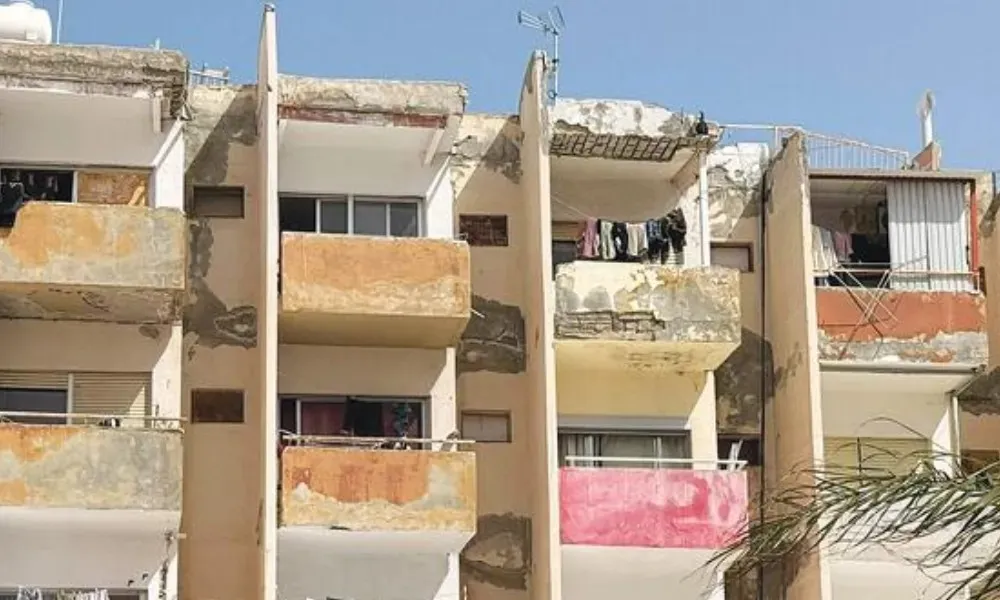
He notes that the age of a building is not, by itself, a problem. What significantly increases risk is the combination of age, insufficient maintenance and older construction practices.
In Cyprus, he adds, the overwhelming majority of buildings are not adequately maintained.
Asked about major European cities where apartment blocks are often 40, 50 or even 60 years old, Theodotou replied that age itself is not the enemy.
Many European countries operate strict periodic inspection programmes that keep older buildings safe.
More important, he says, is the culture of maintenance demonstrated by owners themselves.
"The issue is not to demolish history but to maintain it and evaluate it systematically."
Even greater concern, he says, surrounds pre-1994 multi-storey apartment buildings with open-ground parking areas or commercial premises at ground level, the so-called "soft-storey" configuration, which is considered one of the most vulnerable designs during a strong earthquake.
Preventive inspections
ETEK is once again calling for the introduction of mandatory pre-seismic inspections, arguing that the state continues to act more reactively than preventively.
The chamber has for years advocated a Building Inspection Certificate that would identify dangerous structures before problems become critical.
However, the effort failed to progress because of bureaucracy, implementation costs and a lack of political will.
Theodotou notes that the process was effectively frozen at the end of 2025 when the District Local Government Organisations refused to assume responsibility for managing jointly owned buildings.
Electronic platform
According to Theodotou, the first and most important priority is the creation of a comprehensive record of Cyprus' building stock.
Only through reliable data, he says, can the country design a national programme of pre-seismic inspections and secure European funding for seismic upgrades, similar to the support made available for energy-efficiency improvements in buildings.
As part of this effort, ETEK is developing an electronic platform for recording dangerous buildings, which will function as a digital identity for every structure.
"The platform aims to create a common language: a building identity registry indicating whether a building is fully or partially habitable, its level of risk and whether a standardised visual inspection form has been completed," Theodotou says.
Citizens will be able to view the condition of a building in a structured manner, while authorities will, for the first time, have a comprehensive, geographically mapped picture of risk.
"It is a first but important step from fragmented information to systematic management."
Warning signs that should not be ignored
Theodotou urges property owners and apartment-management committees not to rely on a building's outward appearance.
Structural and seismic adequacy, he stresses, cannot be assessed through visual impressions alone.
Cracks in structural elements, visible corrosion of reinforcement, ground settlement, severe moisture damage and structural deformations are all warning signs that require immediate examination by a civil engineer rather than simple cosmetic repairs.
Asked who bears responsibility when an ageing apartment block develops serious defects but no action is taken, Theodotou says responsibility legally rests with property owners.
In practice, however, without a mandatory inspection framework, responsibility is often diffused and nobody acts until something serious happens.
"This is the gap legislation needs to close," he says.
The law should clearly specify who is required to commission inspections, within what timeframe and what consequences arise from non-compliance.
"Today, the absence of such a framework leaves many buildings in a grey legal and practical area."
Even a properly designed building, he explains, can become dangerous if reinforcing steel corrodes, if leaks degrade the concrete or if unauthorised alterations are made, such as removing walls without an engineering study.
"Maintenance is not a luxury; it is part of structural safety."
He notes that owners frequently remove load-bearing or non-load-bearing elements to create more space without realising they are changing how the entire building will behave during an earthquake.
Schools and hospitals
Turning to public infrastructure, Theodotou says extensive inspections have been carried out in schools in recent years, while an evaluation programme for state buildings is currently under way.
"Hospitals, and more generally buildings where large numbers of people gather, should be the first priority in any national pre-seismic assessment programme, because the social cost of a possible failure would be incomparably greater."
Theodotou concludes by stressing that maintenance is an inseparable part of structural safety and warning that, without systematic assessment, no one can say with certainty how prepared Cyprus is to withstand a major earthquake.