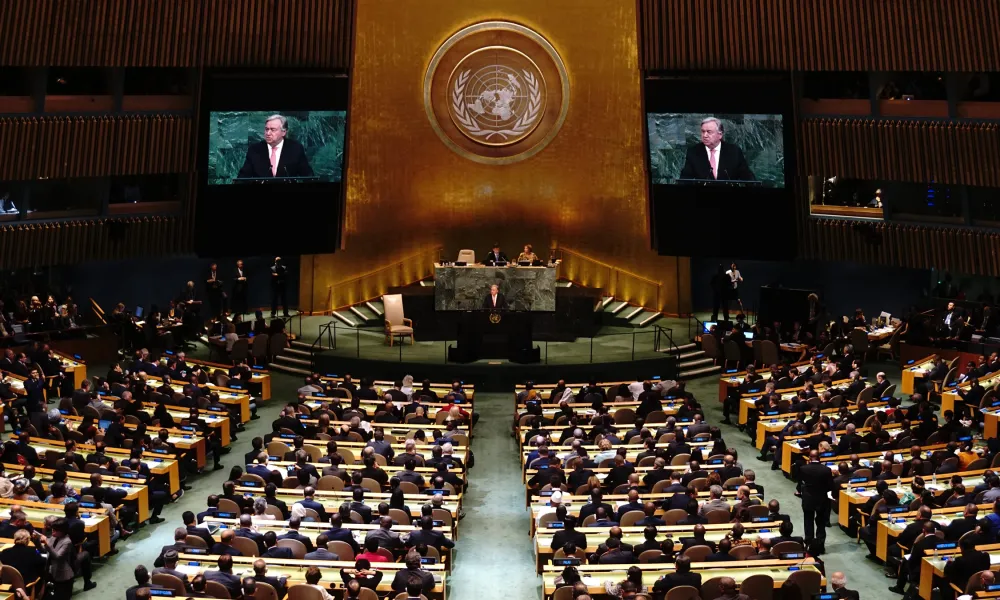

The ninth informal United Nations Security Council straw poll ended without agreement on a successor to Antonio Guterres as UN secretary-general, despite renewed support for Costa Rica's Rebeca Grynspan. Greece also participated in the process as an elected member of the Security Council.
Grynspan once again secured the highest number of positive votes, but her candidacy was opposed by two of the Council's five permanent members. Guterres' second term expires on 31 December, and no date has yet been announced for the Security Council's formal recommendation to the General Assembly.
Results of the ninth informal ballot
While Grynspan was again the only candidate to surpass the nine-vote threshold required in a formal Security Council vote, opposition from two permanent members continued to block her path.
All eight candidates received at least two negative votes from permanent members, leaving the race deadlocked, with no candidate currently commanding the support needed for a formal recommendation to the General Assembly.
Where the process stands
The Security Council remains at the informal voting stage.
Following the ninth round, the United States Permanent Representative to the United Nations, Ambassador Mike Waltz, said candidates who had failed to secure sufficient support should consider withdrawing so that the Council could focus on a smaller field of contenders.
Diplomats who spoke to Reuters assessed that the latest outcome increases the possibility that the post could temporarily become vacant.
What happens if Guterres' term ends without a successor
If no successor has been appointed and no transitional arrangement has been agreed by 31 December, the position will become vacant on 1 January 2027.
The UN Charter does not provide for the automatic extension of Guterres' term or the automatic succession of the deputy secretary-general. The resolution establishing the deputy secretary-general's post stipulates that the deputy's term may not extend beyond that of the secretary-general.
Among the transitional options identified by the 1 for 8 Billion initiative are a short extension of Guterres' term or the temporary appointment of an individual to perform the duties of secretary-general following a recommendation by the Security Council and a decision by the General Assembly.
The Security Council and the General Assembly could continue to meet even in the event of a vacancy in the post.
Historical precedents
In 1950, the Security Council informed the General Assembly that it was unable to agree on a recommendation for the post of secretary-general. On 1 November, the Assembly adopted Resolution 492 (V), deciding that the UN's first secretary-general, Norway's Trygve Lie, would remain in office for another three years.
The decision was taken without a Security Council recommendation and concerned the continuation in office of an incumbent secretary-general. Lie resigned in 1952 and remained in office until Dag Hammarskjöld assumed the post in April 1953.
A genuine vacancy occurred in 1961. Hammarskjöld was killed in an air crash on 18 September while serving his second term. On 3 November, approximately six weeks later, the Security Council adopted Resolution 168 recommending the appointment of U Thant of present-day Myanmar as acting secretary-general. The General Assembly unanimously appointed him the same day to complete the remainder of Hammarskjöld's term.
In November 1962, U Thant was formally appointed secretary-general.
A different transitional solution was adopted in 1966. On 28 October, the Security Council recommended a short extension of U Thant's term, and on 1 November the General Assembly unanimously approved his continuation in office until the end of its regular session. On 2 December, following a new recommendation from the Council, the Assembly appointed him to a new term ending on 31 December 1971.
The temporary extension allowed him to remain in office while consultations continued.
In 1981, agreement on a new secretary-general was reached only in December after a series of inconclusive informal ballots, echoing the current deadlock. The Security Council recommended Peru's Javier Pérez de Cuéllar on 11 December, and the General Assembly appointed him on 15 December. He assumed office on 1 January 1982, immediately after the end of Kurt Waldheim's term.
Source: Athens-Macedonian News Agency (AMNA)