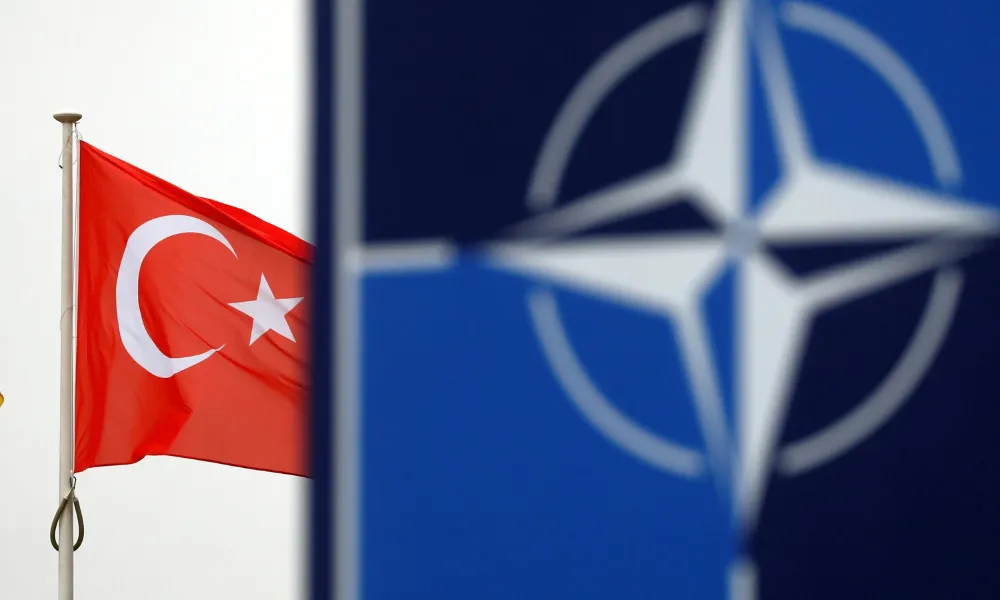

Preparations are proceeding at a fast pace for the NATO Summit in Ankara, with the leaders of member states expected to meet on 8 July.
According to Turkish newspaper Hürriyet, attention is focused on the visit of US President Donald Trump, who is expected to arrive in the Turkish capital accompanied by a delegation of around 1,000 people.
Trump's arrival and the Erdoğan meeting
From 7 July, American aircraft are expected to land in Ankara in succession, carrying personnel, equipment and the security vehicles of the US president.
A day before the meeting of NATO leaders, Trump is expected to pay an official visit to Turkey and be received at the Presidential Palace by Tayyip Erdoğan.
The two presidents are expected to hold an initial one-on-one meeting, followed by talks involving their respective delegations. A joint press conference has not been ruled out.
According to the report, the question of approving the sale of engines for Turkey's KAAN fighter jet is also expected to be raised in Ankara, with the Turkish side hoping for a related announcement from the American president.
Trump will bring his special presidential vehicles and helicopter to Turkey. The presidential helicopter is expected to be transported disassembled by aircraft and reassembled in Ankara by American technical teams.
Plans are also being made for the US president to be welcomed by children, while soldiers wearing uniforms symbolising the "16 great Turkish states" of history will line up during the official ceremony at the Presidential Palace.
The agenda for the Erdoğan–Trump meeting is expected to be particularly broad, with cooperation in security and the defence industry as the first item. Among the topics expected to be discussed are the supply of engines for the KAAN fighter jet, Turkey's return to the F-35 programme, the American CAATSA sanctions, new joint procurement and defence programmes, Turkey's security demands in Syria, the actions Ankara expects from Washington regarding the PKK and the YPG, and the American military presence in the region.
The discussion is also expected to cover the process for a ceasefire in Gaza, tension between Israel and Iran, the war between Russia and Ukraine, security in the Black Sea, and cooperation within NATO.
The expectation in Ankara is that the meeting will not be limited to managing existing differences, but will lead to strategic decisions shaping a new period in Turkey–US relations.
What the summit communique is expected to say
A large number of bilateral meetings are expected to take place at the 8 July summit. According to Hürriyet, the final communique is expected to underline commitment to Article 5 of the NATO Treaty, under which an attack on one ally is considered an attack on all, along with an assessment of the Alliance's main threats, including references to terrorism and Russia. It is also expected to highlight a commitment from European countries to take on a greater share of the defence burden, the goal for each member state to spend 5% of GDP on defence and security-related expenditure by 2035, increased production of weapons, ammunition and military equipment, the development of infrastructure, cybersecurity, critical facilities and military logistics, and the financing and management of support for Ukraine.
The aim is to reach agreement on building a broader defence industry ecosystem that combines military power, infrastructure, production and technological security.
One of the most notable features of the Ankara summit is that the defence industry is, for the first time, placed so prominently at the centre of a NATO leaders' meeting.
Turkey's push in European defence
For Turkey, this is considered particularly significant. Ankara argues that over the past 20 years it has developed substantial production capacity in the defence sector and is among the few countries able to respond immediately to the Alliance's increased needs.
On the European agenda are increased production, the creation of new manufacturing lines, new financing models and the development of joint defence programmes. The Turkish position is that European defence plans should complement NATO rather than create alternative structures that compete with or replace the Alliance. Ankara is also calling for NATO allies that are not EU members to participate on an equal footing in European defence initiatives, effectively putting forward its demand for full participation of the Turkish defence industry.
One phrase expected to dominate the summit is "burden sharing". The United States has for years called on its European allies to take on a greater share of responsibility for their own defence. Turkey, however, argues that the issue should not be limited to the level of military spending alone. According to Ankara's approach, genuine burden sharing means more production, new investment, the assumption of military responsibilities and the development of real operational capabilities. Turkey is seeking to present itself not simply as an ally protecting NATO's eastern flank, but as a country that can help shape the Alliance's future in security, production, diplomacy and strategy.
Particular importance is also being placed on the NATO Defence Industry Forum, which will take place on the morning of 7 July, with the participation of Alliance officials and senior defence company executives.
Sideline diplomacy on the summit's opening night
The first evening of the summit is expected to bring intense diplomatic activity, with three separate high-level meetings taking place simultaneously. The first will be a working dinner for foreign ministers under the NATO–Ukraine Council. In the second, NATO defence ministers will meet with representatives of the so-called Asia-Pacific Group, comprising Japan, South Korea, Australia and New Zealand. At the same time, Tayyip Erdoğan and his wife, Emine Erdoğan, will host a reception in honour of the leaders. Alongside NATO leaders, the Ukrainian president, the heads of EU institutions and the leaders of Asia-Pacific partners have been invited to the reception. These informal contacts are considered particularly significant, since brief conversations on the sidelines of international summits can often pave the way for negotiations that last for months.
Source: CNA