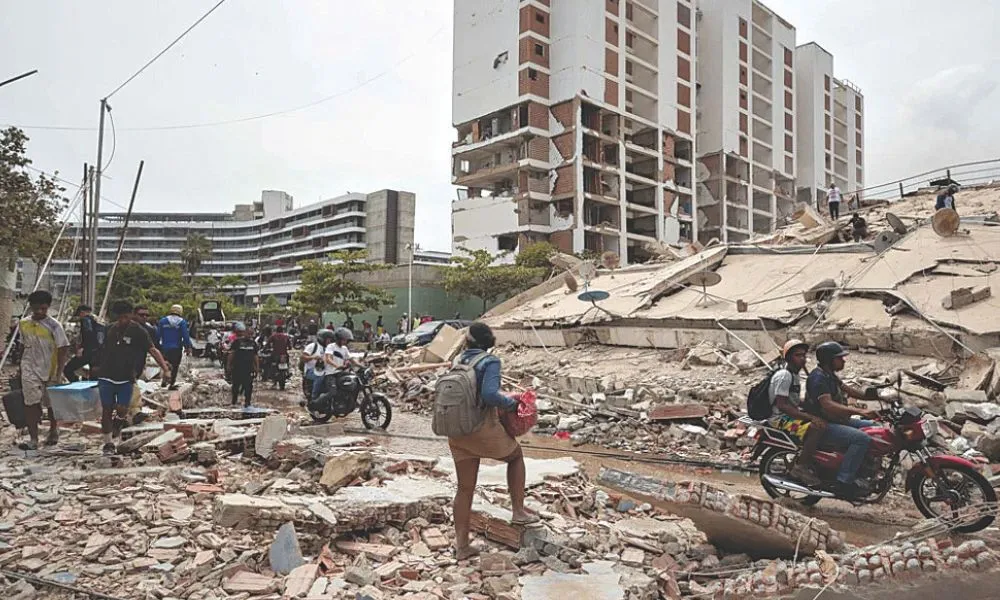

On Saturday night, exactly 72 hours after the twin earthquakes that devastated northern Venezuela, the so-called golden rescue window came to an end. The head of the Swiss rescue team, Sebastian Ohlgster, told Reuters: “There is a window of about three days, 72 hours, after which the likelihood of finding people alive decreases dramatically.” Nevertheless, rescue operations did not stop. By evening, 33 trapped survivors had been pulled alive from collapsed buildings, with American and French teams continuing to work in high-rise apartment blocks in La Guaira. Interim President Delcy Rodríguez posted a video of a man rescued after 106 hours trapped beneath the rubble, writing: “At these hours, every life is hope for Venezuela.”
Diana and Juan David
Among the rescues that moved people around the world was that of Diana Patiño and her 18-day-old baby. She was in the kitchen of her eighth-floor apartment in La Guaira when the two earthquakes struck. “I felt as if I was flying. Then I felt as though I was sinking into water and earth,” she told the BBC. She was trapped beneath furniture, with her left leg pinned under concrete, but she never let go of her baby for a single moment. “As long as he was alive, I would stay alive too. Every now and then I touched his nose to make sure he was still breathing.”
She decided not to shout into the void in order to conserve her strength. When she eventually heard her brother calling her name, she shouted with all her strength: “I’m here.” He replied: “I found you, and I promise I won’t leave until I get you out.” Their rescue was completed on Thursday night. Little Juan David suffered only minor injuries. Her husband, Gerson, who survived by jumping over a fence at the moment the earthquake struck, described the moment he saw them alive: “I felt life returning to me.”
Anger and Desperation
It was not only the rubble that hindered rescue operations. In Caraballeda, residents angered by what they described as the passivity of military personnel forced them to pick up shovels and start digging. “A general arrived with twenty armed soldiers and they sat in a corner,” said 26-year-old volunteer rescuer Alexander Mihares. Volunteers from all over the country arrived on their own carrying supplies and equipment, but the government imposed special permits for entry into La Guaira. “You need to be given permission to go and save lives,” said an outraged 27-year-old Carlos Itriago.
The Toll
More than 1,500 people have lost their lives and over 3,000 have been injured, with National Assembly President Jorge Rodríguez describing the earthquake as “the worst natural disaster in Venezuela’s history.” Around 51,000 people remain missing, while independent databases have recorded as many as 68,900 missing-person reports submitted by families. Material damage is estimated by the United Nations Development Programme at $6.7 billion, an amount equivalent to 6% of the country’s GDP.
Of the 24 countries that have sent assistance, 2,741 rescuers and 86 teams with trained search dogs have been deployed. At Simón Bolívar Airport, 100 members of the US Air Force are working to restore operations in order to remove one of the critical obstacles affecting the flow of humanitarian aid.