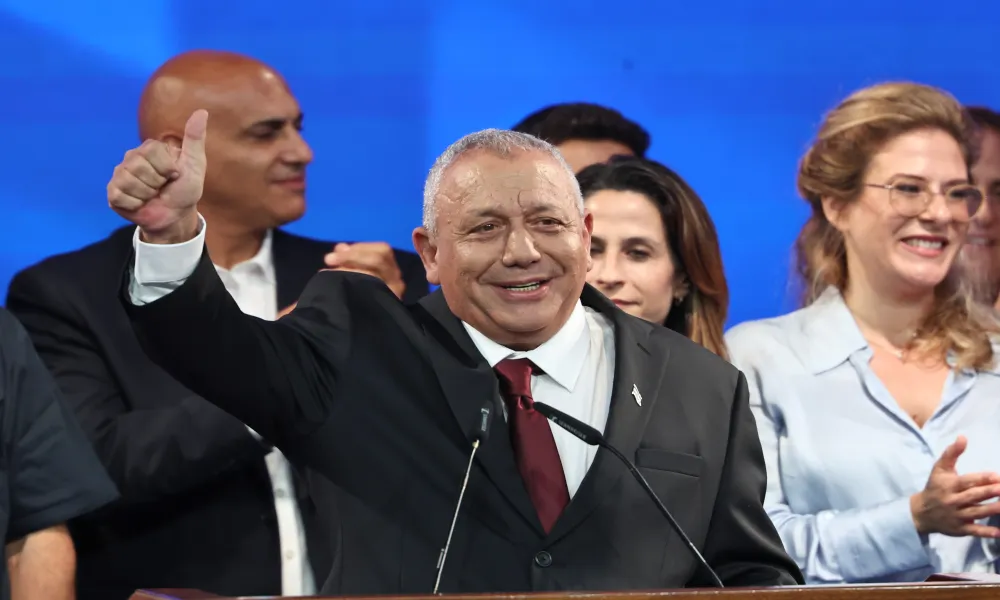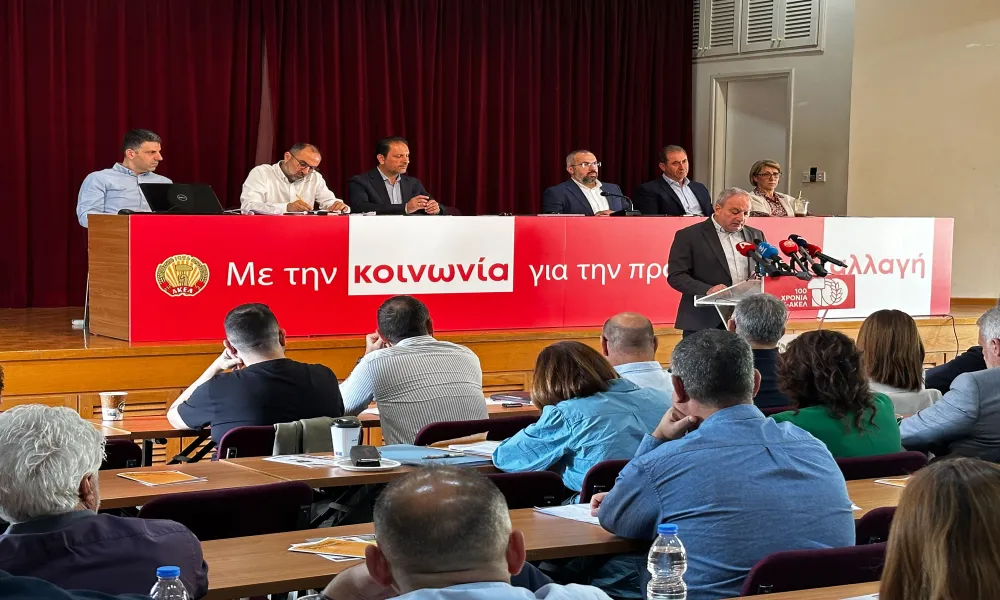

Akel’s central committee approved on 31 October the political framework with which the party will contest the presidency in February 2028. General Secretary Stefanos Stefanou called it “progressive change” and set it out in seven pillars: a solution to the Cyprus problem, a stronger welfare state, the isolation of the far right, a new economic model with an environmental dimension, protection of strategic infrastructure from being sold off to foreign capital, the restoration of the rule of law and a multidimensional foreign policy. He described cooperation with other forces as the only way forward, contrasting the “easy” path of going it alone with the “difficult” one of seeking alliances for a broad progressive front. It remains to be seen whether the parties Akel is addressing, Edek, the Greens, Alma, Volt and Direct Democracy, can stand under this umbrella, or in other words fit into Akel’s suit.
Natural allies, divided by the Cyprus problem
For Yiannos Katsourides, associate professor of comparative politics at the University of Nicosia, the starting point is simple. Akel has a natural ideological affinity with social democratic and green parties. On the left-right axis, the role of the state in the economy and institutional questions, the left and social democracy speak a common language, he told Politis. Socioeconomic and environmental issues bring Akel close to Edek and the Greens, as do questions of identity and individual rights. With Edek, the closeness also has historical depth, reaching back to the resistance against the 1974 coup.
The picture changes once the national question is on the table. According to Katsourides, the unresolved Cyprus problem distorts ideological affinities, and the tension with Edek’s more nationalist profile and the Greens’ stance on the Cyprus problem goes back a long way. The Greens, he explained, were founded largely by figures from Edek, Diko and Disy rather than from the left, which is why on national issues such as the Cyprus problem they diverged from the more progressive European Greens. In May 2015, on the proposal of its then newly elected leader Marinos Sizopoulos, Edek’s central committee decided unanimously that it does not accept a bizonal, bicommunal federation as either the name or the content of a solution. If that position does not change under the new leadership, Katsourides believes, an understanding will not be easy. He also notes a gap on migration, where Akel takes a more open stance and Edek and the Greens a more exclusionary one.
Akel reads the contradiction differently. Party spokesman Haris Polycarpou told Politis that Edek is part of the government of a president who declares his commitment to the agreed basis for a solution. The framework drawn up at Akel’s headquarters, however, asks for more than a declaration. In his address, Stefanou noted that at this stage, supporting a bizonal, bicommunal federation with political equality is no longer enough on its own, and that the negotiating acquis must be safeguarded and the Guterres Framework put to use.
People over ideology
With the newer parties, the ideological scales are less helpful. In Odysseas Michaelides’ Alma, Katsourides sees common ground on corruption, the rule of law and the party’s opposition stance, issues on which Akel could justify a partnership, as well as its acceptance of a mixed economy. The main differences lie in Michaelides’ framework for the Cyprus problem and his more right-leaning economic outlook. As for Fidias Panayiotou’s Direct Democracy, he says there is nothing ideological bringing it close to Akel, since its voters rally around a method of participation rather than a programme, so any convergence there would be more opportunistic and based on the candidate. With Volt, there is convergence on progressive thinking and social policy. Among the new formations more broadly, however, he notes that ideological convergence counts for less, as they are shaped more by their members, some of whom have a background in Disy, Diko or elsewhere.
Policy first, names later
At Akel’s headquarters, they insist the order will not change. Polycarpou explained that the outline of positions is being built during this period, with the party’s policy groups analysing it issue by issue, while the results of contacts with other parties will be discussed in the party’s bodies, where partners’ input will be incorporated as far as possible. The core direction, he said, goes beyond a single definition. Agreeing on a bizonal federation is not sufficient by itself, as partners also need to agree on how to move forward from there. Names will be put on the table only if there is found to be room for convergence, and the assessment will be made as a whole, not on the basis of public statements by individual officials. He did not rule out a fundamental disagreement emerging during private consultations. As for Diko, if its leadership persists with statements leaving the door open to cooperation with the far right, there is no room for discussion at all.
That condition rests on one of the framework’s seven pillars. Stefanou warned in his address that the prospect of Elam formally entering government is now visible and that progressive forces have “a historic duty to cooperate to isolate the far right”. Akel is also calling for what it describes as the doctrine of attachment to the governments of Israel and the United States to be replaced with a multidimensional foreign policy that takes into account Cyprus’ status as an EU member state.
The open questions
In the May parliamentary elections, Akel won 23.9%, Alma 5.8%, Edek 3.3%, Volt 3.1% and the Greens 2%, a combined total of around 38%. Edek and the Greens failed to enter parliament, with Edek also losing its €700,000 state subsidy. Whether that total can become an electoral front will largely be decided by the congresses of the two parties ideologically closest to Akel. The Greens elected a new leadership on Saturday, while Edek heads to an electoral congress on 12 and 13 December, with the question of whether it stays in government still open. At its statutory congress in October, members had also tabled an amendment calling for the party to contest the presidency on its own. According to Katsourides, the identity of both parties will be shaped by the people who emerge as leaders and the course they take, while Edek needs to make clear where it stands. Such clarity, he added, does not mean the issues each party prioritises will change.