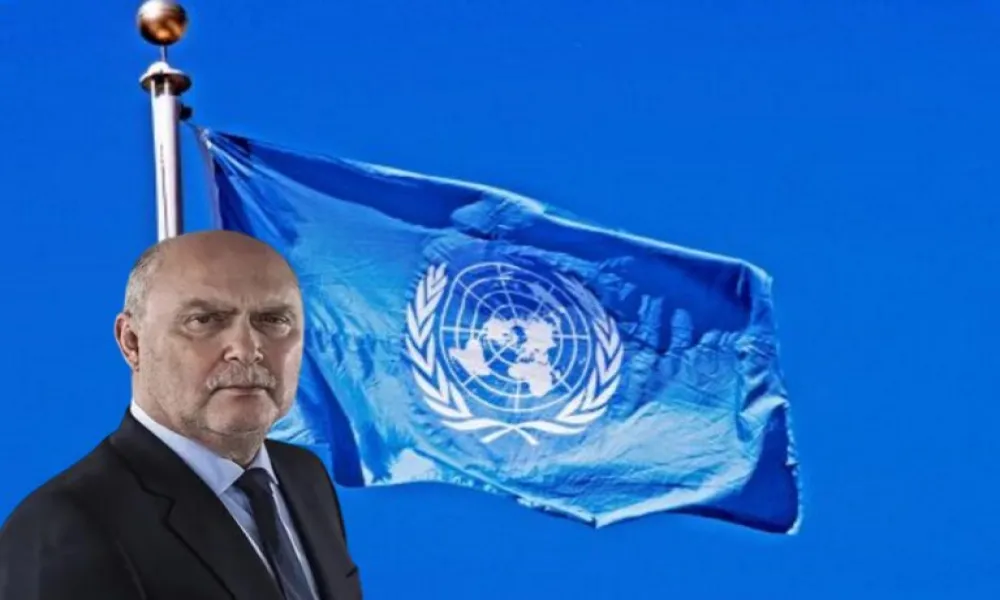

Turkey’s candidate for the next United Nations Secretary-General, Feridun Sinirlioglu, faced pointed questions from the European Union, Greece, Cyprus and Israel over international law, the Cyprus dispute, the Turkey-Libya maritime memorandum and Hamas during an interactive dialogue at the UN General Assembly.
The exchanges focused on whether Sinirlioglu’s stated commitment to the principles of the UN Charter would be reflected in his approach to longstanding international disputes, with Greece, Cyprus and Israel citing previous positions he had taken as Turkey’s representative.
Sinirlioglu was nominated by Turkey on 1 November 2026. During the dialogue, he repeatedly stressed that, if elected, he would act as an impartial and independent international civil servant rather than as a representative of his country.
Cyprus seeks explicit recognition of its sovereignty
Cyprus put forward five questions, asking Sinirlioglu to clarify his position on the Republic of Cyprus, the situation in the country and human rights concerns in Turkey.
Cyprus’s Permanent Representative to the UN, Ambassador Maria Michael, referred to a letter dated 19 May 2022, in which Sinirlioglu, writing in his national capacity, had argued that the Republic of Cyprus had ceased to exist as a legal entity in 1963.
She asked whether he recognised the Republic of Cyprus’s sovereignty, independence, territorial integrity and status as a UN member state.
Michael also called on the candidate to condemn attacks against peacekeeping operations in Pyla in August 2023, accept the Security Council’s position on Varosha and commit to the full implementation of relevant Security Council resolutions.
Two further questions focused on human rights in Turkey.
Referring to concerns raised by the UN Committee against Torture in 2024 over allegations of widespread torture in the country, Michael asked whether Sinirlioglu shared the Committee’s concerns and would support independent, impartial and effective investigations into the allegations.
She also raised restrictions on freedom of expression and peaceful assembly following the arrest of Istanbul Mayor Ekrem Imamoglu in 2025. She noted that the Office of the UN High Commissioner for Human Rights had described blanket bans on public demonstrations as unlawful.
Michael asked whether Sinirlioglu agreed with that assessment and, if elected Secretary-General, would be prepared to publicly call on all member states to respect the rights to freedom of expression and peaceful assembly.
No explicit answer on recognition of the Republic of Cyprus
Sinirlioglu did not address the five questions individually, instead referring broadly to the principles that would guide him if elected.
He said the UN Charter would underpin his work, including on the Cyprus issue.
“It goes without saying that the Charter of the United Nations, by which the Organisation and its member states are bound, will guide my work if I become the next Secretary-General, including with regard to the Cyprus issue,” he said.
He also referred to the impact of changing geopolitical circumstances on international disputes, arguing that it would be unrealistic to assume that such developments had no bearing on them.
Nevertheless, he stressed that the UN Charter remained a source of inspiration in an evolving international environment.
In concluding his response, Sinirlioglu cited former UN Secretary-General Dag Hammarskjöld, referring to remarks made at a press conference in June 1961 about the distinction between personal convictions and neutrality in the exercise of official duties.
He argued that a person could retain their own ideas and ideals while undertaking neutral actions, describing this as an act of integrity.
However, he did not explicitly confirm whether he recognised the sovereignty, independence and territorial integrity of the Republic of Cyprus or its status as a UN member state. Nor did he give specific answers on the attacks against peacekeeping operations in Pyla, the Security Council's position on Varosha or the human rights questions concerning Turkey.
EU calls for respect for international law and UNCLOS
Speaking on behalf of the EU and its member states, EU Ambassador Stavros Lambrinidis said the United Nations needed a Secretary-General who was fully prepared to defend and promote respect for the UN Charter and international law, while supporting all three pillars of the Organisation.
He expressed concern over violations of international law that frequently went unaddressed, citing Ukraine, the Strait of Hormuz, the Middle East, Sudan, Myanmar and the continuing division of Cyprus.
Particular emphasis was placed on maritime security, with the EU including the Eastern Mediterranean among the regions facing growing challenges.
Lambrinidis asked how Sinirlioglu would use the Secretary-General's Good Offices and the authority of the position to promote compliance with international law, including the UN Convention on the Law of the Sea (UNCLOS), and ensure accountability.
The EU also sought concrete commitments on human rights and gender equality, noting that only 1% of expenditure across the UN system was directed towards human rights mandates.
In response, Sinirlioglu described freedom and safety of navigation as a central priority, saying attacks against commercial vessels were unacceptable, regardless of their origin or motivation.
He referred generally to international legal instruments but did not specifically mention UNCLOS.
On human rights funding, he argued that the issue could not remain the most underfunded pillar of the UN system. He also supported women's meaningful participation in decision-making.
Israel demands unequivocal condemnation of Hamas
Israel focused its intervention on Sinirlioglu's previous position on Hamas.
Israel's Permanent Representative, Ambassador Danny Danon, recalled that in June 2018 Sinirlioglu had called on the General Assembly to reject an amendment condemning Hamas and demanding an end to all its violent activities.
Referring to the 7 October 2023 attacks, which he described as the worst massacre of Jews since the Holocaust, Danon asked whether Sinirlioglu could now condemn Hamas unequivocally as a candidate for the UN's top post.
Sinirlioglu responded that, in 2018, he had been speaking as a representative of his country.
“I fully and unequivocally condemn terrorism in all its forms,” he said.
However, his remarks concerning Hamas were accompanied by qualifications relating to violations of rules and the designation of the organisation as a terrorist group under international legal instruments.
Greece challenges Sinirlioglu over Turkey-Libya memorandum
Greece raised questions about the consistency between Sinirlioglu's stated commitment to international law and the positions he had defended as Turkey's Permanent Representative, focusing on the 2019 Turkey-Libya maritime memorandum.
Greece's Permanent Representative, Ambassador Aglaia Balta, said Athens fully shared the principles of good faith, respect for international law and the peaceful settlement of disputes, which every Secretary-General should uphold without exception.
However, she argued that Sinirlioglu's previous actions raised questions about how those commitments would translate into practice.
Balta said Turkey and Libya had neither adjacent nor opposite coastlines and therefore had no common maritime boundary.
She argued that the so-called Turkey-Libya memorandum completely disregarded Greek islands, including Crete and the Dodecanese, as well as their entitlement to generate maritime zones beyond their territorial waters under the law of the sea, as reflected in UNCLOS.
Describing the memorandum as a blatant attempt to reshape geography, she called it null and void, adding that its reported recent ratification by the Libyan House of Representatives could not give it legal effect.
Balta then directly challenged Sinirlioglu over his previous defence of the agreement.
She asked how he reconciled his declared commitment to good faith, international law and the peaceful settlement of disputes with his defence of claims that, according to Greece, disregarded geographical reality, violated international law and contributed to persistent tensions in the Eastern Mediterranean.
Sinirlioglu avoids addressing the substance of the memorandum
Sinirlioglu did not directly address the substance of the Turkey-Libya memorandum.
Instead, he stressed that although he had been nominated by his country, he was not attending the dialogue as its representative.
He recalled his election as Secretary-General of the Organisation for Security and Co-operation in Europe (OSCE), which had followed a joint Greek-Turkish proposal for leadership positions within the organisation and had received Greek support.
He also referred to his cooperation with the Greek director of the OSCE Office for Democratic Institutions and Human Rights (ODIHR).
“I do, of course, have a national identity. But I have also repeatedly demonstrated that I can be an impartial and independent international civil servant,” he said.
“You can therefore be assured of that,” he added.
The exchanges highlighted the diplomatic challenges facing Sinirlioglu's candidacy, with several delegations seeking assurances that his record as a Turkish diplomat would not influence his conduct if elected to lead the United Nations.
While he repeatedly invoked the UN Charter, impartiality and the independence of the Secretary-General's office, a number of the specific questions raised by Cyprus and Greece remained unanswered.
Source: CNA