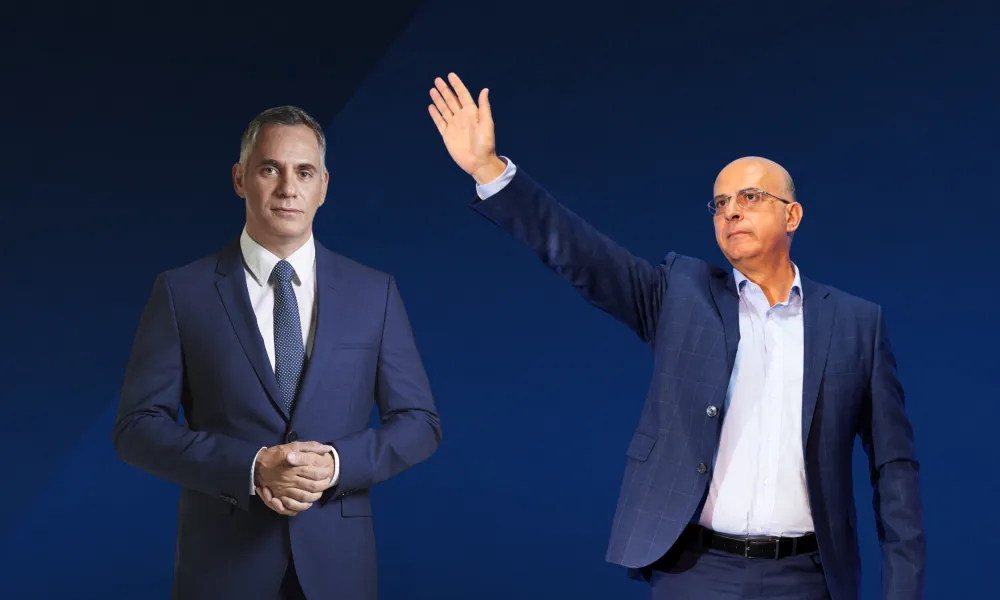

DIKO and DIPA have agreed to begin developing common positions on key issues as a first step towards closer cooperation or a possible merger of Cyprus’s political centre.
The two parties will first brief their decision-making bodies and seek their approval before moving forward.
First meeting held in July
Sources told Politis that DIPA President Marios Garoyian accepted an invitation from DIKO President Nikolas Papadopoulos to hold an initial meeting following the parliamentary elections.
The talks, held in late July, focused on the prospects for cooperation and the possible unification of the parties occupying the political centre. A source familiar with the discussions said the meeting took place in a very positive atmosphere.
Three options presented by Papadopoulos
Papadopoulos placed three options on the table.
The first would involve DIPA merging with DIKO. Under this proposal, DIPA officials would join DIKO, followed by a transitional period lasting until the 2028 presidential election. During that period, the current leaders of the two parties would serve as co-presidents.
The second option would involve the establishment of an entirely new party, bringing together the existing parties of the political centre.
The third proposal would allow the parties to retain their autonomy while pursuing close political cooperation. They would form a united front for the 2028 presidential election and develop common positions on various issues.
Under this arrangement, DIKO, as the only parliamentary party currently representing the political centre, would also promote the positions of the other parties in the House of Representatives and submit legislative proposals on their behalf.
Garoyian proposes policy-first approach
According to Politis sources, Garoyian responded with a different model for cooperation.
He proposed that the parties initially work together through policy-development teams tasked with drafting common positions.
The DIPA president argued that citizens are less concerned with who would lead a new party or what form the cooperation would take. Instead, he said, they want political parties to address their everyday problems and present practical solutions.
Concerns over the 2028 election timetable
Papadopoulos expressed doubts over whether cooperation between policy-development teams could produce the desired result within a sufficiently short period.
He noted that preparations for the 2028 presidential election were already under way and warned that the parties of the political centre might not have enough time to form a united front.
Garoyian, however, sought to separate the upcoming presidential election from the broader effort to bring the political centre together.
He maintained that any cooperation should be built gradually through common policies on major issues, allowing it to rest on firm foundations.
Papadopoulos ultimately accepted Garoyian’s proposal, and the two leaders agreed that cooperation would begin through their parties’ policy-development teams.
Party bodies to be briefed
The DIKO and DIPA presidents also agreed to inform their respective decision-making bodies about the discussions and to hold another meeting in September.
Papadopoulos is expected to brief the DIKO Secretariat in the coming days, while Garoyian has already informed DIPA’s relevant party bodies.
DIKO renews unification effort
The idea of uniting the political centre returned to the agenda after DIKO Parliamentary Spokesperson Panikos Leonidou raised it during the party’s Political Congress in March 2025.
An effort followed, with approaches made to the leaderships of DIPA, EDEK and the Movement of Ecologists – Citizens’ Cooperation. Those contacts did not produce a positive outcome.
The proposal resurfaced on the night of the parliamentary elections, when Papadopoulos announced that he would launch a new initiative to unite the political centre.
EDEK and Greens remain cautious
According to Politis sources, the leaderships of EDEK and the Greens have again shown little enthusiasm for the proposal.
Both parties suffered painful defeats in the parliamentary elections and are now preparing for internal leadership contests.
EDEK recently elected Sofia Christodoulou Makri as its new president for the remainder of Nikos Anastasiou’s term following his resignation in July.
An electoral congress will be held in December to elect a new leadership and members of the party’s decision-making bodies. EDEK may then be in a position to enter talks on potential cooperation within the political centre.
Papadopoulos is nevertheless expected to raise the issue during a meeting with EDEK’s new president next week.
The Movement of Ecologists – Citizens’ Cooperation will also hold its electoral congress in the autumn, when a new party leadership will be chosen.
Any discussion on cooperation before the congress is considered unlikely, as the current leadership resigned following the parliamentary elections and does not have a mandate to make decisions that would bind its successor.