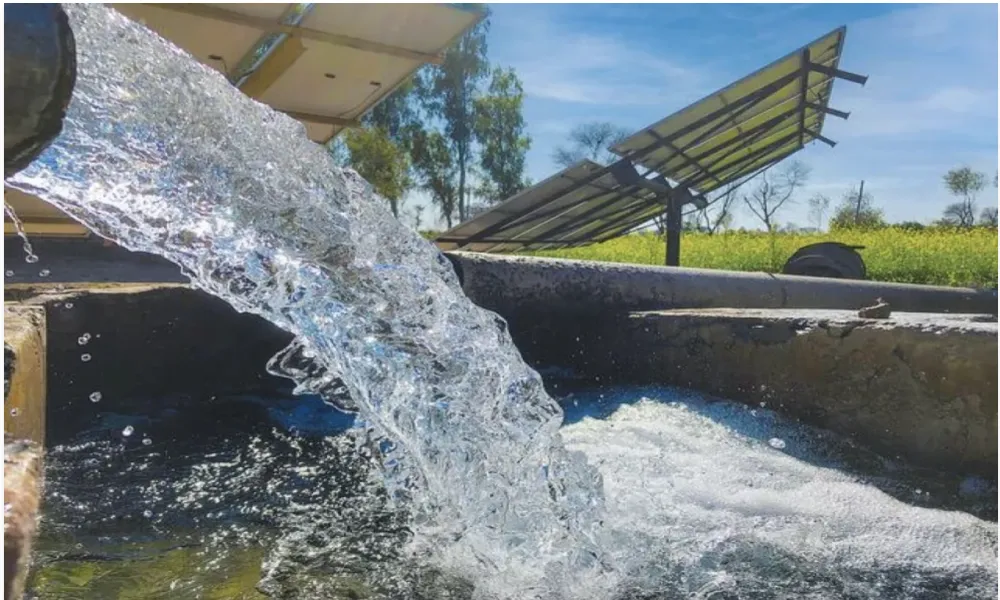

Parliament is set to examine new legislation aimed at establishing a more comprehensive and sustainable system for managing the country's water resources.
The House Agriculture Committee will begin discussing the proposed amendments on Tuesday. The bill, submitted by the Ministry of Agriculture, Rural Development and Environment on 6 April under the title “The Unified Water Management (Amending) Law of 2026”, seeks to strengthen and update the existing legal framework.
Among its main objectives are facilitating the legalisation of unlicensed water projects, including illegal wells and reservoirs; strengthening controls, licensing and monitoring mechanisms for water abstraction and retention projects; and ensuring compliance with Article 11 of the EU Water Framework Directive (2000/60/EC).
According to the impact assessment, the legislation is intended to promote rational and transparent management of water resources, reduce administrative and legal burdens and ensure Cyprus complies with EU law.
Illegal wells could be legalised at higher cost
One of the most notable provisions concerns the legalisation of illegal wells and reservoirs, which number in the thousands.
Under the proposed legislation, existing offenders would be able to apply for a licence by paying an increased fee equal to twice the amount charged for a standard licence.
If an application is rejected, the Director of the Water Development Department (WDD) could require the well or other water abstraction project to be filled, sealed or permanently closed.
€3,000 fixed penalty for illegal water projects
The WDD is also seeking to introduce a system of out-of-court settlements for offences involving the illegal construction or use of water abstraction or retention projects.
The proposed fixed penalty would be up to €3,000, alongside measures requiring compliance and restoration.
Water abstraction and retention projects include wells, reservoirs, dams and any other structures capable of retaining water or obstructing its flow.
The bill provides that a fixed penalty could be issued by the WDD director within 30 days of an offence to the person responsible.
If that person cannot be identified, the penalty could instead be served on the owner or manager of the land where the illegal project is located.
The penalty could be delivered personally or by registered post and would not exceed €3,000.
If it is not paid within 15 days, the amount would increase by 50%. If it remains unpaid 30 days after service, the offender could face criminal prosecution.
Following the imposition of the fine, the WDD director could issue a notice requiring the filling, sealing or closure of a well, or the demolition or destruction of an unauthorised water abstraction or retention project.
Restoration would be carried out at the offender's expense within a reasonable period, which could not exceed two months unless an extension was granted by the WDD director.
The proposed legislation would also cover offences involving interference with natural watercourses, with a €3,000 fixed penalty and measures to restore any resulting damage.
Local authorities to gain representation
The bill would also modernise the composition of the Water Management Advisory Committee (WMAC) by amending Article 8 of the existing law.
The changes would ensure representation for all five District Local Government Organisations — Nicosia, Limassol, Larnaca, Paphos and Famagusta — strengthening the role of local government in water management.
The WMAC provides advice and support to the Minister of Agriculture, Rural Development and Environment on water policy.
It meets twice a year and can submit recommendations on the government's overall water policy, the implementation and promotion of major water projects, and guidelines for the rational allocation, use and protection of water resources, including supplies for irrigation and drinking water.
Stronger controls and monitoring
The legislation would strengthen controls, licensing and monitoring of projects involving the abstraction and retention of surface and groundwater.
It would also update national legislation to properly reflect obligations under Article 11 of the Water Framework Directive.
The changes are intended to address a European Commission infringement procedure concerning Cyprus, identified as infringement procedure 2024/2227 in a letter of formal notice dated 14 November 2024.
Floating solar and pumped storage
Another significant change would allow water projects to be licensed for energy production and/or storage.
Amendments to Articles 37 and 132 of the existing law would cover newer technological applications, including floating photovoltaic systems and pumped-storage projects.
According to the WDD, the changes would also support more rational use of water resources by reducing over-exploitation and promoting the sustainability of water systems.
Environmental impact expected to be limited
The proposed amendments are expected to have environmental implications, particularly by strengthening the conservation, protection and sustainable use of groundwater and surface water.
The impact assessment says the new provisions would help prevent deterioration in water quality and promote more sustainable management of water resources.
The legislation would introduce stricter rules for licensing water abstraction and retention projects, directly affecting how surface and groundwater are extracted and managed.
It could also indirectly affect energy consumption through the licensing of energy production and storage projects, including floating solar and pumped storage, as well as through more efficient water management that could reduce unnecessary pumping.
The WDD assesses the overall environmental impact as moderate to low.
The proposed changes are also expected to contribute to reducing emissions and supporting adaptation to climate change by promoting more sustainable water use and facilitating energy production and storage projects such as pumped storage.
Limited consultation carried out
According to the WDD, targeted consultation was carried out on the proposed changes concerning the composition of the Water Management Advisory Committee.
No broad consultation was held on the remaining provisions, as these mainly concern technical, institutional and harmonisation measures arising directly from Cyprus's obligations under the EU acquis.