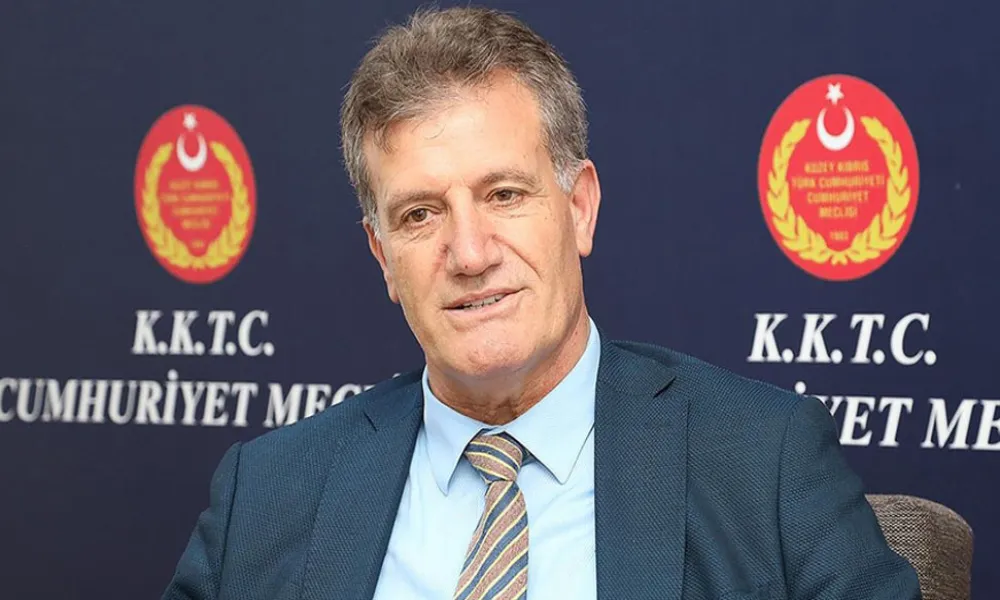

The dismissal of Erhan Arıklı as "minister of public works and transport" in the north has cast renewed attention on one of the most controversial figures in Turkish Cypriot politics.
The move came after the Filo Jet disaster off Kyrenia, which has claimed nine lives, while search efforts continue for those still missing. Arıklı was removed from office by "prime minister" Ünal Üstel, who said the decision was necessary to safeguard the investigation into the sinking.
The dismissal was formalised through a decree signed by Turkish Cypriot leader Tufan Erhürman and published in the north's official gazette.
Political fallout
Arıklı's removal came only hours after he attempted to defuse mounting pressure by announcing that he would seek the transfer of the "ports department" from his ministry to the "prime ministry" until the investigation was completed and would also request the lifting of his parliamentary immunity.
His dismissal was followed by the withdrawal of his Rebirth Party (YDP) from the coalition administration.
Arıklı later criticised the manner of his removal, describing it as "immoral" that he had learned of the decision by telephone rather than in person.
While Üstel argued that the move did not prejudge guilt and that the presumption of innocence remained intact, opposition figures rejected the idea that removing a single minister was sufficient.
Republican Turkish Party (CTP) leader Sıla Usar İncirli said the administration could not escape responsibility for the disaster by dismissing one minister, while Communal Democracy Party leader Zeki Çeler described the move as a "late and incomplete step" and called for the entire government to resign.
Who is Erhan Arıklı?
Born in 1962 in Ardahan, near the Turkish-Armenian border, Arıklı moved to Cyprus with his family in 1975, after the Turkish invasion.
A graduate of the Faculty of Theology at Ankara University, he later obtained three postgraduate degrees and a doctorate from the Academy of Sciences of Azerbaijan.
He served as a representative of the Turkish Cypriot administration in Baku and Central Asia and taught at Arabayev State University in Kyrgyzstan.
During the early 1990s, he emerged as a leading figure in nationalist organisations in the occupied north.
Returning to active politics in Cyprus in 2014, he founded the Rebirth Party (YDP) in 2016. The party is largely associated with Turkish settlers and nationalist voters. He was elected as an "MP" for Famagusta in 2018, and his party later joined the Üstel administration, remaining in government for more than four years.
Wanted in connection with the killing of Tassos Isaak
Arıklı's name appears on arrest warrants issued by the Republic of Cyprus over the fatal beating of Tassos Isaak in the Deryneia buffer zone on 11 August 1996.
He is among five individuals sought under international arrest warrants in connection with the killing.
In September 2012, he was detained at an airport in Kyrgyzstan following an Interpol alert but was later released after Turkish intervention and returned to the north without being extradited.
Arıklı has publicly acknowledged that he was:
"One of the organisers"
who mobilised people to gather at the barricades during the events of August 1996.
Controversial statements
Last year, following reports of a possible new arrest warrant, Arıklı accused the Greek Cypriot side of reopening the issue and used inflammatory language against Turkish Cypriots who supported the initiative.
He also defended the shooting of Solomos Solomou, writing that:
"A flag should not be brought down."
His past remarks have repeatedly attracted criticism.
One of the best-known controversies dates back to a 2001 headline in the Turkish Cypriot newspaper Avrupa, which reported that Arıklı had said he would "castrate traitors".
At the time, he advocated harsh treatment for those who described the Turkish military as an occupying force, writing that he would extinguish cigarettes on their tongues.
Although he later said he personally visited the newspaper to apologise, he added:
"If it happened today, I would do the same."
Source: CNA