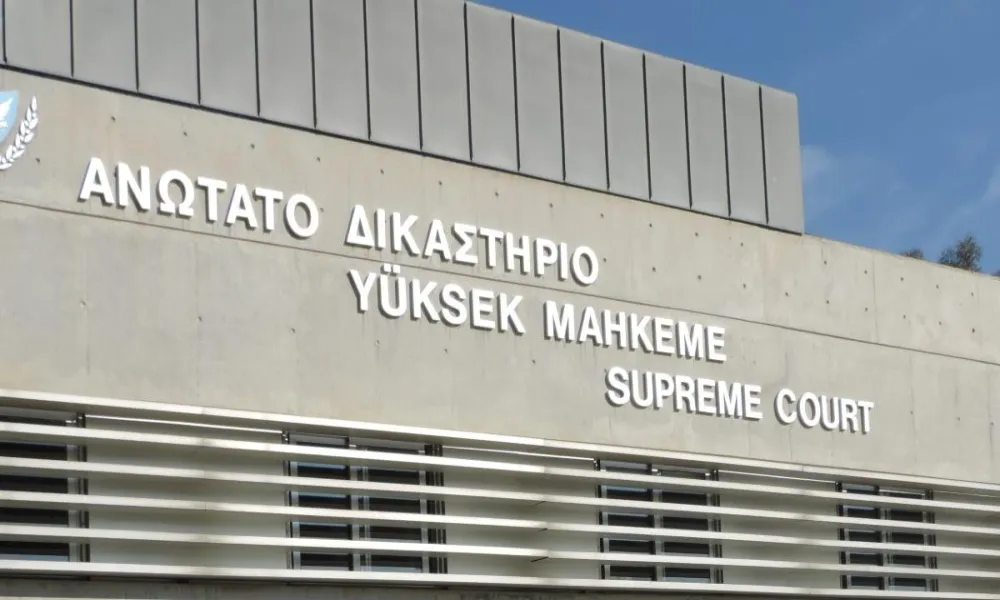

The Supreme Court has rejected an application by Giorgos Maltezos, an elected representative of the Pancyprian Trade Union Isotita, to bring private criminal charges against five state officials. The case concerned allegations that action taken against him amounted to retaliation for his trade union activity.
Issued in Criminal Application 1/2026, the decision has prompted the union to raise wider questions about the scope of criminal protection available to public-sector employees.
The case before the Supreme Court
The application sought permission to file charges over alleged violations of the legislation ratifying International Labour Organization Convention 135, which protects workers’ representatives from acts connected with their trade union activity.
Maltezos, who was employed as a prison officer, sought the prosecution of five individuals holding state positions.
Court finds no dependent employment relationship
According to Isotita, the Supreme Court found that the existence of a dependent employment relationship was an essential element of the offences cited in the application.
The Court ruled that Maltezos did not have such a relationship with the Republic of Cyprus because his indefinite-term employment was governed by administrative law.
It also found that the Republic of Cyprus did not constitute an organisation or legal person within the meaning of the relevant legislation and could not be considered an undertaking or economic entity. The Court further ruled that disciplinary proceedings could not fall within the criminal offences established by the provisions in question.
Isotita disputes abuse-of-process finding
The Court also found that pursuing the charges constituted an abuse of the judicial process, concluding that the application was effectively intended to influence and overturn the administrative and disciplinary proceedings.
Isotita rejects that interpretation. It argues that the disciplinary process was not a parallel procedure that the union was attempting to overturn, but the very subject of the complaint concerning alleged anti-union retaliation.
According to the union, the criminal proceedings were intended to examine whether specific individuals bore personal criminal responsibility, rather than to annul any administrative or disciplinary decision.
Timeline raises further concerns
The application was filed with the Supreme Court on 17 July 2026, while Maltezos was still employed.
Fourteen days later, on 31 July, he was dismissed with immediate effect. According to Isotita, no finding from the disciplinary proceedings had been issued or communicated to him at that stage.
The union considers the timing particularly significant because the Supreme Court’s decision points to the administrative and disciplinary procedures as the available avenue of protection. Isotita argues that those same procedures had already resulted in Maltezos’ dismissal before the Court ruled on his criminal application.
Public-sector employment protections
The interpretation of employment relationships in the public sector is also central to the dispute.
Isotita argues that the fact an employment relationship is governed by public law should not automatically exclude the employee from the protections provided under labour legislation.
Isotita considers further legal action
Isotita says it does not regard the matter as closed following the Supreme Court’s decision. It will examine every available legal remedy with its advisers and continue pursuing proceedings already pending pending at European and international level.
Maltezos’ dismissal constitutes a separate legal front. The union describes it as unlawful and says it will challenge the decision in court.
The case acquired a further trade union dimension on 3 August, when prison officers elected Maltezos president of the Prison Officers Branch Council, three days after his dismissal.
Isotita argues that the issue now extends beyond the outcome of a single private criminal application. It says the ruling raises a broader institutional question over whether public-sector employees receive the same practical protection against anti-union retaliation as workers in the private sector.