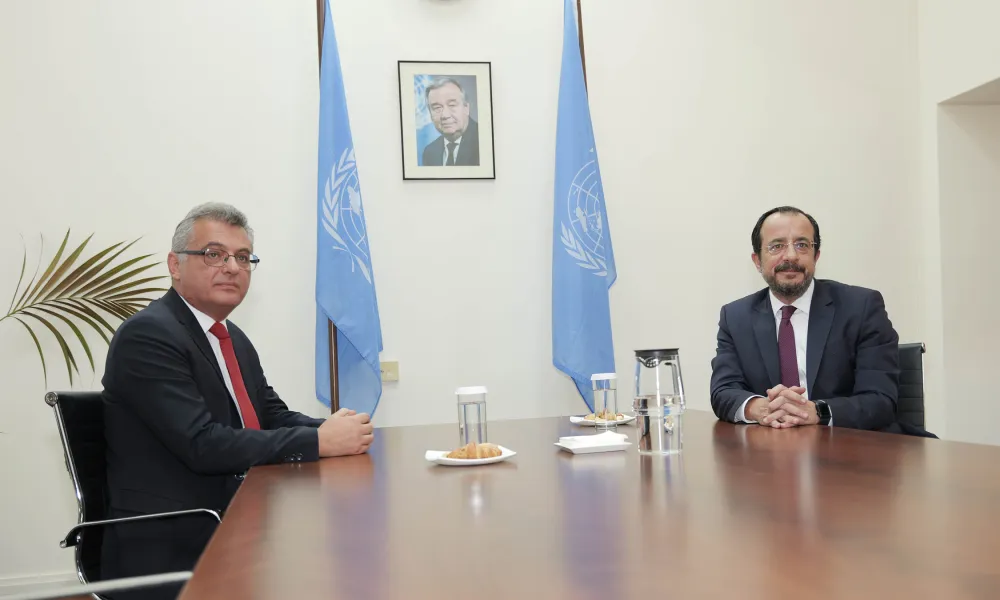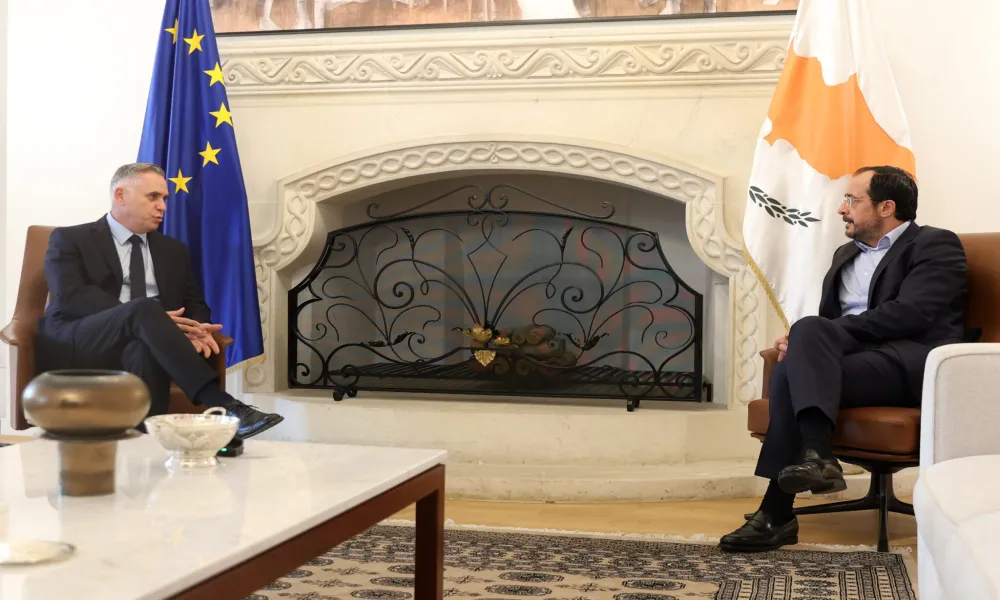

Members of DIKO’s Secretariat will meet President Nikos Christodoulides on Friday, 10 July, for a second round of talks focusing on the Cabinet reshuffle, upcoming appointments to semi-governmental organisations and the party’s cooperation with the administration.
DIKO is seeking to expand its presence in government beyond its current two ministers. It also wants to secure prior consultation over appointments, arguing that decisions should not be taken unilaterally by the Presidential Palace.
DIKO seeks a larger government role
According to information obtained by Politis, the previous meeting at the Presidential Palace took place in a tense atmosphere, with DIKO president Nicolas Papadopoulos firmly raising the issue of increasing the party’s representation in government.
Papadopoulos reportedly argued that DIKO is now the only governing party represented in Parliament following the parliamentary elections.
Christodoulides did not commit himself on any of the issues raised and instead scheduled a new meeting for Friday, when he is expected to respond to DIKO’s demands.
The party is attempting to convert its parliamentary election result into greater political influence, taking advantage of the new balance of power. The other two parties that supported the government, EDEK and DIPA, failed to enter Parliament.
As a result, DIKO believes it now carries most of the responsibility for supporting the government’s programme and helping secure parliamentary approval for government legislation. The party therefore considers that the President has become more dependent on its support and should increase the number of DIKO-linked ministers.
Agriculture portfolio attracts attention
DIKO appears to have developed a particular interest in agricultural policy. Papadopoulos’ decision to join the House Agriculture Committee, an unusual move for a party leader, has not gone unnoticed and has prompted discussion among MPs.
The party is therefore believed to be looking closely at the Ministry of Agriculture, particularly after Agriculture Minister Maria Panayiotou decided to accept a position in public education from September. Her departure is one of the factors that triggered discussions over a wider Cabinet reshuffle.
Panayiotou, however, represents EDEK within the government, and Christodoulides cannot afford to disregard the Socialist party ahead of the 2028 presidential election.
One possible scenario would involve appointing an EDEK-linked figure as deputy minister of tourism, particularly if reports that current Deputy Minister of Tourism Costas Koumis will not remain in the next Cabinet prove accurate.
Tensions over appointments
DIKO is formally represented in the Cabinet by Health Minister Michalis Damianos and Energy Minister Neofytos Charalambides. They are not technocrats loosely associated with the party, but two of DIKO’s three vice-presidents.
The previous reshuffle, carried out in December 2025, was therefore more closely aligned with DIKO’s expectations than Christodoulides’ original Cabinet appointments following the 2023 presidential election, when the parties supporting him were given limited influence over his selections.
Nevertheless, dissatisfaction remains within DIKO over what party officials view as the President’s continued tendency to act unilaterally and select appointees without prior consultation.
The concern is that this approach is helping create a group of openly pro-Christodoulides figures within DIKO who may not be prepared to follow the party leadership if it adopts a different course ahead of the 2028 presidential election.
Former DIKO MP Christos Senekis has been widely discussed as a possible candidate for the Agriculture Ministry. Senekis, who is considered close to the Presidential Palace, failed to secure re-election.
Health Minister Michalis Damianos also highlighted the growing debate over DIKO’s future direction during a recent interview with Kathimerini.
“DIKO has a candidate for 2028,” he said. However, if Christodoulides decides to seek re-election, Damianos added, “DIKO should support him.”
Reports of additional government posts
Following Friday’s meeting at the Presidential Palace, DIKO’s Secretariat is expected to meet again to assess the outcome of the talks and decide on the party’s next steps.
Reports circulated on Thursday suggesting that Christodoulides may be prepared to offer DIKO an additional ministry, a deputy ministry and a commissioner’s position.
The deputy ministry under consideration is reportedly either Tourism or Culture.
Should the reports be confirmed, they would indicate that the President is taking seriously the possibility of DIKO forming an alliance with DISY ahead of the 2028 presidential election.
Three competing positions within DIKO
Christodoulides’ efforts to keep a distance from political parties and present himself as a non-partisan president have frustrated several DIKO officials.
Party figures have repeatedly complained publicly that the President does not consult DIKO and that the party often learns about government decisions through media reports.
At the same time, Christodoulides is trying to maintain his connections with DISY voters. He was elected with the support of several DISY figures and a section of the party’s electorate.
The President understands that he cannot secure re-election solely with the support of parties from the political centre. This has encouraged him to consider figures from the wider DISY camp for government positions, but the same strategy risks alienating DIKO.
Three broad schools of thought are now emerging within the party. One supports continuing the partnership with Christodoulides, another sees an opening towards AKEL, while a third favours closer cooperation with DISY.
The prevailing position within DIKO’s collective bodies remains against a political break with the government. However, the internal balance could change.
Some party figures interpret Papadopoulos’ decision to attend the Presidential Palace meeting alongside the entire Secretariat as an attempt to demonstrate directly how the President treats the parties supporting his government.
Cooperation scenario with DISY
Papadopoulos has repeatedly stated that DIKO should not be considered a guaranteed ally of any candidate and that the party never gave Christodoulides a blank cheque.
During the parliamentary election campaign, he placed particular emphasis on DIKO’s cooperation with DISY in Parliament and said the relationship would continue after the election. Similar statements were made by DISY, which is preparing for the presidential race and needs a strong ally from the political centre.
DIKO did not withdraw from the government in exchange for DISY’s support for the presidency of the House of Representatives.
Such a move would probably not have been approved by DIKO’s collective bodies at this stage, while Papadopoulos is understood to consider it too early for such a decision. Participation in the executive branch is also seen as more valuable than control of the legislature.
Nevertheless, the political courtship between DIKO and DISY headquarters on Pindarou Street remains active.
Papadopoulos appears to recognise that DIKO could become the focus of competition between DISY and Christodoulides ahead of 2028. The party is now seeking to secure political gains from that rivalry and strengthen its position before deciding which side, if either, it will support.