The leader of DIKO has raised the flag of uniting the centrist space, seeking dialogue with DIPA, EDEK and the Green Movement.
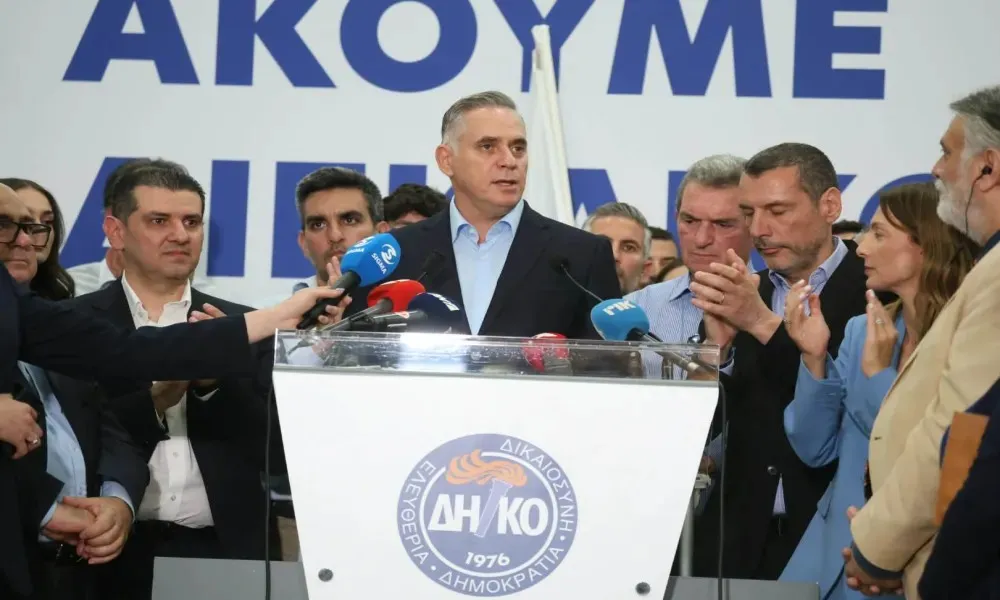
The initiative to unify the centrist space was the first and most significant political message sent by DIKO president Nikolas Papadopoulos on the night of the May 24 parliamentary elections. Against the backdrop of the euphoria created among DIKO supporters by the election result, Papadopoulos chose to address centre voters disappointed by the outcome, making an ambitious pledge.
“From tomorrow,” he said, “DIKO will take the initiative to unite the centrist space.” Soon, he added, “we will all proclaim together: the Centre is here, united and strong.”
It was clear the message was directed at voters of DIPA, EDEK and the Green Movement – three centrist parties that failed to enter parliament. However, it remains unclear how Papadopoulos’s proposal is being received within those parties. At leadership level, there is significant scepticism about DIKO’s true intentions. There are fears that, as the largest party in the centre, DIKO is seeking to absorb the other political forces in the intermediate space. These concerns have not been dispelled by Papadopoulos’s insistence that the effort is a sincere attempt to restore the centre’s lost influence.
At the same time, the leadership of the other three parties is struggling under the pressure created by their electoral defeat. There is also a risk that party officials and voters could drift towards DIKO in an unstructured way, since Papadopoulos’s party is the only one to have secured its political future following the elections.
Initial contacts
Immediately after the elections, Papadopoulos contacted the leaders of the other centrist parties to begin discussions on achieving the goal set by DIKO. He held telephone conversations with DIPA president Marios Karoyian and Green Movement leader Stavros Papadouris, and also had an initial meeting with EDEK president Nikos Anastasiou.
Sources told Politis that during these contacts, Papadopoulos explained the reasons behind his initiative and committed to returning with a concrete proposal after the election of the House president and after receiving authorisation from DIKO’s collective bodies.
Papadopoulos and Karoyian agreed to reconvene in early July to discuss the matter further. Contacts with the other two party leaders are also expected during the same month, as August is a holiday period. June, meanwhile, was devoted to assessing the election result and planning next steps.
Three scenarios
Last Tuesday, DIKO’s Central Committee and Executive Bureau met to evaluate the election outcome. Papadopoulos presented specific proposals regarding the centrist space. A party source told Politis that he outlined three scenarios.
The first, and most ambitious, involves the creation of a new party under a new name through the merger of the four centrist political forces. According to the same information, Papadopoulos made clear in his contacts with other leaders that he is not interested in leading the new formation.
The second scenario concerns the creation of a political alliance that would allow the four parties to retain their autonomy. Under this model, a political platform would be established to contest elections with a unified electoral list. However, there is a significant drawback linked to electoral law, which stipulates that a coalition of more than two parties can participate in the second allocation of seats only if it secures 20 per cent of the total valid vote nationwide. If the other parties view this scenario positively, DIKO is prepared to raise the issue with the two largest political forces – DISY and AKEL – to secure parliamentary support for an amendment to the electoral law.
The third scenario under consideration involves coordination among the four parties through a “hybrid model of cooperation”, which would even allow participation in DIKO’s collective bodies. Within this framework, the four parties could jointly shape legislative proposals to be submitted to parliament by DIKO, including proposals originating from individual parties. They could also adopt common positions on bills introduced by other parliamentary parties and on government legislation. Furthermore, the four parties could agree on a common approach for the 2028 presidential elections.
A potential third force
The proposal to unify the centrist space did not emerge on election night. It stems from a party conference decision taken by DIKO in March 2025 following a proposal by MP Panikos Leonidou. A round of contacts followed in June that year but yielded no substantial result due to resistance from the other parties.
However, DIKO believes the election outcome confirmed its pre-election concerns. The parliamentary presence of the centre has diminished, with DIKO now the only party from the space represented in parliament. There is a risk that the intermediate space could weaken further at both political and electoral levels.
At the same time, DIKO sees an opportunity. If unification is achieved, it could significantly reshape the political landscape. The new political force could emerge as the third-largest party, with more than 65,000 voters. Based on recent election figures, this could translate into a share of around 18.4 per cent, compared with ELAM’s 10.9 per cent.
Coffee meeting signals caution
Papadopoulos’s persistence on unification may also explain why the leaders of DIPA, EDEK and the Green Movement met informally after the elections. They indicated the meeting aimed to examine the reasons behind their failure to enter parliament and explore possibilities for future cooperation.
However, it may also have been an effort to coordinate a response to DIKO’s initiative, as concerns are shared about the risk of smaller parties being absorbed by a larger one.
DIPA
A party source in DIPA told Politis that it is awaiting DIKO’s proposals, which will then be discussed within its collective bodies. The source stressed the distinction between “what one wants” and “what is feasible”, noting that any discussions must be based on equality rather than absorption by DIKO.
Each party, the source added, must retain its autonomy, implicitly rejecting the first scenario of creating a new unified party.
Referring to the earlier meeting with EDEK and the Greens, the source said a framework for cooperation had been established, with agreement that each party would maintain its independence.
“The cooperation of the three parties,” the source said, “mainly concerns socio-economic issues, with the involvement of each party’s policy teams, aiming to formulate common positions to be presented jointly in public debate and to the government.”
EDEK
A senior EDEK figure also backed maintaining each party’s autonomy, while leaving the door open. If the initiative proves to have strong foundations, the party’s collective bodies will examine it seriously.
However, the official said it would be very difficult to engage in such discussions at this stage, as EDEK is focused on internal matters following the election defeat and is preparing for an extraordinary electoral congress in October. The issue may be examined in depth during that congress, which will also address ideological and political direction.
If a concrete proposal from DIKO emerges in the meantime, the congress may be asked to take a position and potentially mandate the new leadership on how to handle the matter.
The official added that EDEK currently has a very good working relationship with the Green Movement, particularly noting alignment on the Cyprus issue. He did not rule out cooperation in upcoming local government elections and European elections, recalling past successful collaborations, including the election of Demetris Papadakis to the European Parliament.
Greens
The Green Movement is also not in a position to engage in substantive dialogue with DIKO at this stage. A party source said key decisions will be taken after its October congress, when new leadership emerges.
At present, the focus is on developing a strategic plan for the coming years. A committee to be established for this purpose will examine whether the movement should cooperate with other political forces.
It will also consider whether the party should collaborate with a parliamentary party to submit legislative proposals or limit itself to extra-parliamentary activity.