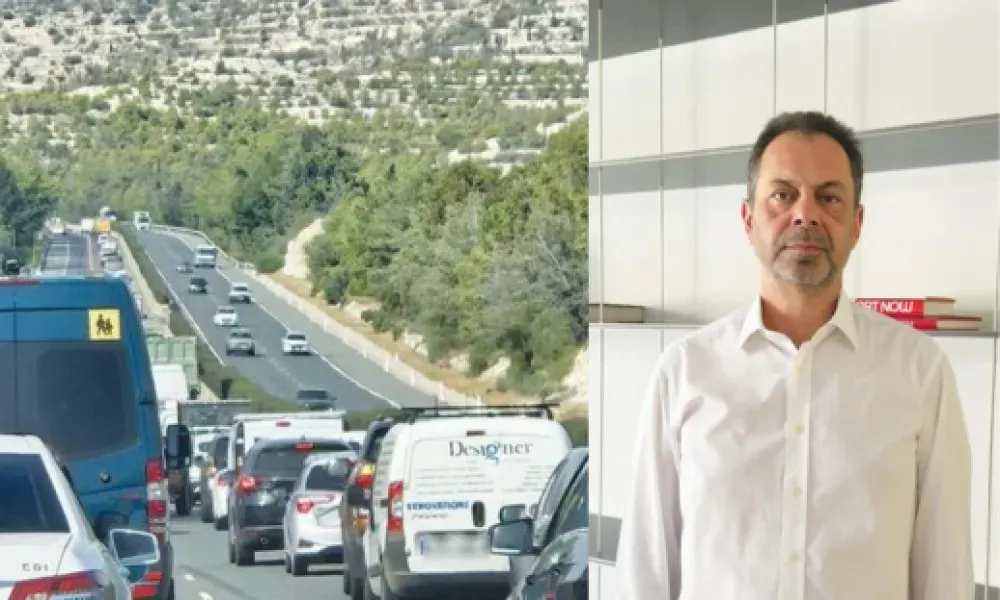

Despite hundreds of millions of euros invested over recent decades in roads, traffic interventions and public transport, congestion in Cyprus continues to worsen. According to Dr Loukas Dimitriou, associate professor and director of the Transport Engineering Laboratory at the University of Cyprus, the main cause is not a lack of projects but how Cypriot cities were designed and developed.
Long-term focus on private cars, uncontrolled urban sprawl and the degradation of public space have created a mobility model that inevitably leads to congestion. In his interview with Politis, Dimitriou analyses decades of planning mistakes, challenges for public transport and a vision for more human, sustainable cities centred on people rather than cars. He is also co-coordinator of the mobility, urban and spatial masterplan for greater Limassol.
Car-centric cities
Asked why congestion is worsening, Dimitriou said delays in preparing cities for increased mobility demand – linked to economic growth and population expansion – are a key factor.
Cyprus remains largely “car-centric,” built around a culture of individualism and the illusion of success expressed through car ownership, while public space – including public transport – has been undervalued or even disregarded.
As a result, car-related choices, which are immediately visible as “projects” – wider roads, more lanes, uncontrolled parking, large roundabouts – gained acceptance. These, however, inevitably led to saturation of the road network, especially at city entry and exit points and throughout much of the day within city centres.
Planning failures
Dimitriou stressed that transport planning is not limited to traffic management but includes spatial planning, urban design, landscaping, planting, lighting, materials, interaction with citizens and modern technologies – essentially everything encountered when someone leaves their home.
Transport planning is not about facilitating cars, but about facilitating movement and life in the city.
“The mistake,” he said, “was assuming that local traffic measures – new roads, smart lights, more parking – would solve congestion.” These interventions offered only temporary relief.
Nicosia and Limassol
Both cities face acute congestion, with Limassol “taking first prize”, he said.
Limassol’s broader economic activity and rapid population growth contrast with Nicosia’s more structured, administrative character, but both suffer from uncontrolled suburban expansion. Each therefore requires a somewhat different approach.
Infrastructure like trees
Low cycling levels are often blamed on high temperatures. Dimitriou rejects that explanation.
“Cyprus is not hotter than Mediterranean cities in Spain, southern France or Italy, where cycling use is increasing,” he said.
The issue is infrastructure in the broad sense – including planting. A cycle path without shade is effectively unusable in summer, not because of the climate itself but because design failed to adapt to it.
“Trees, shading, proper route alignment, rest areas and water – all these are infrastructure, not luxury,” he stressed.
Where conditions are right, heat simply shifts usage times rather than preventing cycling. Culture follows infrastructure, not the other way around.
Public reaction sends a message
Public backlash in Limassol against plastic bollards revealed rising expectations.
“Safety is not negotiable, but neither is quality of life,” he said. Citizens want modern, attractive urban environments, and poorly executed projects are no longer acceptable.
Rather than a setback, the removal of bollards marks a decisive moment and possible shift in thinking about public space interventions.
Survey findings from the Limassol masterplan also show strong public opposition to micromobility infrastructure. “Given what they have seen so far, are they wrong?” he asked. The goal now is to change that perception by delivering useful, modern and aesthetically pleasing projects.
Modern approach
Overuse of physical barriers can produce the opposite of the intended effect, he warned. If drivers rely on such measures for caution, they may assume no danger exists where they are absent.
Modern design should be clear but not visually intrusive, preserving urban character while encouraging respectful behaviour toward all road users, especially vulnerable ones.
Soon many announcements
Responding to whether Cyprus implements properly designed sustainable mobility projects, Dimitriou pointed to the Limassol masterplan.
Instead of addressing congestion in isolation, the project examines deeper causes: urban structure, lifestyle, individualism and the absence of civic culture.
The aim is to change the “style” of the city through urban restructuring, reducing monocentricity, strengthening identity and improving city–citizen interaction.
It is based on three principles:
A. Aesthetics
B. Participatory planning
C. Optimisation
It seeks to create a modern, open Mediterranean city through a unified vision. “Many initiatives will be announced very soon,” he said.
Revitalisation
Removing traffic lanes from private vehicles can be justified as a reallocation of space to pedestrians, cyclists, older people, children and people with mobility difficulties.
This supports movement, commerce, recreation and everyday life. While essential access must be preserved, the balance is shifting toward revitalising urban life, with the private car no longer dominant.
The nightmare scenario
If current policies continue, congestion in 2035 may resemble today’s situation, perhaps slightly worse.
The real nightmare, Dimitriou said, is losing the opportunity to build modern, human-centred cities, resulting in lost economic growth, investment and tourism potential, and failing to provide a proper urban environment for future generations.
Cities that reorganise around people will attract talent and investment, while others will struggle to function.
Redistribution, not punishment
One inevitable decision will be reallocating space from private cars to public transport and micromobility – not as punishment but redistribution.
Political resistance stems from the immediate cost of such decisions, while benefits emerge later and are harder to attribute. Still, no city has solved congestion by expanding road capacity indefinitely.
Political courage
Dimitriou said political cycles discourage long-term decisions, but responsibility also lies with technocrats, who must provide strong evidence for bold policies rather than defaulting to safe solutions.
Both decision-makers and advisers must show “political courage” so technically sound choices are not sacrificed to short-term convenience.
Walking experience
People in Cyprus do not walk because the urban environment discourages it.
Abroad, walking is attractive because it offers continuity, shade, safety and meaningful destinations. In Cyprus, pavements are often narrow, discontinuous, obstructed and lack shade.
“Behaviour follows what the city allows,” he said. Improve infrastructure, and walking will return naturally.
Long-term planning
Measures required include long-term planning beyond election cycles, prioritisation of public transport with dedicated corridors, integrated micromobility networks, high-quality public spaces and serious exploration of tram or light rail systems.
Results will come only through consistent, combined implementation.
“Not everything is solved with money”
Asked why bus use remains so low despite heavy spending, Dimitriou replied: “Not everything is solved with money. Some things require decisions.”
Public transport must compete with cars in speed, reliability and overall experience. While services have improved and ridership increased, congestion still slows buses.
A secondary system
Public transport has not failed, he said – it has fulfilled its role as a secondary system.
“We wanted cars – we got cars,” he said.
The city itself shapes behaviour by favouring cars and neglecting infrastructure for buses, walking and cycling.
Reliability
Reliability, route design and travel time are more important than frequency. While progress has been made, the lack of dedicated lanes and proper stations remains critical.
Tram and rail
The need for tram and light rail systems is becoming more realistic, he said, starting with a Nicosia–Limassol connection.
Growing motorway congestion and increased use of intercity buses support the case. Both cities are studying such interventions, with results expected soon.
“These investments must be driven by need, not vanity,” he concluded.