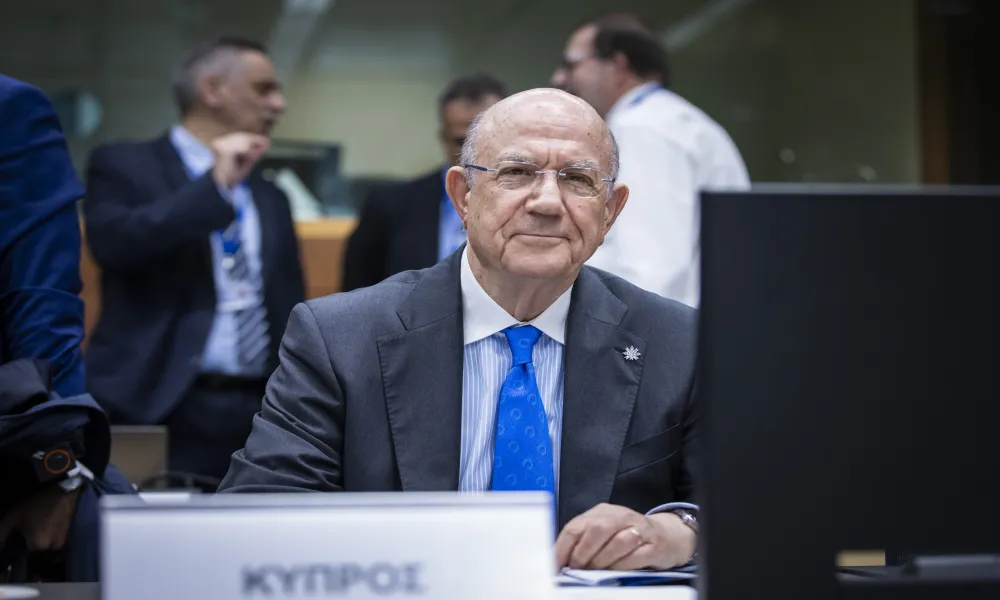

Cyprus has expressed its support for the Irish Presidency's ambition to secure a negotiating mandate at the October ECOFIN Council on the Markets Integration and Supervision Package (MISP), with Finance Minister Makis Keravnos saying the progress achieved during Cyprus' Presidency of the Council of the European Union provides a strong foundation for the next stage of negotiations.
Asset management
Addressing Friday's ECOFIN meeting in Brussels, Keravnos said advancing the MISP package is a key element of the Savings and Investments Union (SIU), aimed at removing barriers and unlocking the full potential of the EU's single market for financial services.
He welcomed Ireland's commitment to reaching an agreement in October and thanked the Presidency for recognising the work carried out during Cyprus' six-month term at the helm of the Council of the EU.
Keravnos also said Cyprus supports the discussion paper presented by the Irish Presidency, which places particular emphasis on asset management, financial innovation, supervisory arrangements and the governance of the European Securities and Markets Authority (ESMA).
Compromise
The meeting marked the first ECOFIN Council under Ireland's Presidency. Speaking afterwards, Ireland's Deputy Prime Minister and Finance Minister, Simon Harris, said finance ministers had given unanimous backing to the Presidency's objective of reaching agreement on the MISP package by October.
He stressed that such an outcome would only be possible through "a high-quality, balanced and proportionate compromise" and said ministers had instructed their technical teams to intensify negotiations over the coming months.
Presenting the Irish Presidency's broader agenda, Harris said its priorities would focus on competitiveness, security and shared values, adding that the Presidency's motto is inspired by an old Irish proverb meaning that "there can be no strength without unity".
Oil prices
European Commissioner for Economy, Productivity, Implementation and Simplification Valdis Dombrovskis welcomed the Presidency's programme, highlighting its strong focus on competitiveness, the digital euro and the Savings and Investments Union.
Dombrovskis also updated ministers on the EU's economic outlook, noting that energy prices had fallen following the US-Iran peace agreement reached in mid-June, with oil prices returning close to pre-conflict levels earlier this month. Inflation during the second quarter was also slightly lower than forecast in the European Commission's spring outlook.
However, he warned that renewed hostilities in recent days had once again pushed oil prices sharply higher, with the Commission closely monitoring developments and their potential impact on economic growth and inflation.
Significant milestone
Under the Recovery and Resilience Facility, ECOFIN approved revised national recovery and resilience plans for Lithuania, Cyprus, Finland, Luxembourg, Germany, Latvia, Slovenia and the Netherlands, together with Hungary's new €10 billion plan.
Dombrovskis described Denmark as having reached a "significant milestone" by becoming the first Member State to complete all measures under its national plan. He added that just over 50 days remain for Member States to deliver all outstanding milestones and targets.
On Ukraine, he said more than €7 billion had already been disbursed under the EU's financial support loan, including an initial €3.2 billion payment under the macro-financial assistance package announced at the recent Ukraine Recovery Conference in Gdańsk. He also called for the swift adoption of the EU's 21st package of sanctions against Russia.
Eurogroup
The Council also adopted the 2026 European Semester country-specific recommendations and conclusions on the Macroeconomic Imbalance Procedure. In fiscal matters, ministers confirmed the existence of an excessive deficit in Bulgaria, with the Commission recommending corrective measures to reduce the country's deficit below 3% of GDP by 2029.
ECOFIN further approved the EU's terms of reference for participation in the G20 Finance Ministers and Central Bank Governors' meeting at the end of August, while the European Central Bank and the European Commission presented their annual Convergence Reports on Member States preparing to adopt the euro.
Separately, euro area finance ministers meeting at the Eurogroup on Thursday exchanged views on fiscal policy for 2027, agreeing that a neutral to slightly expansionary fiscal stance remains appropriate for 2026 as the Recovery and Resilience Facility draws to a close. They also reaffirmed their commitment to implementing the EU's revised fiscal framework to safeguard sustainable public finances.
In an expanded format involving all EU Member States, ministers also discussed the impact of emerging technologies on the financial sector, focusing on the implications of artificial intelligence for cybersecurity, and adopted a joint declaration supporting the further development of digital finance across the European Union.
Source: CNA