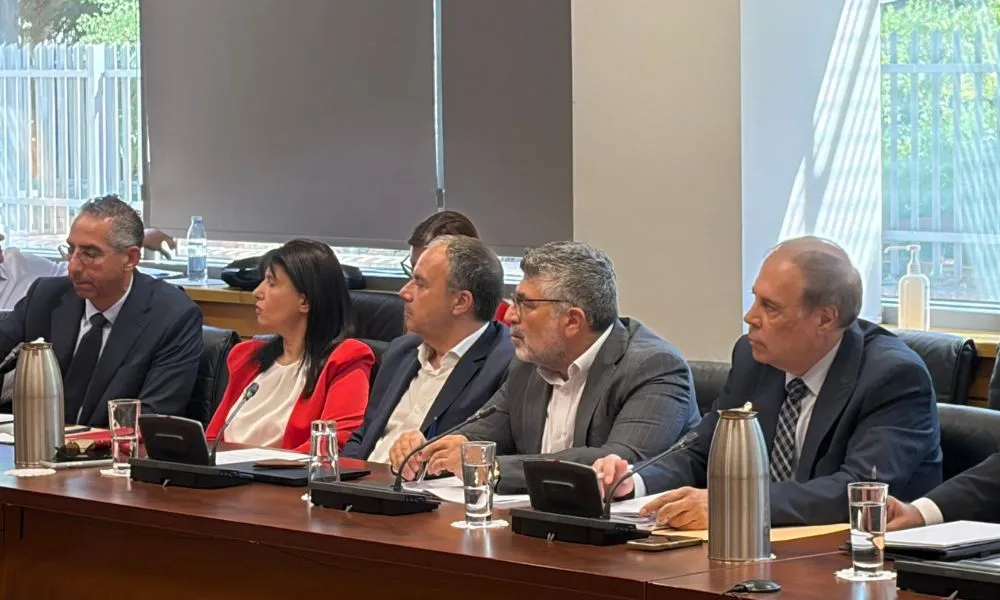
The bill on first-pillar pension reform will be submitted to the House of Representatives on September 20, 2026, regardless of the outcome of consultations with social partners, Labour and Social Insurance Minister Marinos Mousiouttas said during an event organised on Wednesday, July 1, by the Achilleas Kaimakli Sports Association on the theme Social Insurance Fund and Pensions – What Changes.
As he explained, the pension reform, which is expected to come into force on January 1, 2027, “constitutes the most important and emblematic priority of the Nikos Christodoulides government for 2026,” describing it as “a conscious act of social justice.”
“Regardless of whether a final agreement is reached with everyone before September, the legislation will be submitted to parliament so that discussion can begin with the legislative branch, because parliament has the final say,” Mousiouttas said.
Round of contacts with political parties
The Labour Minister announced that a series of meetings will be held in the coming period with parliamentary parties in order for the actuary to explain the technical details of the bill.
The aim, he said, is that when parties officially receive the bill in September, “they will know its strengths and weaknesses, what suggestions they wish to make and what concerns they intend to raise.”
Mousiouttas said it would be preferable if social partners agreed, or at least broadly consented, to the proposals before discussions begin with political parties.
“It would be much better for everyone if the social partners reach agreement, or at least consensus on most issues, so that we can speak with one voice when discussing the matter with parliamentary parties. Even if that does not happen, we will proceed and everyone will have to face their responsibilities,” he said.
Regarding the dialogue with social partners, the minister noted that “there is a system that everyone, absolutely everyone, agrees must change. The differences concern how much we give and to whom we give it. We approach these meetings in good faith in order to address concerns and questions that exist.”
Increases of up to 50% for low pensions
Outlining the main aspects of the planned reform, the minister said improving pension adequacy and reducing the risk of poverty are among the government's priorities.
“Our objective is to increase the basic pension to the greatest extent possible without affecting the capacity and sustainability of the Social Insurance Fund,” he said.
According to Mousiouttas, the greatest benefits will be directed towards low and middle-income pensioners.
“In several of the lowest pension categories, the increase will approach 50% of the current pension, while middle-range pensions will also see increases in double-digit percentages,” he said, adding that the increases will be phased in over five years, with 60% of the increase paid during the first two years following implementation of the legislation.
Commenting on figures that have appeared in public discussion, Mousiouttas said: “Minimum pensions are not going to reach the figures we have heard, such as €1,088, €1,100 or €1,200. I wish I could tell you they would reach €1,500 or €2,000. When you have a fund and certain constants remain unchanged, namely contributions from employees, employers and the state, and the retirement age is not changed, then the benefits that can be provided are specific. The only thing that can change, and this is where we await proposals from employers and trade unions, is whether they have well-studied proposals that would alter what we are proposing through the legislation.”
Main changes being promoted
The Labour and Social Insurance Minister also referred to the principal changes being promoted, while avoiding detailed discussion because consultations with social partners remain ongoing.
As he explained, the pensionable age will not increase and will remain at 65. However, those who wish to continue contributing until the age of 67 will be allowed to do so, thereby increasing their future pension.
At the same time, the government is promoting a substantial reduction in the actuarial reduction applied to those who retire before the age of 65. According to the minister, both current and future pensioners will benefit during the transitional period.
On this issue, he noted that there has been a proposal to abolish the 12% reduction.
“If you abolish it, you effectively lower the retirement age from 65 to 63. In no European country is the retirement age being reduced; on the contrary, it is being increased. We have said it should remain stable at 65. Every proposal must be accompanied by the necessary financial justification and philosophy,” he said.
According to Mousiouttas, the system will also be expanded to cover “new entrants to the labour market, informal carers, women who dedicated their lives to caring for their children and persons with disabilities,” through the recognition of credited contributions.
As part of measures supporting families and vulnerable groups, increases are planned for the majority of invalidity and widowhood pensions, calculated on the basis of the new basic pension. Additional improvements are envisaged for allowances relating to dependent children and orphan benefits.
At the same time, entitlement to sickness and unemployment benefits will be extended beyond the age of 63.
End to state borrowing from the Social Insurance Fund
The minister also placed particular emphasis on the management of the Social Insurance Fund reserve, which currently amounts to €12 billion.
“One of the most important decisions being taken by the government is that state borrowing from the Fund will stop,” he said, explaining that the gradual repayment of those amounts will begin.
To ensure transparency and efficiency, he said an independent supervisory authority will be established, fully aligned with European requirements, which will be responsible for managing and investing the reserve.
The Social Insurance Fund, he added, will evolve into “a strong investment fund working for the benefit of the insured themselves.”
Provident funds need more time
Regarding discussions on the second pillar of the pension system, which concerns occupational pension schemes and provident funds, Mousiouttas said dialogue is continuing, but acknowledged that the process requires another three to four years to mature.
“Trade unions want participation to be mandatory. On the other hand, employers want it to remain voluntary, as it is today. The state must find the golden mean between the two in order to achieve agreement and create a provident fund system, whether mandatory or voluntary,” he said.
He also expressed optimism, saying that despite the complexity of the issue, “I feel we will find the golden mean and move forward.”
According to Mousiouttas, current efforts are focused on reaching an agreement, which does not automatically mean implementation.
“It has been accepted that implementation will take place three to four years later. It is clear and accepted by everyone that there will first be an agreement on how this system will be created, and when the time comes, the legislation, the supervisory authority and all the other necessary structures will then follow,” he said.
Source: CNA