“As time passes, the Cyprus problem does not simply remain unresolved, it becomes increasingly complicated.”
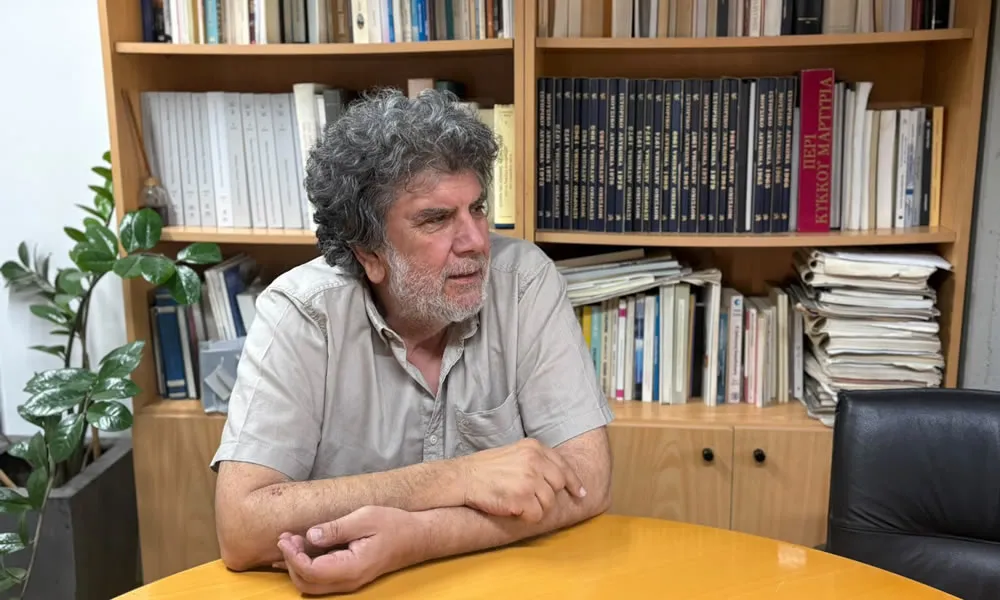
With that warning, journalist and Politis Media Group director Dionysis Dionysiou described the state of play surrounding new efforts to restart Cyprus talks during an appearance on Politis Radio's Morning programme with Katerina Eliadi. Despite discussion surrounding the possible presentation of a strategic framework or even a comprehensive settlement plan, Dionysiou stressed that there does not appear to be any specific written proposal currently before the two sides.
The UN Secretary-General's Personal Envoy on Cyprus, María Ángela Holguín, has held dozens of meetings in Nicosia, Athens, Ankara and with European Union officials, recording positions and attempting to gauge the reactions of those involved. However, Dionysiou noted that having ideas and intentions is one thing, while presenting a concrete draft proposal on which substantive negotiations can begin is quite another.
“The intention is very good and very positive,” he said, stressing the importance of having someone trying to move the process forward.
Good intentions alone, however, are not enough. Something specific must be placed on the table if a resumption of negotiations is to become a reality.
The logic of a ‘looser federation’
According to Dionysiou, the core differences between the two sides remain broadly the same as those outlined in the Guterres Framework. What may change is the way those differences are managed, within a broader and more flexible federal model. That model has been described as a “looser federation,” with significantly expanded autonomy for the two constituent states. Under such a structure, discussion could move away from the traditional model of a president, a vice-president and a presidential council.
At the same time, a federal parliament could potentially be formed through two local legislatures, while only a limited number of key ministries would remain under the authority of the central federal government. These could include foreign policy, migration, passport issuance and key areas of economic policy. Should the two communities wish to pursue closer cooperation and greater convergence in the future, they would have the ability to do so.
“If the two entities seek closer integration later on, the opportunity would be there,” he said.
Without territorial returns, a deal would face difficulties
Territory remains one of the most difficult chapters of any future settlement. In Dionysiou's assessment, a new agreement would struggle to gain acceptance within the Greek Cypriot community without the return of at least part of Morphou and without the recovery of certain coastal areas.
The passage of time, however, is making territorial adjustments far more difficult. Areas that were once relatively undeveloped have since been built up, creating new social, property and economic realities. Turkish Cypriots, meanwhile, expect that a settlement would provide political equality, international personality and a meaningful end to their isolation.
“As more time passes, the Cyprus problem becomes increasingly complex,” he said, noting that both the difficulties of territorial restitution and the likely costs of compensation and relocation continue to grow.
Security, NATO and possible gains for Turkey
In the chapter dealing with security, one of the ideas reportedly under discussion is the prospect of a reunified Cyprus joining NATO. Based on the picture Dionysiou has formed, Turkey no longer appears to object to Cyprus joining NATO after a settlement of the Cyprus problem. Ankara is nevertheless expected to place a number of demands on the table linked to EU-Turkey relations.
These include an upgrade of the EU-Turkey Customs Union, easier visa procedures for Turkish businesspeople and Turkish participation in the European SAFE defence programme. These issues carry significant economic and strategic importance for Ankara, particularly given the importance of the European market to the Turkish economy and the substantial production capacity of Turkey's defence industry.
Ideas for a gradual implementation process
Considerable discussion is also taking place regarding how any future agreement might be implemented. One concern is that a comprehensive settlement package submitted directly to referendums could encounter the same mistrust that emerged in previous attempts. For that reason, what Dionysiou described as “out-of-the-box” ideas are being discussed, involving a gradual process under which both sides would implement specific measures before a final agreement is completed.
Under such an approach, Greek Cypriots could gradually recover territory, such as the fenced-off city of Varosha, while Turkish Cypriots could receive forms of international upgrading, including access to ports or airports and the ability to conduct direct trade. Such steps would be, to some extent, irreversible. This means that even if a final agreement were later rejected in a referendum, the two communities would not return precisely to the status quo that existed beforehand.
As Dionysiou noted, a difficult question lies behind this discussion: what would happen to the Turkish Cypriots if negotiations were to fail again, particularly if the failure could not be attributed to their side? He clarified that he does not know how far any such international upgrading could go in the absence of a settlement. He referred, however, to hypothetical scenarios including the creation of an entity with limited international recognition, or a territory linked to the European Union without enjoying full membership rights and voting powers. As he stressed, these are ideas and scenarios being discussed, not decisions or agreed proposals.