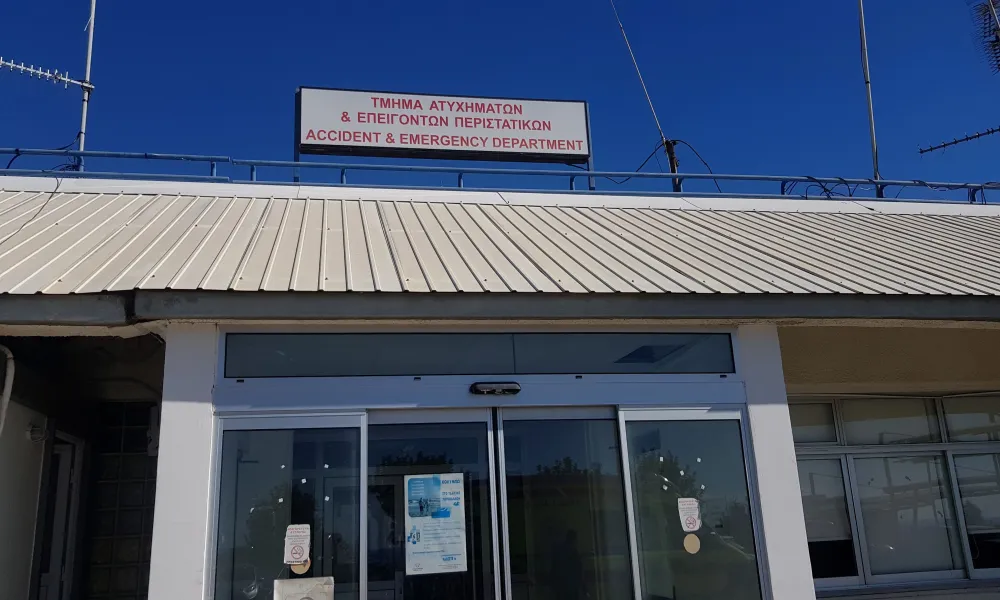

A body remained in a refrigeration unit at Paphos General Hospital's mortuary for 1,040 days, according to a report by the Audit Office, which identified a series of serious and long-standing shortcomings in the facility's operation.
The findings range from prolonged storage of bodies and risks of misidentification to inadequate equipment maintenance, an inoperative alarm system, unclear responsibilities and warnings dating back to 2023 that allegedly went unaddressed.
Audit reveals wider systemic problems
The Audit Office said a refrigeration failure recorded in May 2026 was only the trigger for a broader investigation that exposed chronic weaknesses in management, oversight, staffing, maintenance and governance.
According to the report, the problems extend beyond issues of dignity and respect for the deceased and their families, raising concerns about workplace safety, hygiene and public health.
Body remained in refrigerator for nearly three years
One of the most serious findings concerns the length of time bodies were stored.
The Audit Office cited international guidelines stating that when a body is not expected to be released promptly, it should generally be transferred from a refrigeration unit to a freezer facility after approximately 30 days.
At Paphos, auditors found several cases far exceeding that period.
The most extreme case involved a body that remained in a refrigeration unit for 1,040 days, nearly three years.
Other bodies had been stored for:
- 533 days.
- 234 days.
- 172 days.
- 39 days.
The Audit Office concluded that internationally accepted standards were not being followed, potentially affecting both preservation conditions and the dignified handling of remains.
Seven bodies affected by refrigeration breakdown
When the refrigeration unit malfunctioned in May, it was not empty.
A total of 11 bodies were being stored in the mortuary at the time, including four in the freezer chamber and seven in the refrigeration unit that failed.
Six of the seven bodies were transferred to the mortuary of Limassol General Hospital, while relatives arranged the burial of the seventh body.
Concerns over identification and traceability
The report also highlighted weaknesses in procedures governing the identification and tracking of bodies.
Auditors found that documentation prepared for the transfer of bodies to Limassol included details relating to a seventh body that was never moved.
When auditors requested the corresponding receipt documentation from Limassol General Hospital, they received the same form containing handwritten alterations but lacking both a signature from the receiving officer and a date identifying when the changes had been made.
As a result, auditors said they could not determine when the discrepancy was discovered or corrected.
The report warns that shortcomings in tracking procedures create risks of inaccurate recording of body locations and difficulties in locating remains when required.
Unclear responsibility for mortuary operations
The Audit Office also identified confusion regarding institutional responsibilities.
Correspondence examined during the investigation suggested that OKYPY management was unaware that responsibility for mortuary operations fell under the organisation's remit.
The issue was only clarified in an email sent on 7 May 2026 by the organisation's chief executive to the executive director responsible for the Limassol-Paphos region.
Auditors concluded that responsibilities had not been sufficiently defined at organisational level.
Fault discovered after strong odour
The report also found significant deficits in equipment monitoring.
There was no systematic temperature recording for refrigeration chambers, no central register of faults, repairs or maintenance activity, and OKYPY did not possess a copy of the maintenance contract.
Auditors said they were unable to verify whether scheduled maintenance had been carried out at the required intervals.
The report further criticised both the contractor's performance and OKYPY's oversight of the maintenance agreement, while also raising concerns regarding the role of the Electromechanical Services Department.
Alarm system not functioning
A maintenance contract dating back to February 2015 required the installation of an audible and visual alarm system to warn of temperature irregularities.
Although such a system had been installed, auditors found it was not operational.
According to the report, OKYPY was unaware this requirement existed under the contract.
As a result, the refrigeration failure was detected only after a strong odour developed within the hospital premises, suggesting that the malfunction had occurred some time earlier.
Following the inspection, a new alarm system was installed on 5 June 2026.
No emergency response plan
Auditors also found that no business continuity plan existed to outline procedures, responsibilities and alternative storage arrangements in the event of equipment failure.
This was despite indications that similar breakdowns had occurred previously.
Mortuary assistant transferred without replacement
Until May 2026, the mortuary employed a mortuary assistant responsible for tasks including body transfers, temperature monitoring, record-keeping and supervision of cleaning procedures.
After post-mortem examinations ceased in Paphos, the employee was transferred to Nicosia General Hospital.
According to the report, no replacement was assigned and no formal handover of duties took place.
Some responsibilities were instead assigned to A&E porters who, auditors noted, lacked specialised mortuary training and experience.
Complaints raised since 2023
The Audit Office found that employees at Paphos General Hospital had been raising concerns since 2023.
Complaints reportedly referred to strong decomposition odours affecting nearby workspaces, overcrowding within the mortuary and inadequate cleaning conditions.
Despite repeated warnings to both hospital management and OKYPY, auditors said corrective action was not taken.
OKYPY accepts findings
In its response, OKYPY said it agreed with the Audit Office's findings and recommendations and stated that corrective measures had already been initiated.
The organisation argued, however, that responsibility for maintenance contracts lies with the Electromechanical Services Department.
The Audit Office responded that, regardless of who manages the contract, the hospital had a responsibility to monitor the condition of critical equipment and report faults promptly.
OKYPY said it has since installed a new automatic temperature-monitoring system, begun work on a central register for maintenance and repairs, and started preparing a business continuity plan.
The organisation also said interim arrangements have been agreed with Limassol General Hospital for the transfer and temporary storage of bodies should another refrigeration failure occur.
Regarding staffing, OKYPY said consultations with trade unions are ongoing.
The Ministry of Health stated that unclaimed bodies are buried once post-mortem examinations and coroner's procedures have been completed, sufficient time has elapsed and the necessary documentation has been obtained.