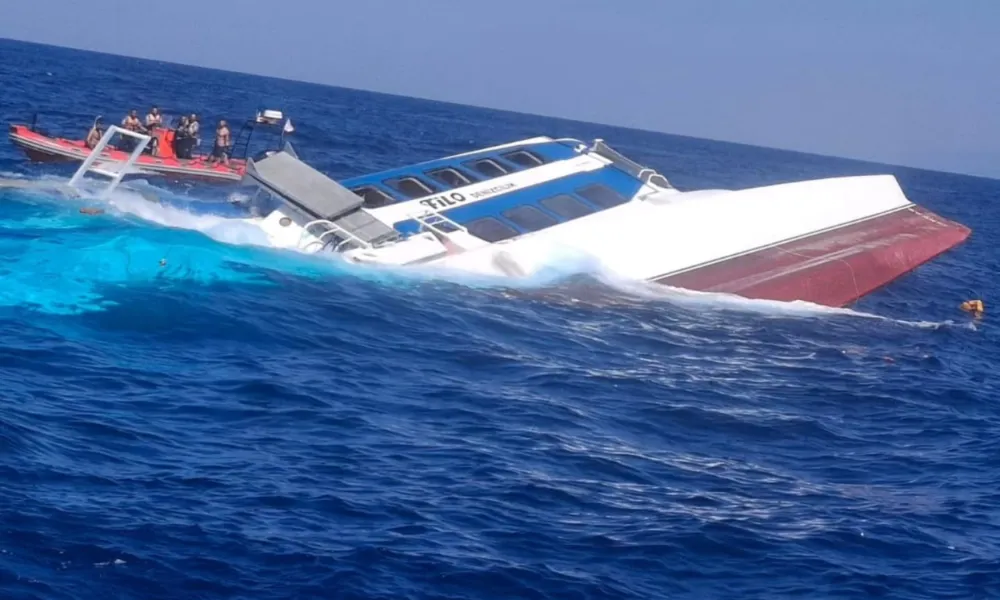

New details about the technical history of the FİLO JET have emerged as investigations into the deadly sinking off Kyrenia intensify and search-and-rescue operations continue for the 18 passengers still missing.
Attention is increasingly centred on the catamaran's inspection history, operating permits and previous incidents involving the vessel.
The latest confirmed toll remains eight dead, 18 missing and 241 survivors. According to passenger records, 267 people were on board, including 259 passengers and eight crew members. The figures have been confirmed by Turkish Cypriot leader Tufan Erhürman.
The wreck lies at a depth of approximately 514 metres, and investigators believe crucial answers may come from locating and examining the vessel's data recorder, commonly referred to as the "black box".
Court proceedings begin
Alongside search-and-rescue efforts, both criminal and technical investigations are under way.
The captain and seven other crew members were detained following the sinking. The "prime minister" Ünal Üstel previously said the inquiry would examine every aspect of the disaster.
According to reports published on Monday, court proceedings have already begun, with Turkish media reporting that the captain has been remanded in custody pending further investigation.
Authorities are seeking to establish both how the vessel began taking on water and whether the crew's actions before and during the evacuation complied with safety procedures.
FİLO JET's earlier identity
Particular interest has focused on the vessel's past.
The FİLO JET previously operated as the Iris Jet under IMO number 8962034, according to international vessel databases that list both names for the same craft.
The catamaran was built in La Rochelle, France, in 2000 and operated routes in the western Mediterranean during its early years, including services between Menorca and Mallorca.
Earlier water-ingress incident reported
Turkish Cypriot outlet Detay Kıbrıs has reported that the vessel was involved in a serious incident more than two decades ago.
Citing documents from a French court case involving an insurance dispute, the report states that the then-Iris Jet struck a pier on 26 October 2003.
Roughly ten days later, the vessel reportedly experienced a significant water-ingress problem.
According to the report, claims were made during the insurance proceedings that continued operation of the catamaran before repairs were completed may have aggravated existing damage.
There is currently no official finding linking the 2003 incident to the present disaster, but investigators are expected to examine the vessel's full maintenance and repair history.
Questions over 2018 inspections
More recent concerns relate to inspections reportedly carried out in 2018.
According to claims cited by Serhat Akpınar, secretary-general of the Democratic Party and a "member of parliament" for Kyrenia, the vessel underwent inspections by Türk Loydu on 19 March 2018 and 26 May 2018, followed by a sea trial in Antalya on 13 June 2018.
Akpınar says the inspections recorded 29 observations relating to defects, deficiencies or departures from regulatory requirements.
The findings were reportedly referenced in proceedings before the 17th Commercial Court of Istanbul.
A key question now is whether all of those observations were resolved before the vessel was permitted to operate services to and from Kyrenia.
Twenty-two questions submitted
Against that backdrop, Akpınar has submitted 22 questions to the so-called Ministry of Public Works and Transport seeking publication of the vessel's permits, certificates and inspection records.
According to reports by Haber Kıbrıs and Kıbrıs Gerçek, the questions cover nearly every aspect of the catamaran's seaworthiness history, including:
- Operating licences and renewals.
- Safety certificates.
- Classification records.
- Technical inspections.
- Inspection findings.
- Maintenance documentation.
He is seeking clarification on what documents were submitted to secure operating permission, which organisation certified the vessel and whether all safety certificates remained valid on the day of the sinking.
Focus on hull integrity
Particular attention has been directed at the vessel's aluminium hull.
Akpınar is requesting information on possible:
- Material fatigue.
- Corrosion.
- Structural cracks.
- Other hull weaknesses.
He is also seeking details regarding watertight compartments, pumping systems and past repair or maintenance work.
What did the 2026 inspection find?
One of the most significant questions concerns an inspection reportedly conducted by Türk Loydu in 2026, before the disaster.
Akpınar has requested disclosure of:
- The exact date of the inspection.
- The conclusions of the review.
- Any condition reports.
- Seaworthiness certificates.
- Recommendations or observations issued.
He is also asking whether inspectors identified any structural or technical problems requiring corrective action.
In addition, he has renewed calls for documentary proof that all 29 observations recorded in 2018 were addressed and for clarification on which organisation certified the remedial work.
Sources: Haber Kıbrıs, Detay Kıbrıs, Kıbrıs Gerçek and Kıbrıs Postası.