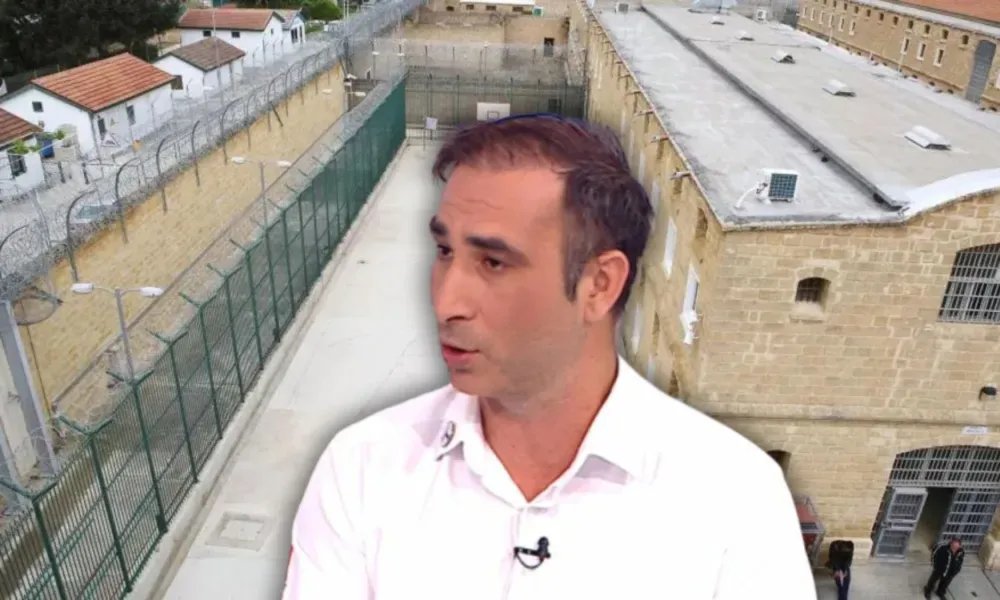

Giorgos Maltezos, president of the Prison Guards Sectoral Council of the ISOTITA trade union, has levelled serious allegations concerning conditions at the Central Prison, claiming the institution is facing a security crisis driven by chronic understaffing and overcrowding.
In a statement released on Thursday, Maltezos said conditions had deteriorated to such an extent that effective management of the correctional facility had become extremely difficult. He added that the union had repeatedly warned the relevant authorities in writing about the risks arising from the situation.
Recent incidents cited
As a recent example, Maltezos referred to two separate fights that allegedly occurred on 5 August in different prison wings, resulting in the injury of an inmate.
According to him, these incidents are not isolated events but form part of a broader pattern of serious disturbances recorded in recent months.
References to rape allegation, violence and arson
In his statement, Maltezos also pointed to a reported rape allegation involving an inmate that became public in September 2025, a serious clash involving sharp objects in June 2026, and a fire at a maximum-security wing in July 2026, during which a member of staff was taken to hospital after suffering smoke inhalation.
He further claimed that drug trafficking within the prison remains an ongoing problem.
Maltezos also cited observations by the European Committee for the Prevention of Torture (CPT) regarding the difficulties staff face in exercising effective control because of personnel shortages.
State accused of failing to ensure safety
The union leader attributed responsibility for these incidents to what he described as the state's failure to guarantee safe conditions for both inmates and prison employees.
He argued that detainees are under the exclusive responsibility of the state and that adequate safeguards should therefore be in place to protect everyone within the facility.
Allegations of union silencing
Particular reference was made to Maltezos’ own dismissal on 31 July 2026, when he was serving as vice-president and spokesperson of the Prison Guards Sectoral Council. He now holds the position of elected president.
According to ISOTITA, the dismissal constituted an attempt to silence union representatives who speak publicly about problems within the prison system.
Swipe at rival union over funding
ISOTITA further claimed that it receives no state funding, unlike another trade union operating in the sector.
According to Maltezos, this allows the union to maintain its independence when criticising public authorities and raising concerns about conditions in the prison system.
Call for immediate action
Maltezos concluded by urging the state to move swiftly on measures aimed at:
- Increasing staffing levels.
- Reducing prison overcrowding.
- Improving working conditions.
- Protecting staff from biological hazards.
He said these demands have already been submitted in writing to the relevant authorities and warned that further delays could have serious consequences for the security of the prison.