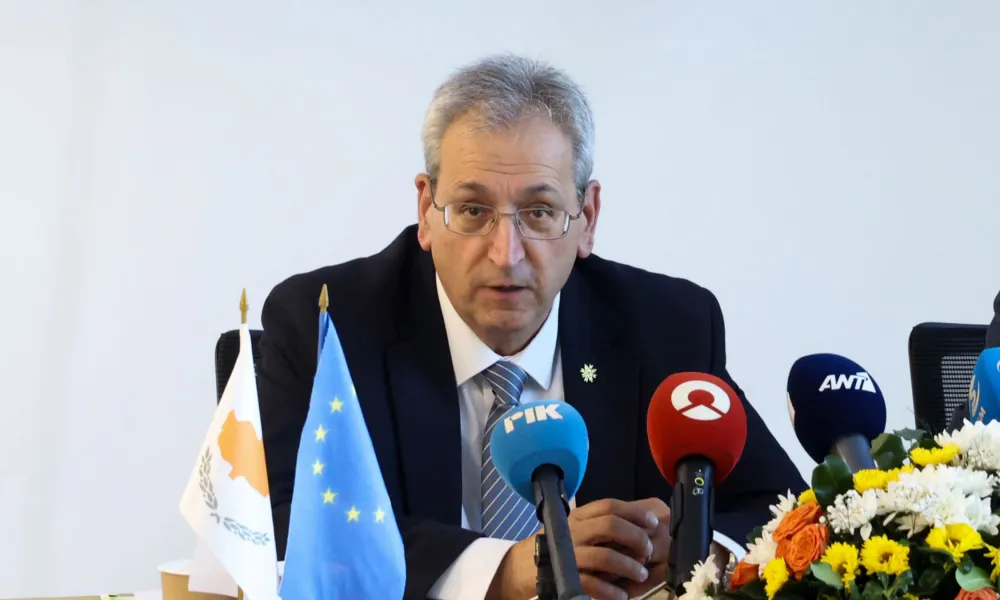



The draft bill on pension reform is expected to be completed by the end of next week, when it will be handed to the social partners, Labour and Social Insurance Minister Marinos Mousiouttas told CNA. Representatives of the social partners said they are waiting to receive the draft so they can set out their positions on it.
Mousiouttas said he will meet Finance Minister Makis Keravnos on 5 August to discuss the financial aspects affecting the state budget, adding that the government's policy is unified. A meeting with the president will follow, and the minister estimated that the process should be wrapped up within the following week. Depending on the decisions taken, the bill will be amended if necessary and then passed to the social partners and put to public consultation as soon as possible, followed by meetings to brief stakeholders and hear their questions and concerns.
Mousiouttas said he also intends to ask parliamentary parties for meetings, with an actuary present, to brief them on the details of the legislation so they are prepared once debate begins. Asked whether he believes the partners' positions are converging, given that he already knows the content of the draft, he said their positions are known, but that everyone will be in a better position once they see the bill and the reasoning behind each decision, which he suggested could shift some views.
He clarified that since the retirement age and contribution rates will not rise, the reform's design represents the fund's maximum possible use of its resources. Any change involving additional spending, he said, would need to be matched by a proposal to cut spending elsewhere, depending on priorities. Asked where the revenue for the reform would come from, given no increase to the retirement age or contributions, the minister pointed to a rise in the number of contributors, stronger checks against undeclared work, and existing surpluses, though he noted the surpluses must be managed with a 40-year horizon in mind, in line with the actuarial study.
He added that after 2028, once surpluses begin flowing into a new fund to be established through legislation submitted by the end of 2027, along with a related supervisory authority, the fund's investment policy will also be part of the planning, and is projected to generate returns each year. Mousiouttas said the first pillar's implementation horizon runs to 1 January 2027 for the revision of pensions and related benefits, and that reaching a framework agreement on the second pillar and provident funds would also be welcome. Despite a slight delay, he said the timeline set out should still be met, adding that everyone recognises the reform must succeed and be completed as soon as possible, and that differences of opinion should not outweigh that larger goal.
Employers want more detail before committing
The social partners are waiting for the labour ministry to send the draft bill, and say they are ready to meet the minister in August, even as several issues remain unresolved, CNA reported.
Philokypros Rousounides, secretary-general of the Cyprus Chamber of Commerce and Industry (Keve), said employer organisations are waiting for more information from the ministry and for the draft bill to be tabled. Referring to the minister's public comments on a package of increases ranging from 5% to 55% and a reduction in the 12% actuarial adjustment, Rousounides said what employers most want to see is the contribution rate and retirement age. If these remain unchanged, he said, an updated actuarial study will be needed on the reform's impact on the system's long-term sustainability, since benefits are being increased. He said this combination, raising benefits without changing the contribution rate or retirement age, raises the key question of what the cost of the reform is and who bears it, adding that for Keve the priority is safeguarding the sustainability of the Social Insurance Fund.
On the second pillar and provident funds, Rousounides said Keve supports voluntary expansion of provident funds, backed by strong incentives for the state, employers and workers, wherever this can be applied, but opposes making this mandatory across the board. He said such an obligation could affect the viability and competitiveness of small and medium-sized businesses already facing rising operating, energy and financing costs alongside greater regulatory demands, and could lead to fewer new hires, reduced investment, or smaller pay rises for existing staff. He said any such change should be pursued through genuine social dialogue that allows flexibility and solutions balancing social protection with business competitiveness. Asked whether the necessary convergence between the social partners can be found, he said dialogue is the only way to reach solutions, and that Keve is discussing every aspect despite having made clear its opposition to mandatory second-pillar coverage, while the main question for the first pillar remains the cost of the reform, who will bear it, and whether the fund's sustainability will be affected. He said that if the timelines given are kept, a meeting with the labour minister should be arranged within August.
Unions flag open questions on both pillars
Andreas Matsas, secretary-general of the Cyprus Workers' Confederation (SEK), said the last official meeting of the Labour Advisory Board on the issue was held on 22 June. He said unions are awaiting the preliminary framework for the first pillar, while technical committee talks continue on the second pillar, with a target of completing that process by mid-October, adding that the overarching goal remains the alignment of reform planning across all pillars linked to the pension system.
Asked whether the minister's timeline, tabling the bill in parliament by 20 September, could hold given that the second pillar is expected to conclude later, Matsas said these are separate bills. He said the first-pillar bill could be tabled in parliament, but that it would not be acceptable to unions for it to be voted on without the second pillar's design also being agreed, even if the two pillars are not implemented simultaneously, since the overall planning needs to be settled.
He noted that political parties have largely stated their positions, and said he believes it would be preferable to extend discussions within the Labour Advisory Board while keeping January as the target for implementing the reform, rather than table something that isn't agreed to the fullest possible extent among the partners, risking delays in parliament and changes to the framework that would force the debate to be reopened.
Matsas pointed to the 5 August meeting between the labour and finance ministers as a milestone, saying they are expected to look at the bill as a whole and flag any issues needing adjustment, and that if the final draft has no major discrepancies, the president will review it before it is sent to the social partners, likely around 8 to 10 August. He noted that the mid-August holiday period will affect availability at the labour ministry and among union and employer officials alike, meaning substantive discussions will likely only resume from late August.
Asked about the remaining differences between the social partners, Matsas said unions do not yet have a clear picture of the draft's contents, since matters such as pension levels, the supplementary welfare approach from the deputy ministry of welfare, and the 12% adjustment remain unresolved, and that unions are waiting to see the draft before taking a specific position, though he believes convergence is possible. He added that even where positions appear diametrically opposed, as with mandatory provident funds under the second pillar, he is convinced a resolution can be found with the right handling.
Sotiroula Charalambous, secretary-general of the Pancyprian Federation of Labour (PEO), said the 5 August ministerial meeting is expected, with the second-pillar technical committee due to meet again on 6 August, adding that PEO is waiting to see whether a roadmap will be agreed for extending provident fund coverage to all workers.
Beyond the draft bill, she said other issues remain open, including the "pillar zero" allowance for low-income pensioners and the income threshold for eligibility, adding that PEO will take an overall position once the government's final stance on these matters is submitted. She said the minister had informed her the bill would be sent within August, with the Labour Advisory Board expected to convene again in the last week of the month.
Charalambous said how close or far apart the sides are will depend on these questions, and that she would be able to say more specifically whether PEO agrees or disagrees once she sees the bill and the provisions for the first pillar, pillar zero and the second pillar. She added that unions are also pushing to resolve widower's pensions for men, provident funds, and the 12% actuarial reduction, saying the government's proposal on the latter, as presented, is not satisfactory.
Source: CNA