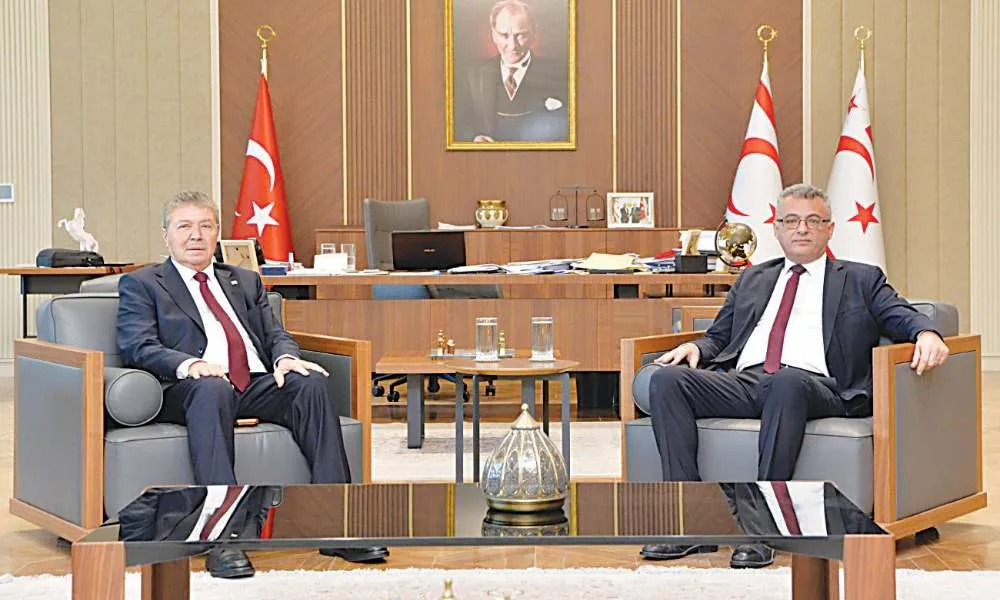

The prospect of early parliamentary elections in the north is moving rapidly up the political agenda as the coalition government of the National Unity Party (UBP), Democratic Party (DP) and Rebirth Party (YDP) faces growing pressure and visible political fatigue, according to Havadis journalist Hasan Düzgün.
Speaking to Politis, Düzgün says the three parties are making every effort to avoid an early election, but public dissatisfaction is growing while allegations of corruption and poor governance continue to multiply.
Polls show declining support
Düzgün says a series of opinion polls point to a significant decline in support for the governing parties.
Some surveys, he notes, suggest that the Democratic Party (DP) could fail to enter the next parliament altogether if it does not clear the electoral threshold.
At the same time, the same polls indicate that Prime Minister Ünal Üstel of the UBP could face difficulties securing re-election as an MP, highlighting what Düzgün describes as the substantial erosion of support for the current administration.
The journalist attributes part of the current situation to the economic policies pursued in recent years.
He argues that the current government was formed with Ankara's support as part of a political arrangement that served both Turkey's objectives and Turkish business interests.
According to Düzgün, public finances have reached a particularly difficult point, with the administration repeatedly resorting to borrowing even to cover public-sector salaries.
Possibility of a double election
Düzgün also draws attention to proposals for parliamentary elections to be held on the same day as the scheduled local elections in December.
According to him, the proposal originates from the government, while many believe its aim is to create confusion during the electoral process.
As he explains, voters would be required to cast ballots simultaneously for mukhtars, community councils, municipal councils, mayors and MPs, potentially involving up to seven separate ballot papers.
Under such a scenario, vote counting could take several days and create significant organisational challenges.
Even so, the proposal faces strong opposition from opposition parties as well as other political and social groups, making it uncertain whether it will ultimately go ahead.
Cyprus issue
Düzgün links political developments in the north with the future of the Cyprus problem, arguing that a potential victory for the Republican Turkish Party (CTP) could create different political conditions should negotiations resume.
In his view, the prospect of a centre-left government is regarded by many Turkish Cypriots as an important factor for the future of the Cyprus issue, helping explain growing support for early parliamentary elections.
Government losing public support
The possibility of early parliamentary elections has become one of the biggest unknowns in Turkish Cypriot politics.
Although parliamentary elections are officially scheduled for January 2027, discussions about bringing them forward have intensified, with parties from both the governing and opposition camps seeking to shape alliances and strategies ahead of time.
Düzgün describes a government suffering significant political wear and tear, worsening economic conditions and rising public dissatisfaction. He believes a victory by the CTP could positively influence future developments in the Cyprus issue.
One proposal under discussion is to hold parliamentary elections on the same day as local elections.
However, the scenario faces significant practical obstacles.
Because of the cross-voting system used in the north, vote counting is already highly complex and time-consuming.
Judicial authorities have reportedly expressed reservations, arguing that conducting both elections simultaneously would create an extremely burdensome process that would be difficult to complete smoothly.
Coalition divisions
Different approaches have emerged within the governing camp itself.
- The Rebirth Party (YDP), led by Erhan Arıklı, supports early elections because it believes it is gaining momentum and wants to convert that momentum into electoral gains.
- The Democratic Party (DP) opposes an early vote because it is widely seen as suffering political decline and would likely be disadvantaged by a near-term election.
- The National Unity Party (UBP), led by Prime Minister Ünal Üstel, appears to be trying to buy time. According to reports, it has simultaneously pursued public spending measures and public-sector recruitment in an effort to strengthen support among key voter groups through traditional patronage networks.
Key voter groups
This strategy also includes the recent approval of various measures involving allowances and increases in leave entitlements within the public sector.
Similar measures have been introduced for the police and employees of the Turkish Cypriot broadcaster Bayrak.
These groups are regarded as important electoral constituencies, reinforcing speculation that the UBP is already preparing for an election campaign regardless of when the vote ultimately takes place.
Ankara remains decisive
According to analysts, Ankara's position remains the determining factor.
So far, the Turkish government has not clearly indicated whether it supports early elections.
A key question is whether Ankara would accept the formation of a coalition led by Tufan Erhürman's Republican Turkish Party (CTP).
People's Party leader Kudret Özersay has left open the possibility of participating in such a government.
Similar signals have also come from the Communal Democracy Party (TDP).
At the same time, the CTP appears to be making efforts to improve relations with Ankara.
In that context, recent contacts in Turkey by party chair Sıla İncirli have attracted particular attention.
Parliament in the north suspended its work a few days ago and is expected to reconvene in October.
Should a decision be taken to hold early elections, parliament would have to return earlier to vote for its own dissolution and formally open the way to the polls.
The summer season presents another obstacle.
High temperatures make an intensive election campaign particularly difficult.
That does not mean parties are inactive. On the contrary, they have already intensified activities, organising events and meeting voters in preparation for every possible scenario.
Cyprus issue likely to take a back seat
As far as the election agenda is concerned, the Cyprus issue is expected to play a secondary role.
The UBP appears unwilling to place the issue at the centre of its campaign, particularly following Ersin Tatar's defeat by Tufan Erhürman in the recent presidential election.
Erhürman has argued that his victory reflected Turkish Cypriots' desire for a settlement, claiming that 67 per cent of those who voted for him did so because they want the Cyprus problem resolved.
This is one reason why the UBP, which continues to advocate a two-state solution, is unlikely to emphasise the issue during the campaign.
Instead, the economy and corruption are expected to dominate any election debate, as both directly affect daily life.
Relations between political rivals are already described as highly toxic.
As long as the prospect of early elections remains alive, tensions are expected to intensify further, even before a final decision is taken on when and under what conditions voters will return to the polls.