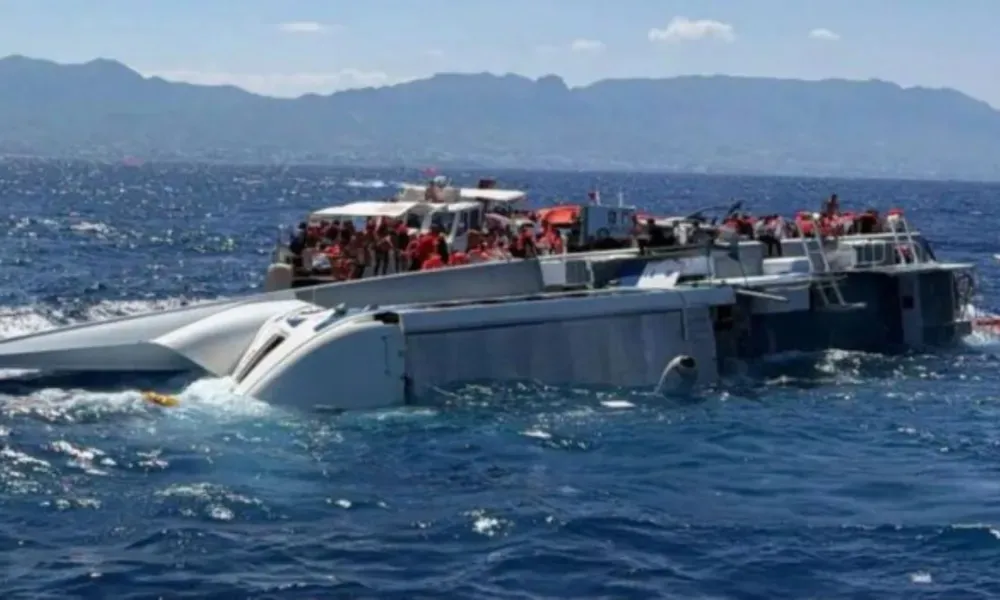

The deadly sinking of the Filo Jet catamaran off Kyrenia on Sunday, 30 August, has once again highlighted the lack of a common mechanism for cooperation between the operational forces of the Republic of Cyprus and the Turkish Cypriot side in disaster response and crisis management.
Although there have been instances of mutual assistance, particularly during wildfires, as well as communication channels through technical committees, more substantial operational cooperation remains complex.
Common protocols, unified coordination, training, safety arrangements and questions surrounding recognition remain key challenges. Officials and experts, however, believe there is both scope and a need for closer cooperation, provided there is the necessary political will.
Cooperation has varied with Cyprus talks
Developments in the Cyprus problem have historically affected the level of cooperation between the two sides on humanitarian issues.
Periods of improved relations between the two leaderships and greater momentum in negotiations have created more opportunities for coordination and joint action. When relations have deteriorated, however, cooperation has become more difficult.
Despite the political and operational obstacles, the two sides have on several occasions in recent years either offered or requested assistance from one another.
Not all offers were accepted, but there have also been instances where cooperation was put into practice.
From 1995 to 2016
In 1995, when a major wildfire broke out in the Pentadaktylos mountain range, the Republic of Cyprus offered assistance, but the offer was not accepted by the Turkish Cypriot side.
The situation was reversed in 2016 during the major Solea wildfire, when then Turkish Cypriot leader Mustafa Akinci offered assistance.
The offer was not initially taken up, as authorities considered that sufficient resources were available. A subsequent offer of Turkish aerial assets also did not proceed because of disagreement over operational control.
Mutual assistance became reality
A turning point came in 2020.
In May of that year, during a major wildfire in the Kormakitis-Diorios area, the Turkish Cypriot side requested assistance and the Republic of Cyprus responded by sending aerial assets.
Several weeks later, three firefighting aircraft and a helicopter were again sent to assist with another fire near Kythrea.
Similar cooperation took place in 2022 during the Kantara wildfire, when the Turkish Cypriot side requested assistance through the United Nations. The Republic of Cyprus sent two aircraft and a helicopter and also helped secure Israeli aerial assets.
Conversely, during major wildfires in Limassol in 2023 and 2025, the Turkish Cypriot side offered personnel and equipment. The assistance was ultimately not used, with the Republic of Cyprus determining that its available forces were sufficient or that the main requirement was for aerial assets.
Filo Jet assistance offer was not accepted
A diplomatic source with knowledge of the issue said there is scope for more substantive cooperation between the two sides on crisis management and suggested that recent developments could provide an opportunity for more systematic discussions.
Regarding the Filo Jet sinking, the source confirmed that the Republic of Cyprus offered assistance, but was told that it was not necessary.
Search and rescue operations are particularly complex and require precise operational coordination, especially when forces that do not come under a common command structure are involved.
For this reason, the source said, additional forces cannot simply be incorporated into an operation on an ad hoc basis without prior agreement on command arrangements, procedures and the responsibilities of each side.
The two sides already have Technical Committees, including the Technical Committee on Crisis Management, which can serve as channels for coordination and cooperation depending on the nature of an incident.
In the case of the latest sinking, however, that mechanism was not activated because the offer of assistance was not accepted.
Experts call for cooperation on solid foundations
George Boustras, a professor who recently took over as head of the Greek Cypriot side of the Technical Committee on Crisis Management, said the committee had not been involved in the Filo Jet incident.
“Nothing was done through the committee in relation to this particular case,” he said.
He explained that specific and established crisis management plans are already in place for such incidents, making it difficult to incorporate an external actor into an operation without prior preparation.
“This could be part of the committee's future work,” he said, adding that there was clear scope for cooperation, particularly in training and public awareness.
Joint operational action, however, was considerably more complicated.
As an EU member state, the Republic of Cyprus operates under specific civil protection protocols, certifications and procedures. A key difficulty, Mr Boustras said, was the lack of a similarly clear picture of the operational system used on the other side.
In rescue operations, wildfires or floods, all forces need to operate with a common operational picture and under a defined system of command and control.
“The safety of those involved is non-negotiable,” he stressed, adding that cooperation could not be conducted on an ad hoc basis.
Preparation, training and coordination would be required.
Operational challenges remain
Mr Boustras placed particular emphasis on safety.
A helicopter or firefighting aircraft cannot simply join an operation without knowing who is in command, where other assets are operating and which procedures are being followed.
“This requires preparation, it requires training and, where possible, joint training,” he said.
Joint training is complicated, however, by the particular circumstances in Cyprus. The presence of Turkish occupying forces and issues surrounding recognition limit the possibilities for joint exercises and institutionalised cooperation.
As a more realistic first step, Mr Boustras suggested mapping the protocols and procedures used by each side to identify areas of common ground.
“We need to see what protocols exist and find out whether there is common ground,” he said.
Having only recently taken up his position, he added that his first step would be to meet with the Turkish Cypriot side and establish its approach.
Political will was necessary, he said, but would not be sufficient on its own.
“It would be nice if it were simply a matter of political will. But it is not that easy; there are operational difficulties.”
Could a European hub provide a new opportunity?
Cooperation in firefighting is already more developed, according to Fire Service Chief Brigadier General Nikos Logginos.
Speaking to Politis, he said communication and mutual assistance procedures were already in place and had been activated in the past when assistance from the Republic of Cyprus was requested for fires in the occupied areas.
Each request is assessed according to the circumstances at the time.
If sufficient resources are available, or assistance has already been secured through bilateral agreements or the European Civil Protection Mechanism, additional assistance from the other side may not be required.
Mr Logginos also said officials and services from both sides participate in committees dealing with crisis management, civil protection and wildfires. Such contacts take place several times a year.
“If they need help, we are at their disposal. They always ask us whether we need help. So there is this consultation,” he said.
Moving towards more advanced forms of cooperation, including joint activities or training, would require a political decision.
“A move to a higher level would concern political decisions,” he said.
A potential new opportunity could come with the planned establishment in Cyprus of a European regional hub for forest fires and other emergencies.
The plans envisage Cyprus also serving as a training and exercise centre for the wider region.
Mr Logginos said it was possible that the facility could eventually be used to train Turkish Cypriots, although he stressed that such a move would require a political decision.
The diplomatic source similarly saw no immediate reason why such a possibility should be excluded if the hub becomes operational.
The issue, however, has not yet been formally raised in talks.