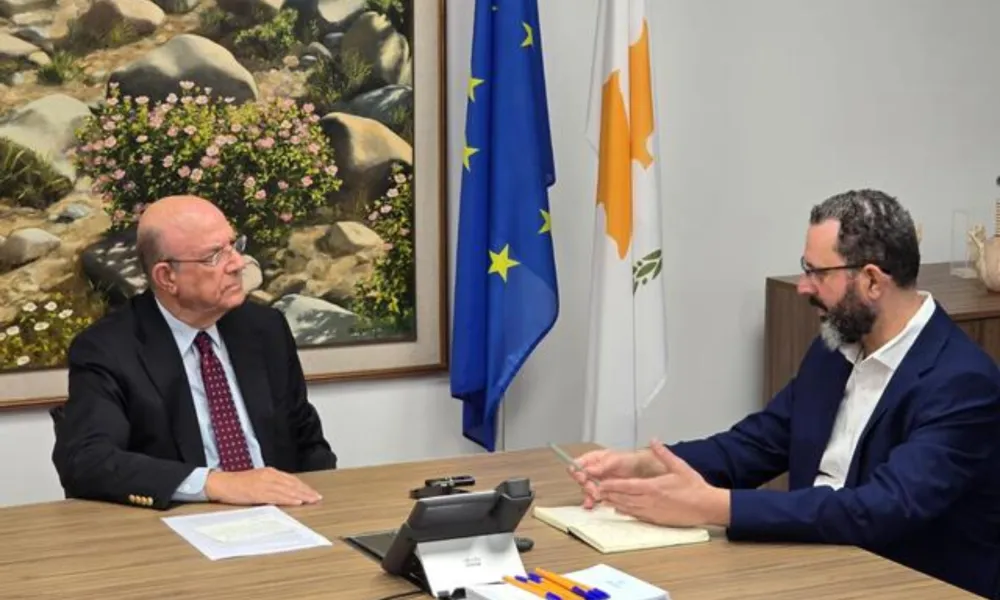

The acceleration of reforms in the public service and semi-governmental organisations, while maintaining fiscal discipline and strengthening social policy, are among the key priorities set out by Finance Minister Makis Keravnos.
In his interview with Politis, he discusses changes being promoted to the public-sector recruitment system, the debate over salary scales and the need to improve the performance evaluation system for public servants. At the same time, he announces changes to the corporate governance model of semi-governmental organisations, aimed at creating more independent administrations and a clearer separation between the strategic role of boards of directors and day-to-day management.
On the fiscal front, Keravnos says the government will continue its policy of generating surpluses and reducing public debt, ruling out the prospect of austerity. Fiscal management, he stresses, will remain prudent and strictly within the economy’s capabilities. At the same time, the government is seeking to channel some of the benefits of economic growth back to society, with an emphasis on vulnerable groups. The overall social protection package exceeds €1 billion, according to the minister.
The guardians are keeping watch
Starting with the current situation, we are once again seeing intense geopolitical tensions and rising oil prices, which are having a direct impact on the energy sector. This comes as preparations are under way for the 2027 state budget, while significant state commitments are also accumulating – social policy, defence investment and pensions. How will all of this fit together, and what are your thoughts on funding these commitments through the budget?
“The guardians are keeping watch.” We have been working on the budget since June and are weighing up all the data, including geopolitical tensions. In our planning, we take into account not only domestic needs but also the obligations arising from the European Union.
You will see, for example, a significantly increased budget for the Ministry of Defence, not only for our equipment needs but also to meet our European commitments. The budget will retain its people-centred character, focusing on social policy and development. It remains balanced, responding to the rapid developments that are creating new economic and social demands every day. Unfortunately, these demands are being shaped on a daily basis by the rapid developments taking place abroad.
Electricity and fuel
Staying with the cost of energy, Cyprus has a high dependence on liquid fuels both in transport and electricity generation. Will the relief measures be extended? Are you planning a new package or will you stick with the existing approach?
For the current period, the intention is to continue the measure of reduced tax rates on fuel. However, I would remind you that EU guidelines explicitly state that support measures for the energy crisis must be targeted and short-term. Countries that recently sought to activate the energy escape clause did not find favourable ground at the Commission, which issued strict recommendations.
We must therefore operate within these parameters, bearing in mind that energy costs remain a negative factor for inflation and the competitiveness of our economy. For this reason, the government’s priority is to diversify the energy mix, develop energy storage and upgrade the grid.
As regards the “double taxation” of electricity – where VAT is imposed on existing taxes – how realistic is it to change this system?
It is not feasible. We have been examining this for two years, but the European Commission is categorical: VAT is imposed on the total final amount of the bill and no derogation is permitted.
The narrative about “double taxation” is countered by the multiple relief measures provided by the government. We have maintained reduced tariffs (08 and 10) for years, reduced VAT from 19% to 9% and temporarily to 5%, while also proceeding with targeted relief measures as part of the tax reform.
A social state with... restraint
The European Commission’s country-specific recommendations point to an overshoot of the limit on the increase in primary expenditure. In order to bring this to the average by 2028, will we see restrictions or some form of austerity in the budgets of the coming years?
The Commission’s observation is real. However, European practice provides a timeframe for corrections – until 2028 – asking member states to keep public debt below 60% of GDP and achieve budget surpluses.
We are acting proactively. We are already implementing a policy of surpluses and debt reduction, with debt currently standing at 49% and a target of reducing it further. Therefore, there is no question of imposing austerity. The only sense of restraint concerns prudent fiscal management, so that we operate strictly within the capabilities of our economy.
Therefore, despite new spending and the expansion of the social state, do you believe the country’s credibility in terms of reducing debt and maintaining surpluses is not at risk?
Exactly. This, of course, does not mean that we are complacent. We must restrain benefits and grants, focusing primarily on vulnerable groups and avoiding horizontal measures, where this is technically possible.
Focus on vulnerable groups
The macroeconomic picture is positive, yet around one-third of citizens earn less than €1,500 and are struggling with everyday life. What can this section of society expect from economic policy?
It is a consistent policy and effort of the government for the benefits of economic growth to return to citizens, with an emphasis on vulnerable households.
The overall social protection package exceeds €1 billion. We abolished income criteria for large families, increased child benefits and the student grant, maintained a zero VAT rate on basic necessities and are implementing the Cost-of-Living Allowance (COLA).
Our aim is to expand collective agreements so that COLA covers an even larger proportion of workers. At the same time, we have allocated €145 million over three years for people with disabilities and are funding new infrastructure and special schools.
Problems do not disappear overnight, but our consistent direction is social justice and support for those most in need.
Is there any thought or plan for faster early repayment of public debt, such as debt owed to the European Stability Mechanism (ESM)?
No, there is no such thinking or obligation. Cyprus is already recording one of the fastest rates of public debt reduction in the eurozone.
We have an agreed repayment programme with the European institutions – both for the ESM and for loans from the European Investment Bank and the European SURE mechanism for the pandemic.
Our aim is the smooth and consistent continuation of this programme without depriving development policy of liquidity.
Public-sector salaries and recruitment
A key area of expenditure is the state payroll, which represents a permanent burden, while another COLA payment is also expected. A year ago we were discussing restructuring the salary scales. What is the latest on this issue?
There has been substantial progress. In all the budgets of the current government, payroll costs have remained strictly contained. From around 28% of the total in 2025, they stood at 27.8% in 2026 and will remain at the same level, as we apply the principle of abolishing positions before creating new ones.
The problem in the public service is that funds are tied up for positions that take excessively long to fill. We prepared a relevant bill, which was approved by the Council of Ministers and submitted to parliament, fundamentally changing the recruitment system.
We are perhaps the only country where recruitment procedures are announced without specific positions having been advertised. In other words, someone applies without knowing which position they may eventually be able to take up, creating distortions, reducing productivity and increasing costs.
Regarding salary scales, are you close to an agreement with PASYDY?
There is understanding on the part of PASYDY, as they recognise that in times of crisis public servants are among the first to be affected.
We are discussing both the scales and the issue of interdepartmental positions. Many services – such as the Law Office – are asking for exemptions so that staff who already have the relevant expertise and experience can be promoted, rather than employees being transferred from unrelated departments.
It is a reasonable request, we are examining it and we are very close to reaching a conclusion.
Regarding public-service reform, are you considering corrective measures? For example, the evaluation system does not appear to be delivering the expected results.
We are examining all the issues, while prioritising them. It is still too early to fully assess measures such as remote working.
We are indeed concerned about the evaluation system, as its results tend to resemble the situation before the reform, which does not satisfy us. We are in consultation with all those involved and with PASYDY.
Our first priority, however, remains the proper and timely staffing of the public service with the right people in the right positions.
Reform of semi-governmental organisations
Regarding semi-governmental organisations, the European Commission’s recommendations also refer to changing the way they operate, appoint and manage their administrations. The state is already applying the Advisory Council system, while technical assistance has also been requested from the IMF. At the same time, there has been talk of an action plan for the corporate governance of semi-governmental organisations. Is there a specific deliverable? Should we expect developments in the coming period regarding independent boards of directors?
It is an extremely important issue and I am pleased that it has been placed high on the European Commission’s list of priorities.
It is an issue that often creates obstacles to the modernisation process that the country must pursue in all areas. The Ministry of Finance has advanced its examination of the issue, taking into account the recommendations of both the International Monetary Fund and the European Commission.
We assigned experts to develop the framework. An initial deliverable was submitted to the ministry, which was assessed and returned for further consultations with the experts. That is precisely the process we are currently in.
So will the existing process change? Will the Advisory Council remain or be replaced by something else?
No, this issue does not negatively affect the Advisory Council.
The reform under consideration concerns the overall corporate governance of semi-governmental organisations, and we now also have new organisations, such as the District Local Government Organisations (EOAs).
They all fall under local government, which by definition presupposes financial and administrative autonomy. However, they all continue to request state funding and approvals.
These are the issues being examined – namely, how semi-governmental organisations in the broader sense will operate.
Beyond that, the Advisory Council concerns the process for appointing boards of directors. It is undoubtedly a positive development, as there is an independent body outside the organisations that applies objective criteria so that appointments are not made directly and arbitrarily.
So the reform concerns internal governance rather than the way members are appointed?
It essentially also concerns the way boards of directors operate.
Today, we often see boards intervening in the day-to-day management of organisations, which is not their role. And it is not only the boards that become involved.
The aim of the reform is to make management more independent and distinct. The board of directors should set the strategic direction, while day-to-day operations belong to management. Boards should operate purely at a strategic level.
The labour shortage
On the issue of the workforce, business organisations say – this was raised at the meeting with OEB at the Presidential Palace – that thousands of workers are missing, who would also contribute to the social insurance funds and to consumption. How is this shortage being addressed in practical terms?
The labour shortage is a pan-European phenomenon.
We have already taken measures to alleviate it, such as expanding access to the labour market for foreign students under certain conditions, as well as signing a bilateral agreement with Egypt for specific skilled categories.
The agreement has not yet been utilised by businesses to the desired extent, and efforts are being made in this direction. Discussions are also under way with other countries, such as India.
The solution lies in accurately recording the needs of each sector and concluding targeted bilateral agreements.
The Recovery and Resilience Facility
Regarding the Recovery and Resilience Facility, will there be losses in the funding to which the country is entitled?
The only recorded loss is due to the government’s conscious decision not to impose green taxes on motor fuels.
This decision was taken for two reasons. First, in a country without adequate alternative public transport, it is not rational to impose additional taxes on fuel in order to force citizens to turn to public transport.
Second, the European Commission itself, because of the international energy crisis, called for incentives, subsidies and tax relief on energy costs. You cannot, therefore, provide compensatory incentives while simultaneously imposing new taxes.
In addition, we succeeded in having the green tax incentives we provided recognised by the European Commission as part of the green transition.
Consequently, the loss is limited to just €23 million out of the total €1 billion package. I believe we achieved almost 100% absorption of the funds, particularly given that when we took over the government in 2023, the Plan was already two years behind schedule.
What keeps Makis Keravnos awake at night?
In the end, you were not reshuffled... (laughs). Having embarked on a second political career and spent around 3.5 years at the Ministry of Finance, how would you assess this experience on a personal level?
On a personal level, I feel great satisfaction at having the opportunity to serve my country, with whatever experience and knowledge I possess, contributing to the positive economic picture the country presents today.
As assessed by independent international observers – rather than speaking subjectively – Cyprus has returned, after many years (before 2011), to an “A” investment grade from all rating agencies.
The work of a finance minister remains extremely difficult, as it requires the continuous safeguarding of fiscal balances in an international environment of ongoing geopolitical turbulence.
At the same time, it is an honour that, within the framework of the Cypriot presidency, we represented Cyprus with distinction in European institutions, such as ECOFIN, something that was recognised by my European counterparts and the EU institutions.
In terms of personal life, of course, carrying this burden does not make it easy at all.
What concerns you most about the Cypriot economy from this point onwards? What keeps you awake at night?
I am concerned by the fact that we have open structural issues that need to be resolved. Demographics and the declining birth rate, housing, as well as the need for further upgrading of public education and healthcare.
We have to manage all of these amid successive geopolitical and energy crises.
In economics, we distinguish between economic growth and economic development. First and foremost, you have to create wealth through growth, so that you can then pursue quality development and social policies in favour of vulnerable groups, people with disabilities and families.
That room for manoeuvre, however, is being squeezed by external crises.
Precisely because we cannot control the external environment, should we not be correcting more quickly the things that are within our control?
Where there were areas falling exclusively within the government’s remit, the response was immediate.
Tax reform was advanced in a much shorter period of time compared with the past, and we are already moving to the next phase, pension reform.
There are, however, issues involving other institutions, such as the Law Office and the House of Representatives, where parliamentary dialogue is required, as well as time for consideration in committees and in plenary.
Cyprus remains an attractive business destination
Regarding tax reform and international obligations – such as the 15% minimum corporate tax under Pillar Two – there have been concerns about the possible departure of businesses from Cyprus. Is there any basis for this?
We are satisfied with the domestic tax reform because it achieved a fairer distribution of the burden and strengthened entrepreneurship, including through the reduction of the special defence contribution on dividends from 17% to 5%.
As regards Pillar Two and the recent alarmist claims about companies leaving, I want to make it clear that they do not reflect reality.
The Ministry of Finance is promoting an amending bill in line with the European Commission’s instructions and the OECD’s guidelines.
The European Commission is ensuring that Pillar Two is implemented uniformly across all member states.
The government has no indication or information of businesses leaving.
A small number of countries received a temporary exemption because of their limited number of multinational groups, but by 2029 the regime will be fully harmonised across Europe.
Cyprus remains attractive thanks to its strong incentives, stable system and geostrategic position. There is no reason for concern.
The second part of the interview will be published on Monday, 7 September. Keravnos opens up on pension reform, the GSI and depositors affected by the bail-in.