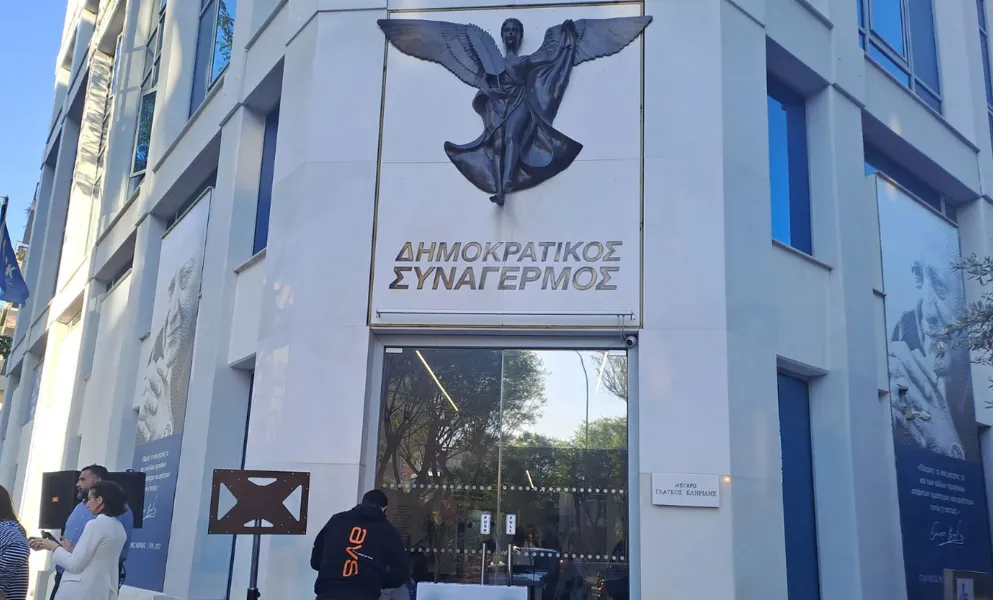

The election of Nikos Christodoulides as President of the Republic in 2023 sent seismic shockwaves through the Democratic Rally (DISY), leading to the resignation of then-party leader Averof Neophytou and the election of Annita Demetriou as his successor.
The party has yet to formally launch its process for selecting a candidate for the 2028 presidential election. But the battle over who will control DISY when the time comes is already well underway.
That helps explain why tensions have risen disproportionately high, despite the presidential election still being almost a year and a half away.
The contest for the party’s nomination, which had been simmering for months, has intensified in recent weeks through moves, statements and political jabs involving the three figures seen as potential contenders: DISY president and House Speaker Annita Demetriou, former party leader Averof Neophytou and MP Giorgos Pamporidis, who has already made clear his interest in running in 2028.
The three contenders
Demetriou has neither confirmed nor ruled out the possibility of becoming DISY’s presidential candidate in 2028. Following the party’s strong performance in May’s parliamentary elections, she is understood to be weighing the political landscape, studying the numbers and considering different scenarios with her team.
Neophytou, meanwhile, appears determined to seek a political comeback. He wants revenge against Christodoulides, as well as against former President Nicos Anastasiades and those within DISY who, he believes, failed to support — or actively worked against — his 2023 presidential campaign.
Neophytou also believes he played a major role in Demetriou’s election as party leader and in her two elections as Speaker of the House of Representatives. He therefore feels he is owed a genuine opportunity to lead the party into the 2028 presidential contest, without the internal obstacles he believes prevented his campaign in 2023 from succeeding.
Then there is Pamporidis, a former health minister under Anastasiades and current DISY MP, whose ambition to become President has been evident for several years.
People close to Pamporidis say he is unlikely to withdraw if DISY holds an internal contest involving Demetriou and Neophytou, or if Neophytou emerges as the party’s preferred candidate.
Pamporidis has proposed what currently appears to be a highly difficult solution: for all three potential candidates to sit down together and assess who genuinely has the best chance of winning the presidency.
DISY is already under pressure
The situation inside DISY is increasingly paradoxical.
The party emerged strengthened from the 2026 parliamentary elections, securing first place with 27.1 per cent of the vote, while Demetriou was re-elected as Speaker of Parliament.
Yet, rather than exploiting that political momentum, DISY is already confronting the shadow of 2023.
The difference this time is that the problem is not an outsider challenging the party’s official candidate. It is a battle over who will become that official candidate in the first place.
The party is heating up before the formal process has even begun, partly because the grassroots now have greater influence over the final choice under the new rules.
What the party’s rules say
Under DISY’s statutes, as amended in February 2025, the party’s candidate for President of the Republic is elected by all eligible party members at an extraordinary nationwide electoral assembly.
Candidates must submit a signed list of 500 supporters who are eligible to vote, distributed proportionally across the districts. The list must include at least 100 members of DISY’s Supreme Council.
All party members registered in the central membership register at least 90 days before the nationwide electoral assembly can vote, provided they are eligible to vote in presidential elections and have fulfilled their financial obligations to the party.
The rules therefore give the party membership a potentially decisive role — a factor that makes the internal contest particularly difficult for the leadership to control.
Tensions rise between Demetriou and Neophytou
Following a series of public statements by Demetriou, Neophytou, Pamporidis and other DISY figures, Demetriou and Neophytou met on Thursday afternoon at the initiative of the party leader.
The atmosphere was reportedly tense.
The discussion focused on the 2028 presidential election and its relationship with the Cyprus problem.
Neophytou has said that his final decision on whether to run will depend on developments in the Cyprus talks. He has also indicated that, should a strategic framework for a settlement emerge, he would be prepared to stand alongside Christodoulides.
Demetriou, however, has made clear that DISY will field its own candidate in 2028 and ruled out supporting Christodoulides.
She has also stressed that personal ambitions are legitimate, but must ultimately serve the party and the country.
The meeting on 3 September failed to produce an agreement, but both sides appear to recognise that the public confrontation could spiral beyond their control.
A meeting with Kasoulides and Pamporidis
Demetriou is understood to favour resolving the nomination issue as soon as possible, potentially before Christmas.
Neophytou, on the other hand, appears to be seeking more time to strengthen his position both inside and outside the party. His emphasis on the Cyprus problem could therefore push the process into 2027.
If the nomination process takes place before the end of this year, there is a possibility that its outcome would not necessarily bind Neophytou.
On Friday, Demetriou said that if there were serious developments on the Cyprus problem, elections would not be the priority, suggesting that the presidential process might have to be postponed. She stressed, however, that this would not amount to supporting a Christodoulides candidacy.
The reality is that few currently expect major developments on the Cyprus problem in the immediate future.
Earlier this week, Demetriou also met Pamporidis over lunch in the presence of former Foreign Minister Ioannis Kasoulides. The meeting had been arranged by Kasoulides several days earlier and was not connected to Thursday’s meeting between Demetriou and Neophytou.
Demetriou starts with the strongest hand
Demetriou has several strong arguments in her favour.
She is the sitting party leader, led DISY to first place in the 2026 parliamentary elections with 27.1 per cent and was re-elected as Speaker.
A poll commissioned by DISY has also reportedly identified her as the only one of the three potential candidates who, in the scenarios tested, could reach the second round and mount a credible challenge to Christodoulides.
She has not yet explicitly declared that she will run. Nevertheless, her actions suggest someone seriously considering — and preparing for — a presidential campaign.
Her institutional position gives her significant advantages: public visibility, daily contact with the party base, control of the party machinery and her own network of supporters.
She also has the Government Project Monitoring Council, which operates to some extent like a shadow cabinet.
Perhaps most importantly, Demetriou does not carry the burden of having previously lost a presidential election.
Neophytou has experience — and the Cyprus problem
Neophytou's strengths are different: political experience and the Cyprus problem.
He has been rebuilding his political momentum through public interventions, tours, meetings, social media activity and a renewed focus on the Cyprus issue.
His recent decision to link his potential candidacy to developments in the Cyprus problem is particularly significant.
The statement appears to serve several purposes.
First, it signals to Demetriou that he may either challenge her for the nomination or potentially support Christodoulides if he believes developments on the Cyprus problem justify such a move.
Second, it sends a message to Christodoulides and his supporters within DISY. With more than 50,000 members potentially participating in the internal process, Neophytou could seek support from DISY members who remain aligned with the President.
Third, it could help him rebuild bridges with Christodoulides voters by suggesting that the divisions of 2023 can be set aside in favour of an informal arrangement offering benefits to both sides.
Supporters of Neophytou also argue that he has the potential to attract voters beyond DISY, including from ELAM, Odysseas Michaelides, Fidias Panayiotou, Volt, DIKO and DIPA.
So far, however, this broader appeal has not been clearly reflected in public or private polling. And it remains too early for opinion polls to provide a reliable picture of the 2028 presidential race.
Pamporidis could become the kingmaker
Pamporidis lacks Demetriou’s party machinery and does not have Neophytou’s established network and historical influence within DISY.
But he has another advantage: he is not widely seen as part of the old power structure.
While he may currently appear unlikely to win the party nomination outright, his political influence is recognised.
If the contest ultimately becomes a straight fight between Demetriou and Neophytou, Pamporidis could emerge as the kingmaker.
The unknown factor: DISY’s Christodoulides supporters
The biggest unknown in the internal contest may be DISY members who supported Christodoulides in 2023.
A significant section of the party’s base abandoned DISY’s official candidate that year and backed Christodoulides instead.
Many of those voters remain DISY members and, under the new rules, could participate in the internal selection process.
That means party members who did not support Neophytou in 2023 could ultimately determine who receives the nomination for 2028.
The key question, therefore, is which of the three candidates can persuade these Christodoulides-aligned DISY members that they are the candidate most capable of defeating the President.
Christodoulides is waiting
The biggest mistake all three contenders could make would be to start behaving as though they are already presidential candidates.
A prolonged period of internal conflict will inevitably affect both the contenders and the party itself.
DISY first needs to overcome its own internal divisions.
The 2026 parliamentary elections gave the party a significant political asset, with DISY finishing more than three percentage points ahead of AKEL. But if the internal nomination process turns into open warfare, the party risks returning to the trauma of 2023.
That is precisely the scenario that would benefit Christodoulides.
The 2028 presidential election will not be determined solely by how strong DISY is, but by how united it remains when voters go to the polls.
The ultimate question is therefore not simply who will win the nomination at the expense of the other two.
It is who can win DISY without destroying or permanently dividing it.
That may be the real challenge facing the party today.
Because Christodoulides is waiting.
He does not need to win a battle inside DISY. He simply needs to let DISY fight that battle by itself.