
Germany’s far-right AfD appears to be on the verge of a historic election victory in Saxony-Anhalt, where voters are going to the polls on Sunday in a result that could further weaken Chancellor Friedrich Merz.
The Alternative for Germany (AfD), a far-right party known for its hard-line stance on immigration and its support for Russia and US President Donald Trump, is polling almost 20 percentage points ahead of Merz’s conservatives.
However, the AfD is not guaranteed an outright majority in the eastern German state, which has a population of around 2.1 million. Much will depend on how many parties clear the threshold to enter the state parliament and the resulting coalition arithmetic.
Around 1.7 million eligible voters in Saxony-Anhalt can cast their ballots from 9am to 7pm Cyprus time on Sunday. Initial projections are expected shortly after polls close.
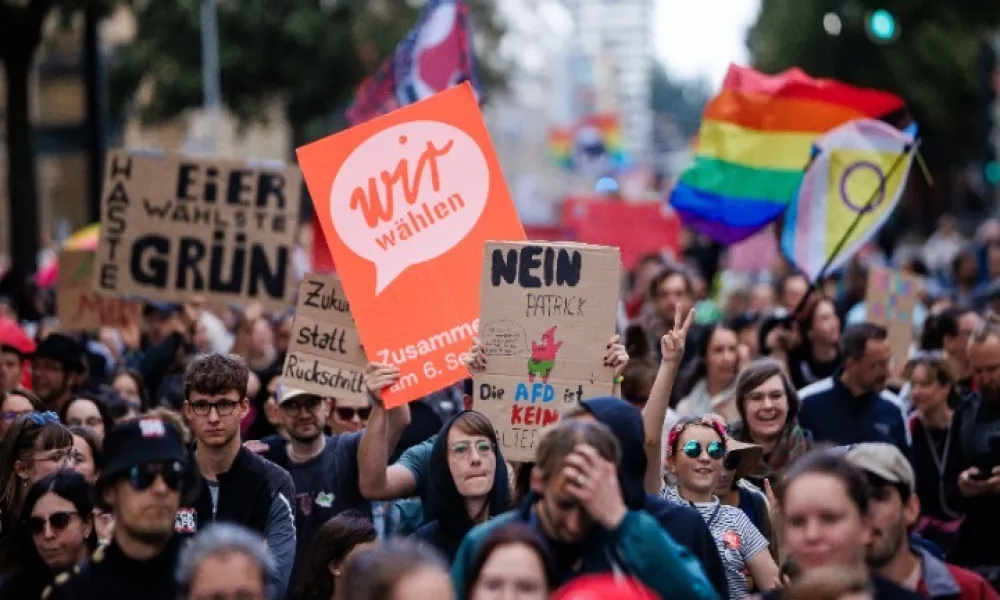
Thousands rally for an open Saxony-Anhalt
The vote comes amid growing political polarisation and heightened concern over immigration.
On Saturday, around 6,000 people, according to police estimates, demonstrated peacefully in Magdeburg, the state capital, under the slogan of an “open Saxony-Anhalt”.
Protesters waved rainbow flags and carried banners calling for “a better life without Nazis”.
Additional police reinforcements have been deployed in the city throughout the weekend amid concerns about possible clashes involving far-right and far-left groups, particularly after polls close.
AfD projected to take 41%
According to the latest poll by public broadcaster ZDF, the AfD, led by 35-year-old social media star Ulrich Siegmund, is projected to win 41% of the vote — almost twice its 2021 result.
The party is campaigning for tougher immigration policies, the abolition of compulsory schooling and changes to the teaching of history in schools, arguing that the curriculum places too much emphasis on German guilt over the Third Reich.
The AfD is also drawing support from nostalgia for the former East Germany and from voters who feel neglected compared with their western German counterparts or migrants.
The conservatives, led by 47-year-old Sven Schulze, are projected to take 23%.
Schulze has headed Saxony-Anhalt since the beginning of the year, having previously served as the state’s economy minister.
Coalition arithmetic could keep AfD out of power
Among the other parties, the radical left-wing Die Linke is projected to win 11.5%, the Social Democrats 8.5% and the Greens 6%.
The pro-Russian Sahra Wagenknecht Alliance (BSW) and the Free Democrats are not expected to clear the 5% threshold required to enter the state parliament.
All major parties have so far ruled out forming a coalition with the AfD, with the exception of the BSW, whose members remain divided over the issue.
That political cordon sanitaire could ultimately allow conservative leader Sven Schulze to remain in office by forming a coalition with other parties that make it into the state parliament.
Even a decisive AfD victory at the ballot box, therefore, may not translate into control of the state government — but a strong result would nevertheless represent a major political setback for Merz and another significant breakthrough for Germany’s far right.