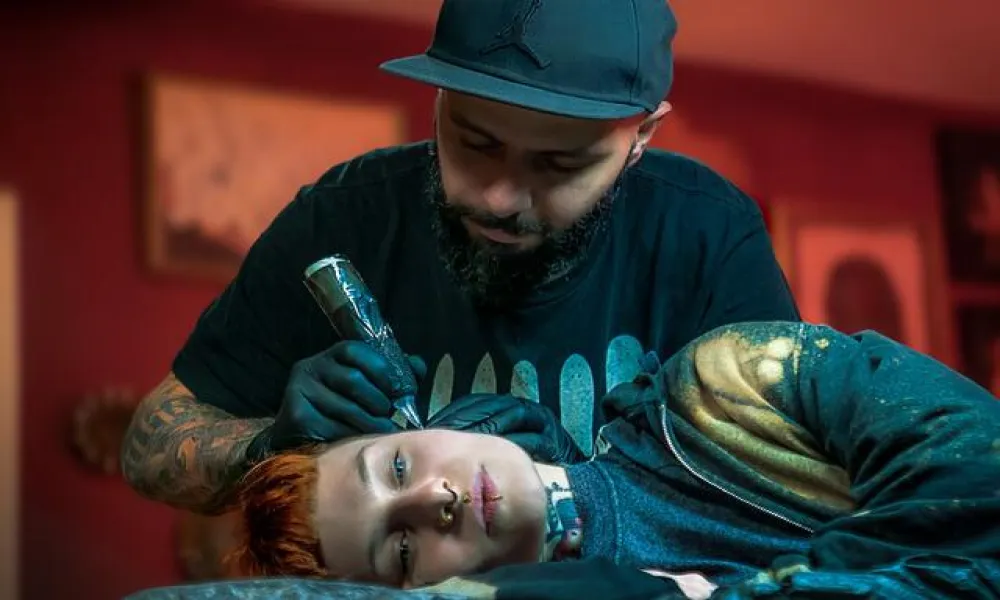


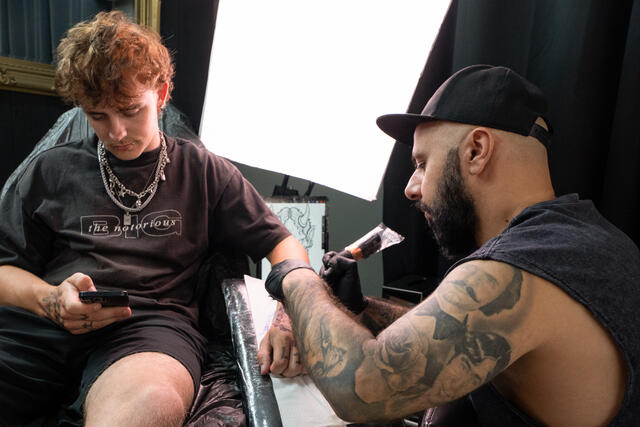
On a warm summer afternoon in Paphos, the door of Gorilla Tattoo Paphos opens, and the first impression is nothing like a typical tattoo studio. Artwork, careful decor and a space that feels more like a gallery set the scene for a conversation about a craft that has, in recent years, taken on a very different place in Cypriot society. Nick, founder of Gorilla Tattoo Paphos, has come a long way in the field. He worked for years in London before returning to Cyprus to open his own studio. He is known primarily for highly detailed black and grey realism work, having previously explored a range of other styles and techniques.
Before the interview begins, he offers to show me around. We go upstairs, where the rest of the tattoo artists are working with their clients. Among the faces I meet, one family immediately catches my eye. The grandmother is covered in tattoos, as are her children and grandchildren. They have been regular clients of the studio for years. The image of three generations sharing the same passion is perhaps one of the clearest signs of how much has changed. Tattooing is no longer the preserve of a particular age group or social category. It has become part of everyday life and personal expression for people of very different generations.
The atmosphere in the studio is lively and welcoming, closer to a creative community than a simple service space. Nick then shows me the sterilisation area, where tattoo and piercing equipment is stored. The organisation and cleanliness are immediately apparent. Behind every design that ends up on skin lies an entire system of hygiene and safety procedures. We head back downstairs, sit on the sofa, and begin the conversation.
From stigma to acceptance
How has society's perception of tattoos in Cyprus changed over the years?
In the past, tattoos carried a strong social stigma and were linked to negative stereotypes. Today, the picture has changed radically. The shift began abroad, where tattoos gradually became more popular and socially accepted. Cyprus followed at a slower pace, but tattoos now hold a very different place in society than they did twenty years ago.
What do you think drove that change?
As tattoos became part of everyday life, people started viewing them more positively. What once felt foreign gradually became familiar and socially accepted. For older generations, the shift often had a personal dimension. Many people who were once against tattoos now have children or grandchildren who have them. When something becomes part of your own family, you stop judging it from a distance. You see the person first, and the tattoo second. The prejudice hasn't disappeared, but it's now the exception rather than the rule.
Tattoos and professional life
The change isn't limited to social life. It has also affected how tattoos are viewed in the workplace.
Have attitudes toward tattoos in the workplace changed too?
Yes, significantly. Years ago, many people chose spots on the body that could be covered up, or avoided tattoos altogether, worried it would affect their career. That concern still exists in certain professions. However, many workplaces now accept visible tattoos. In fields like creative industries, technology, fitness, fashion, beauty and social media, they've become part of a modern professional image.
Does someone still need to think carefully before getting a tattoo somewhere visible?
Yes. Society is more accepting, but not every profession, and not every employer, has changed at the same pace. I always encourage young people to think carefully before tattooing their hands, neck or face. A visible tattoo can, in some cases, affect professional opportunities down the line.
Like painting
Has the profession itself changed as much as society's attitude toward tattoos?
Absolutely. Almost every part of the profession has evolved, from the equipment and techniques to the level of detail and precision we can now achieve on skin. The same goes for hygiene and access to knowledge.
Do people underestimate how much knowledge tattooing actually requires?
Definitely. Many still think of tattooing as simply painting on skin. In reality, it combines an artist's creativity, a craftsman's precision, and serious responsibility at every stage of the process. It requires knowledge of drawing, composition, anatomy, colour theory, how skin behaves, and hygiene, as well as the ability to communicate properly with the person in front of you. That knowledge only builds through years of experience in the field.
Travelling for a tattoo
Nick's work isn't limited to Cyprus. One of his clients, he told me, travelled from the United Kingdom specifically to get tattooed by him.
Is that common?
Yes, it happens fairly often. Some are clients I worked with in England, while others discover my work online or come through recommendations.
What makes someone willing to travel that far for a tattoo?
Once someone connects with an artist's style, trusts their approach, and genuinely cares about the outcome, distance stops mattering.
People often say that once you get one tattoo, you can't stop. Is that true?
People become attached to the experience, but mostly to the confidence it gives them and the way it changes how they see themselves. They don't come back because they need more ink. They come back because the tattoo becomes part of their identity.
Does every tattoo carry some deep story behind it?
No, and it doesn't need to. Some people choose a tattoo simply because they love the design or how it looks on their body. And that alone is enough.
The new legislation
As tattooing evolved and became more widespread, a clearer institutional framework for the profession also emerged. The new legislation on the Registration of Tattoo Artists and Body Piercers brought significant changes.
What changed for the profession?
It was a defining step. For the first time, the profession gained a clear legal framework, with specific requirements for hygiene, safety, premises, equipment and professional practice. Gorilla Tattoo Paphos was the first studio in Cyprus to be licensed for both tattooing and piercing under the new legislation. Both licences carry the number one.
Seeing the two licences, both numbered one, I find myself wondering what it took to get there.
It was a long and demanding process. From submitting the application to the issuing of the licences, around eighteen months passed. Every required qualification and piece of documentation had to be substantiated, and these were reviewed by the Ministry of Health and the relevant licensing committee. I owe particular thanks to Maria Michael at the Ministry of Health, who guided me through the entire process. As an applicant, I only saw one part of that work. Implementing the new framework is an ongoing effort, involving many bodies and professionals, including the Ministry of Health and the Tattoo & Piercing Association Cyprus, aimed at protecting public health and raising standards in the profession in Cyprus.
The Ministry of Health also inspected the studio before the licences were issued. What did that involve?
They examined the premises, the workstations, the sterilisation and cleaning procedures, as well as the equipment and materials we use, from inks and needles to every single consumable. The checks cover every aspect of how a studio operates, from how the space is organised to adherence to hygiene and safety protocols. Nothing is treated as a formality.
Why should a client care whether a tattoo or piercing studio is licensed?
A licence means the studio has been officially inspected and meets the requirements set out in the legislation to protect public health. It doesn't tell you whether an artist's style suits you. But it guarantees something equally important, that the studio operates legally, is subject to inspection, and follows specific hygiene and safety standards. A beautiful tattoo only has value if it's created safely. In our profession, art and hygiene are inseparable.
Can that many things really go wrong during a tattoo?
Unfortunately, yes. Tattooing has become so commonplace that many people forget it's a procedure in which the skin is wounded and the ink stays in the body for life. That's why it needs to be treated with the seriousness it deserves. Without proper training in infection prevention and safe working practices, the consequences can be serious. Beyond health, though, there's also the artistic side. Choosing the wrong artist can result in a poorly designed or poorly executed tattoo, which isn't easy to fix.
Laser removal is a long, painful and expensive process, and even a cover up has its limits. It usually requires a new design that's bigger, darker and bolder to conceal the previous one.
Inks and the European REACH regulation
What changed when the European Union restricted certain tattoo inks? Many artists reacted strongly at the time. What's the situation today?
The legislation concerned the ban on certain chemical substances used in producing specific coloured inks. Without getting into the technical details, the EU took a precautionary approach to strengthen product safety. Manufacturers adapted quickly, developing new ink ranges compliant with the EU's REACH regulation. Today, we have several ink options compatible with the new legislation for creating coloured tattoos, even if the range isn't quite what it used to be.
Confusion with cancer
A lot of people worry that tattoos might cause cancer. Is there any truth to that?
Several studies have looked at possible associations. To date, however, it hasn't been scientifically proven that tattoos cause cancer. What we do know for certain is that excessive exposure to sunlight damages skin cell DNA and is one of the most significant risk factors for skin cancer. With or without a tattoo, strong sun exposure calls for real caution.
How should someone protect their skin, and the tattoo itself, from the sun?
Once a tattoo has fully healed, I always recommend using a high protection sunscreen, ideally SPF 50. No sunscreen offers complete protection, so it's important to seek shade and avoid prolonged sun exposure, especially during peak sunlight hours. UV radiation doesn't just affect the skin. It also fades tattoo pigments. Proper sun protection helps preserve both skin health and the vibrancy of the tattoo.
From idea to design
From hygiene and legislation, the conversation returns to the heart of the process, the art itself.
How does the creative process begin at Gorilla Tattoo Paphos?
Many clients arrive with an initial idea, or an image they've found online. Often, though, they aren't aware of all the possibilities in tattoo design, the different styles available, or how a design can be adapted to work better on the body. Our role is to understand what they really want to express and develop that idea into a design created specifically for that client, one that suits their body and personality.
So the final result can end up quite different from the original idea?
Very often. Through conversation, we might discover there's a better way to express an idea. Sometimes that means a different artistic approach, other times a change in composition, size or placement, so the design works better on the body. We also think about how it will age and hold its aesthetic over time.
What kind of tattoo are you personally most passionate about?
Black and grey realism is my core specialty. I'm particularly drawn to pieces where composition, light, detail and texture play a defining role.
Beyond realism, you've worked in quite a few different styles. How did that path come about?
Over the years I've explored different directions. I started with old school, neo traditional and Japanese, and later moved into mandala, dotwork and microrealism. Each style gave me different knowledge, techniques and ways of approaching the work. I think it's important to have a broader understanding of the art of tattooing, because it gives me more tools to experiment, combine different influences, and create something more personal.
Is it ultimately a long road for an artist to develop their own personal style?
Yes, it takes experience, a lot of trial and error, continuous searching and continuous growth. Realism, in particular, is one of the most demanding styles. It requires great precision and leaves little room for error. It took many years of practice and experience before I felt ready to commit more fully to that field.
How crucial is drawing for a tattoo artist?
It's fundamental. Drawing, anatomy, composition, proportion, perspective, light, shadow and colour theory are all transferred directly onto the skin. The difference is that skin isn't a static canvas. It's alive, it changes, it ages. That's why an artist needs to understand not just the design, but the body itself. The core principles of art, though, always stay the same.
Where would you like to see tattooing in Cyprus in ten years?
I think it's already come a long way. Social attitudes have changed, clients are better informed, and the standard of art and tattoos being created in Cyprus is now very high. At the same time, the profession now operates within a clear institutional framework. I hope that progress continues, without losing the human side of the profession. In many major cities abroad, the personal relationship with the client is fading, as the process becomes increasingly impersonal and commercial. Trends will always change. What shouldn't change is the trust, communication and honest relationship between the artist and the person entrusting them with their body. I hope that's never lost.
Art on skin
The visit to Gorilla Tattoo Paphos began with an image that could easily have been mistaken for a simple family moment, a grandmother, children and grandchildren, three generations sharing the same love of tattoos. In reality, that image captures much of the change that has taken place in Cyprus. From a practice once accompanied by social stigma, tattooing has become a form of art, personal expression, and for many, part of their identity. At the same time, behind the design, the ink and the aesthetics lies a profession that demands technical training, artistic knowledge, responsibility, strict adherence to hygiene standards, and respect for the person entrusting their body to the artist. The evolution of tattooing in Cyprus, then, isn't only about how we see designs on skin. It's also about how we understand art, personal choice, professional identity, and the relationship itself between the creator and the person who chooses to carry a work of art on their body. And perhaps that is the most significant change of all: today, more and more, behind the tattoo, we see the person first, and the ink second.