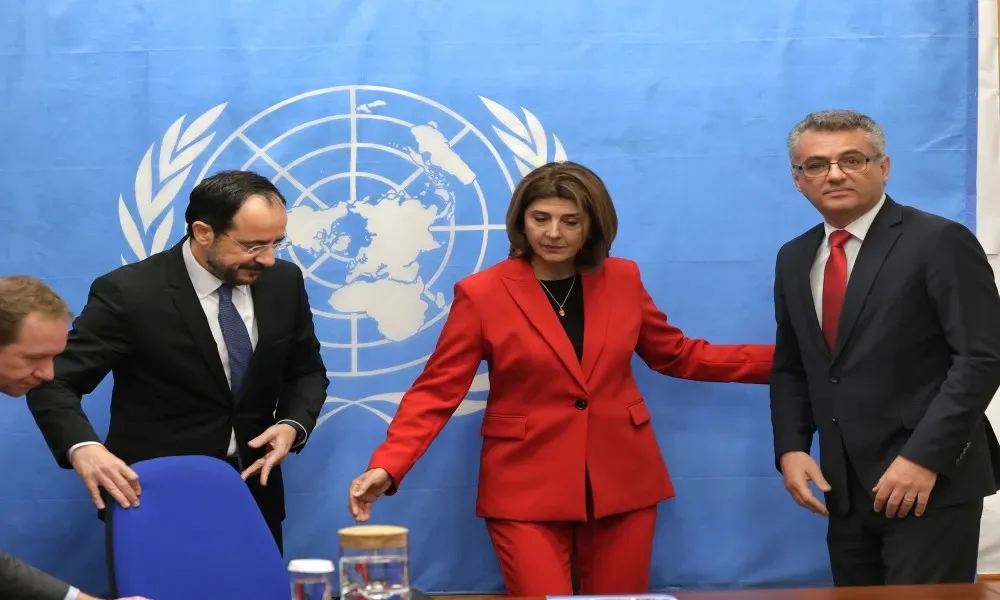
With a clear and detailed statement, the UN Secretary-General’s Personal Envoy on Cyprus, María Ángela Holguín, has sought to keep alive the political momentum behind the latest effort on the Cyprus issue, sending the message that the international organisation will do everything possible to ensure that meaningful steps forward are taken.
Although Holguín has spoken publicly in the past about the uncertainty created by the current status quo, she now stresses that it “can no longer be the solution for Cyprus.”
She argues that “stagnation is not a guarantee of stability, nor can it be regarded as a safe option until conditions mature for a new negotiation.”
In essence, she believes there is an opportunity at this moment and that the two sides should seize it.
In doing so, she directly challenges the logic of managing the problem without making a serious effort to resolve it.
A message to all
The message is directed at all concerned.
It is addressed to the two leaders, who are being called upon to demonstrate genuine political will.
It is addressed to the two communities, which continue to view every new initiative with suspicion.
But it is also directed at those political and social forces which, consciously or unconsciously, have invested in maintaining the current situation.
Holguín herself does not hesitate to note that, within the climate of uncertainty, there are powerful forces that wish to preserve the status quo.
This is a direct observation from a United Nations official who is effectively arguing that inertia is not merely the product of difficulties but, in some cases, a deliberate political choice.
Guterres and the next steps
As Holguín notes in her public written statement, Secretary-General António Guterres is examining what the next steps could be that might persuade both sides to move towards specific actions leading to a final settlement.
She stresses that she remains committed and willing to explore every possible avenue for advancing dialogue towards an agreement that will be satisfactory to all parties involved.
Also apparent in Holguín’s statement is an effort to shield the wider UN initiative from reports and leaks concerning her behind-the-scenes contacts.
She makes clear that she has never issued written positions or leaked information and suggests that a significant part of the public discussion is based on speculation, rumours and arbitrary interpretations of her intentions.
She attributes such reports to misinformation which, she argues, undermines an already fragile climate of trust.
The role of Europe
Beyond her contacts in Nicosia, Holguín makes particular reference to her meetings in Athens and Ankara, which she describes as “frank and clear.”
According to her, the discussions focused on areas and initiatives “on which everyone must work in order to create the necessary conditions for concrete actions that will pave the way for progress on the Cyprus issue.”
In this context, she notes, other actors, including the European Union, can also play an important role by helping shape an environment that actively supports a Cyprus settlement.
In relation to the role the EU can play, particular interest surrounds the joint statement by EU officials and Turkish Foreign Minister Hakan Fidan, in which support was expressed for the efforts of the UN Secretary-General on Cyprus, according to sources.
As reported by CNA, sources described as “significant” the references in the joint statement supporting the UN Secretary-General’s efforts on Cyprus, as well as the importance attached to regional stability.
Holguín nevertheless reiterates in her statement that she “remains committed and willing to explore every possible avenue for advancing dialogue towards an agreement that will be satisfactory to all parties involved.”
“The delicate climate”
Holguín argues that the building of trust has been a difficult undertaking for decades.
“The weight of history is immense and must be approached with wisdom, empathy and generosity,” she adds.
She says she understands that “the political climate is always sensitive”, but continues to believe that trust can prevail if both sides align their thinking and actions in order to permanently resolve their differences and disagreements.
She further notes that her work has focused on “listening to both sides, as well as many other stakeholders from both communities.”
Necessary conditions
Holguín carefully avoids entering into the substance of negotiations or presenting specific ideas regarding the content of a possible agreement.
She insists, however, that the necessary conditions of trust must first be built so that, when negotiations begin, they stand a genuine chance of success.
As she notes, the objective is not to launch yet another round of talks that ends in deadlock, but rather a process capable of reaching a successful conclusion.
This is where the political significance of her statement becomes particularly clear.
The UN envoy reminds all parties that, ten years after Crans-Montana, realities on the ground have changed significantly.
Time is not working in favour of a settlement.
On the contrary, it is entrenching new realities, deepening mistrust and gradually reducing the margins for compromise.
Her final appeal to Cypriots, both Greek Cypriots and Turkish Cypriots, is therefore highly symbolic.
She calls on them not to remain “prisoners of a difficult past” but to seek a shared perspective for future generations.
In essence, and in unmistakable terms, the UN Secretary-General’s envoy is warning all those involved that, unless the conditions for a meaningful agreement are created soon, stagnation will cease to be a temporary impasse and will evolve into a new and even more difficult reality.