
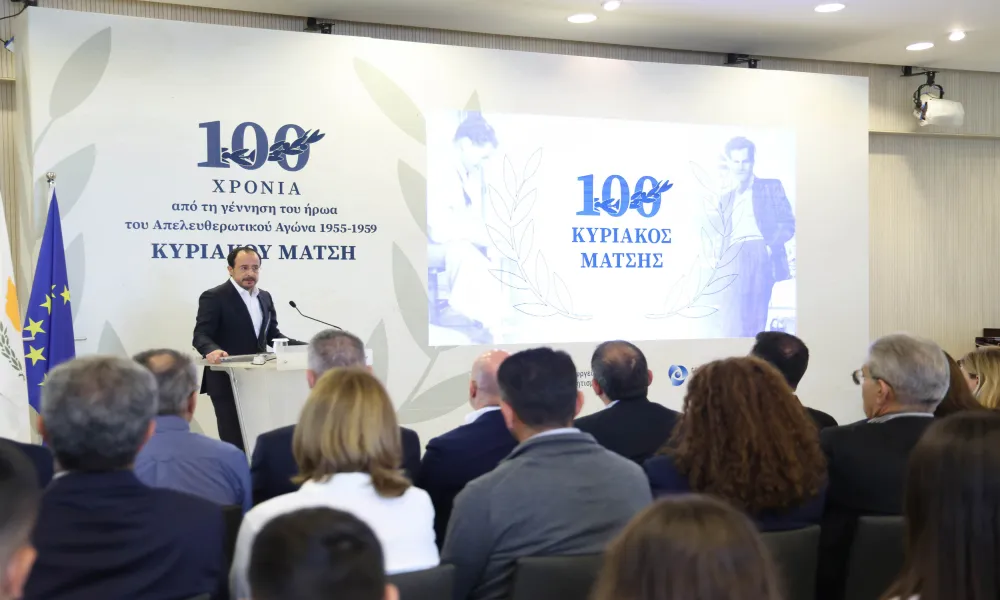

President Nikos Christodoulides' speech on 3 November 2026, marking the 100th anniversary of the birth of Kyriakos Matsis, raises three important issues. The first concerns the historical accuracy of his account of the relationship between the EOKA struggle and the establishment of the Republic of Cyprus. The second relates to the compatibility of this historical narrative with the declared goal of reunification. The third concerns Matsis himself, a freedom fighter whose social convictions extended beyond narrow national and ideological divisions.
The President is right to argue that a sustainable solution requires historical knowledge. However, his own presentation of history is selective and overlooks a fundamental contradiction. EOKA fought for union with Greece, while a settlement of the Cyprus problem today requires the establishment of a common state shared by Greek Cypriots and Turkish Cypriots.
Was the Republic of Cyprus EOKA's objective?
Nikos Christodoulides argued that the existence of the Republic of Cyprus is owed to the EOKA struggle. The Presidency's official text even uses the word 'exclusively', making the statement historically problematic.
EOKA launched its armed campaign in 1955 with the objective of self-determination, which the Greek Cypriot majority identified with Enosis, or union with Greece. The Republic of Cyprus, by contrast, emerged from the 1959 Zurich and London Agreements as a compromise between opposing political aspirations.
Enosis was not achieved, but neither was partition, which Turkey and the Turkish Cypriot leadership had been pursuing. Independence became a third option, ultimately accepted by the parties involved.
It is historically justified to say that EOKA played a decisive role in bringing British colonial rule to an end. It is not, however, accurate to present the state established in 1960 as the intended outcome of its struggle.
There is also a significant omission. The Republic of Cyprus was established as a bi-communal state, with a Greek Cypriot President, a Turkish Cypriot Vice-President and constitutionally guaranteed participation by both communities in governance.
This was a fundamental feature of the state whose establishment the President invokes.
What history should pupils be taught?
Christodoulides has called on pupils to know their history. This is a reasonable request, but it presupposes a comprehensive approach.
Historical education cannot be limited to the anti-colonial struggle and the sacrifices of EOKA fighters. It must also cover the clash of competing national aspirations, intercommunal violence, the 1963 crisis, the 1974 coup, the Turkish invasion and the continuing occupation.
Acknowledging these events does not diminish Turkey's responsibilities or the sacrifices of fighters such as Grigoris Afxentiou, Evagoras Pallikarides and Matsis. It does, however, prevent history from becoming a one-dimensional narrative of heroism and vindication.
Historical knowledge acquires real value when it allows us to examine even the uncomfortable chapters of our past.
From Enosis to federation
The most significant political question arises from the President's statement that the EOKA struggle continues to shape his efforts for liberation and reunification today.
The values of freedom, dignity and resistance to oppression can undoubtedly remain a lasting source of inspiration. However, invoking these values is not the same as adopting the political objectives of the struggle itself.
Christodoulides says he is seeking a bi-zonal, bi-communal federation with political equality, based on United Nations Security Council resolutions, including Resolution 2815 of 2026.
A federation requires shared constitutional legitimacy, Turkish Cypriot political participation, mutual recognition and compromise. These were not the political objectives of EOKA in 1955.
The President must therefore clarify which elements of the struggle guide his current policy.
If he is referring to freedom and self-determination, a connection can be made with a modern state shared by both communities. If he means the national vision of Enosis, a contradiction emerges with the agreed basis for a settlement.
This distinction was absent from his speech.
How does the speech sound to Turkish Cypriots?
Christodoulides was speaking at an anniversary event attended by pupils, relatives of Matsis and state officials. It was to be expected that he would honour the EOKA struggle.
However, he was speaking not merely as a representative of the Greek Cypriot community, but as President of a state constitutionally established with the participation of Turkish Cypriots.
For most Greek Cypriots, EOKA is associated with the anti-colonial struggle. For a significant part of Turkish Cypriot society, the same period is associated with fears of Enosis, political confrontation and intercommunal violence.
These different historical experiences do not mean that all interpretations are equally accurate, nor do they absolve Turkey and the Turkish Cypriot leadership of their responsibilities.
A President seeking reunification, however, must understand how his words are perceived by the other community. He cannot call for Turkish Cypriot nationalism to be overcome without applying the same critical scrutiny to Greek Cypriot nationalism.
Historical criticism is not self-negation
Particular attention should be paid to Christodoulides' reference to 'self-negation', which he appeared to use in response to those who believe that teaching the history of EOKA could work against efforts to achieve a settlement.
He did not, however, specify who is calling for EOKA to be removed from historical discussion. As a result, a complex question of historical education is reduced to a false dilemma: either we honour our history or we deny it.
We can honour Matsis while acknowledging that Enosis was never achieved. We can condemn colonialism without remaining silent about acts of violence committed by Greek Cypriots. We can condemn the invasion and occupation without concealing the coup. And we can teach the history of EOKA without expecting Turkish Cypriots to adopt our own historical narrative.
This is not self-negation. It is historical maturity.
Matsis beyond national divisions
An interesting aspect of the personality of the freedom fighter being commemorated deserves particular attention.
Kyriakos Matsis had a strong Greek national identity and fought for Enosis. At the same time, however, he expressed social convictions that transcended national divisions.
One particularly telling passage from his writings states:
'That is why I do not care whether the people living on this land are Turks or Greeks, Jews...'
For Matsis, what mattered was that the people cultivating the land should live freely and be masters of their own lives.
This reflects a belief in social justice and human dignity that does not make a person's worth dependent on their ethnic background.
Such an outlook did not negate his Greek identity. It nevertheless demonstrated that patriotism could coexist with respect for those who were different.
Perhaps this was the most meaningful aspect of his personality, one that could be given greater political relevance in today's circumstances.
A missed opportunity
It would be an exaggeration to argue that an anniversary speech, on its own, undermines efforts to resolve the Cyprus problem.
The President's policies should primarily be judged by his negotiating positions, initiatives and willingness to compromise. Nevertheless, public discourse matters when the objective is to build trust.
The speech reinforces a familiar and stereotypical patriotic narrative for a Greek Cypriot audience, but offers no new bridge towards Turkish Cypriots. Nor does it explain how the pursuit of Enosis relates to today's federal perspective.
By honouring Matsis, the President could have highlighted precisely his humanitarian values and explained to pupils that today's challenge is not to repeat the national objectives of 1955, but to create conditions of freedom, security and political equality for all Cypriots.
Such an approach would not have represented a retreat from history.
Enosis, the independence established in 1960 and the pursuit of federal reunification are three different political realities. They are historically connected, but they are not interchangeable.
A settlement cannot be built on forgetting, but neither can it be built on selective memory. It does not require the two communities to agree on a shared national past, but rather to accept the possibility of a shared political future.
This is the fundamental question left unanswered by the President's speech.
And perhaps the most valuable legacy of Kyriakos Matsis lies precisely there: in recognising that freedom and human dignity cannot be the exclusive privilege of any one ethnic community.